Facebook vs. Instagram for a Local Business: Where to Spend Your Hour
Only have one spare hour a week? Compare Facebook and Instagram by local buyer intent, clickable links, groups, and Reels to pick your winner.
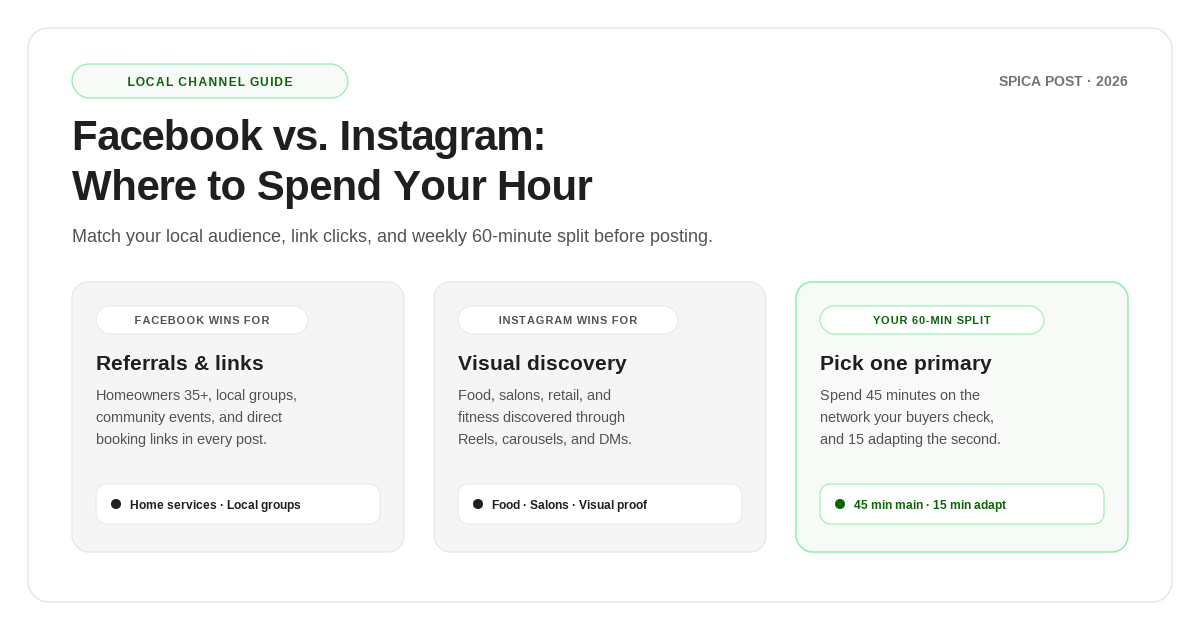
When comparing Facebook vs. Instagram for a small business with only one spare hour a week, spend 45 minutes on the network that matches how your local buyers actually decide, and use the remaining 15 minutes to adapt your best update cleanly to the second platform. Facebook wins when local customers rely on neighborhood referrals, family event calendars, and clickable booking links (home services, auto repair, dental clinics, and community venues), while Instagram wins when buyers decide with their eyes before walking in or sending a message (restaurants, coffee shops, salons, boutiques, and fitness studios).
Platform capabilities, link behavior, and Spica Post integration availability snapshot verified November 2026 against Meta Business Help Center, Instagram Help Center, and Pew Research Center data.
Most local owners burn out on social media because they try to run Facebook and Instagram as two equal full-time jobs inside a busy work week. They film half-finished Reels at midnight, forget to answer Facebook Messenger for three days, or switch on blind auto-sharing that dumps dead “link in bio” copy onto their Facebook Page. Neither network rewards half-hearted clutter. A sharp 45/15 split keeps both profiles visibly alive and trustworthy while concentrating your real creative energy where local inquiries actually convert.
The quick verdict by local profession
Before opening a calendar or designing graphics, match your profession to the buying behavior that happens right before someone pays you. A homeowner whose water heater just leaked behaves nothing like a Friday diner deciding where to get tacos with friends.
| Local profession | Primary winner (45 min) | Secondary role (15 min) | Why the split works |
|---|---|---|---|
| Plumbers, roofers, HVAC, electricians | Instagram proof grid | Homeowners 35+ ask neighborhood groups for referrals and tap clickable estimate links straight from posts. | |
| Auto repair, tire shops, mechanics | Instagram quick tips | Drivers check local groups for honest mechanics, read reviews, and click direct appointment URLs. | |
| Dentists, optometrists, family clinics | Instagram team warmth | Local parents check hours, insurance updates, and neighbor recommendations before booking care. | |
| Restaurants, bakeries, cafes, food trucks | Facebook hours and links | Hungry locals scan fresh dish photos, Reels, and Stories first, then tap the Link Page menu or directions. | |
| Hair salons, barbers, nail and lash studios | Facebook reviews and offers | Clients treat the Instagram grid as a live lookbook and book directly through DMs or bio links. | |
| Boutiques, florists, gift and plant shops | Facebook weekend events | Visual new-arrival carousels and Stories spark same-day walk-ins; Facebook captures local event RSVPs. | |
| Gyms, pilates, yoga, martial arts | Facebook community updates | Visual energy, class clips, and beginner FAQs convert younger local members; Facebook serves parents and youth programs. | |
| Real estate agents and property managers | Both (context split) | Adapt per listing | Facebook captures local buyers 35+, neighborhood updates, and clickable MLS links; Instagram wins visual tours and relocation buyers. |
| Event venues, party rentals, caterers | Facebook event shares | Hosts save inspiration photos on Instagram and share event pages with extended family on Facebook. | |
| Accountants, insurance, local law firms | Instagram trust anchor | Clients ask trusted neighbors for referrals and click directly to plain-English deadline checklists. |
When Facebook wins your first 45 minutes
Facebook deserves the larger slice of your hour whenever your service is urgent, high-trust, family-oriented, or purchased primarily by local homeowners and adults over 35. In those professions, nobody needs thirty transitions to feel inspired about replacing a roof or scheduling a pediatric checkup. They want proof that real neighbors hired you, plain answers about pricing and availability, and a single clickable link or Messenger button to book without hunting through a bio.
Facebook also dominates in smaller towns, suburban corridors, and community-driven counties where local civic boards, PTA threads, HOA announcements, and “Word of Mouth [Town Name]” groups act as the unofficial town square. If your best customers routinely say “My neighbor tagged you on Facebook,” fighting that gravity to chase viral Instagram trends wastes your scarcest asset: owner time.
When Instagram wins your first 45 minutes
Instagram earns the 45-minute lead whenever visual taste drives the purchase before price or urgency even enters the conversation. Diners browse plate shots before picking Saturday dinner. Salon guests zoom in on balayage blends, fades, and nail art to decide whether a stylist matches their taste. Boutique shoppers save outfit combinations or fresh flower bouquets and drive over the same afternoon.
Instagram also doubles as a modern storefront check for adults under 40 who discover your business on Google Maps and immediately search your handle to verify that you are open, clean, and active this week. A bright, recent top nine grid paired with up-to-date Highlights (Hours, Menu or Services, Location, Reviews) closes hesitant visitors who might otherwise pick the competitor across the street.
Buyer demographics and local intent: neighborhood referrals vs. visual discovery
Both platforms belong to Meta, yet people open the two apps in completely different frames of mind. Treating them as interchangeable feeds is the single biggest reason local posts fall flat.
How homeowners 35+ use Facebook neighborhood groups
According to the Pew Research Center Social Media Fact Sheet, Facebook remains one of the most widely used social platforms among United States adults across middle-aged, older, suburban, and rural demographics, whereas Instagram skews noticeably stronger among younger adults and urban or visually driven shoppers. That demographic difference shapes what happens inside each app every weekday morning.
On Facebook, local commerce runs on ask-and-refer threads. Someone posts inside a neighborhood group: “Does anyone know a reliable electrician near Oak Park who actually shows up on time?” Within twenty minutes, four neighbors tag local Pages or drop phone numbers. Even when organic reach on your standalone Facebook Business Page feels quiet (we break down why and how to fix it in our Facebook Page reach guide), your Page acts as the verification landing pad that those referred neighbors click right after seeing your name in a group thread.
If your Page has an updated phone number, clear service area, recent real-job photos, and responsive Messenger replies, the referral converts immediately. For step-by-step group etiquette that earns recommendations without getting muted by moderators, follow our local Facebook Groups playbook and review Meta’s documentation on Pages interacting in Groups.
How local shoppers use Instagram as a visual portfolio
People rarely open Instagram to ask a text question to a 12,000-member neighborhood forum. They open Instagram to look, browse, save, and share visually compelling ideas with friends via DM. A coffee lover sends a Reel of a seasonal iced latte to a coworker with “Go here after lunch?” A bride saves three florists into a private folder before sending quote inquiries.
That visual intent makes Instagram an unmatched engine for before-they-even-need-you familiarity. Regular carousels, short vertical videos, and honest behind-the-counter Stories teach nearby followers what it feels like to visit your shop. By the time they need a haircut, a birthday cake, or a weekend brunch spot, your name already sits at the top of their mind. If you are starting from scratch, our first 30 days on Instagram for a local business walks through exact grid posts that build local proof quickly.
Clickable links, DMs, and booking friction head-to-head
A small business owner does not pay rent with likes; you pay rent with booked jobs, full tables, and paid orders. Comparing the exact path from a post to a real customer action clarifies where each platform shines and where friction hides.
| Channel factor | Facebook Page and Groups | Instagram Business Account | Local business takeaway |
|---|---|---|---|
| Clickable URLs in captions | Yes, direct clickable links inside every feed post | No, typed URLs in feed captions stay plain gray text | Facebook sends direct traffic to booking forms, menus, and blog guides faster. |
| Bio and Story links | Website field + Story link stickers + pinned link posts | Up to 5 bio links (best paired with 1 fast Link Page) + Story link stickers | Instagram needs a clean mobile Link Page so visitors tap once to book, call, or view menus. |
| Local discovery path | Neighborhood groups, shares by friends, local Events tab, Messenger search | Reels local reach, location tags, keyword search in captions/bios, DM shares | Facebook relies on social trust and shares; Instagram relies on visual hooks and search keywords. |
| Events and RSVPs | Built-in Facebook Events with reminders and “Interested” friend notifications | Countdown stickers in Stories and pinned announcement posts | Facebook Events still beat Instagram for driving weekend workshops, tastings, and community pop-ups. |
| Customer messaging | Facebook Messenger (high volume of quote, hours, and booking questions) | Instagram DMs (quick appointment questions, menu checks, and Story replies) | Both convert well when answered fast; connect saved quick replies so no inquiry sits cold. |
| Visual polish expectation | Real daylight phone photos and plain updates perform naturally | Bright, sharp framing, clean crops (4:5 or 9:16), and clear visual hooks matter more | Do not over-produce Facebook; do wipe your lens and frame cleanly on Instagram. |
| Text length tolerance | Comfortable with helpful 100 to 250 word stories, checklists, and clear links | Shorter scannable hooks (first 125 chars above fold) plus clean line breaks | Adapt your opening hook and link line instead of pasting the exact same block everywhere. |
Why Facebook still moves direct website clicks faster
When a homeowner reads your post about a pre-winter furnace tune-up or a clinic posts open Saturday flu-shot slots, one extra tap kills half of your conversions. On Facebook, putting a short, clean link directly beneath two clear sentences lets a reader move from feed to booking confirmation in seconds. You can even pair Facebook’s Event tool with your booking link so local residents receive automatic reminders the morning of an open house, sidewalk sale, or community workshop.
Just remember to keep your Facebook Messenger inbox monitored if you run a service business. Many local buyers skip web forms altogether and ask “Do you service Zip 33134 and have anything open Thursday?” directly in chat. Turning those quick questions into scheduled jobs takes a calm reply habit, covered in our guide to turning Facebook messages into booked customers.
How Instagram turns visual proof into Link Page clicks and DMs
Because Instagram strips clickability from feed caption URLs (as documented in Instagram Help Center’s link guidance), successful local accounts build two friction-free exits instead of typing ugly raw web addresses into captions:
- One fast mobile Link Page in your bio. Put four clear actions at thumb height: Book or Order Now, Hours and Directions, Featured Menu or Services, and Call or Text. Point every grid caption cleanly toward that link using plain next-step language (“Tap Book Now in our profile link for Thursday openings”).
- Low-friction DM invitations and Story link stickers. Telling a reader “Send us the word MENU or tap the link sticker in today’s Story” matches how Instagram users already navigate the app. Pair each grid post with one quick Story sharing that post plus a direct link sticker to your booking page so interested viewers never have to hunt.
Your concrete 60-minute weekly split
Once you choose your primary winner, stop improvising every Tuesday afternoon. Put one recurring 60-minute block on your calendar and run the matching track below.
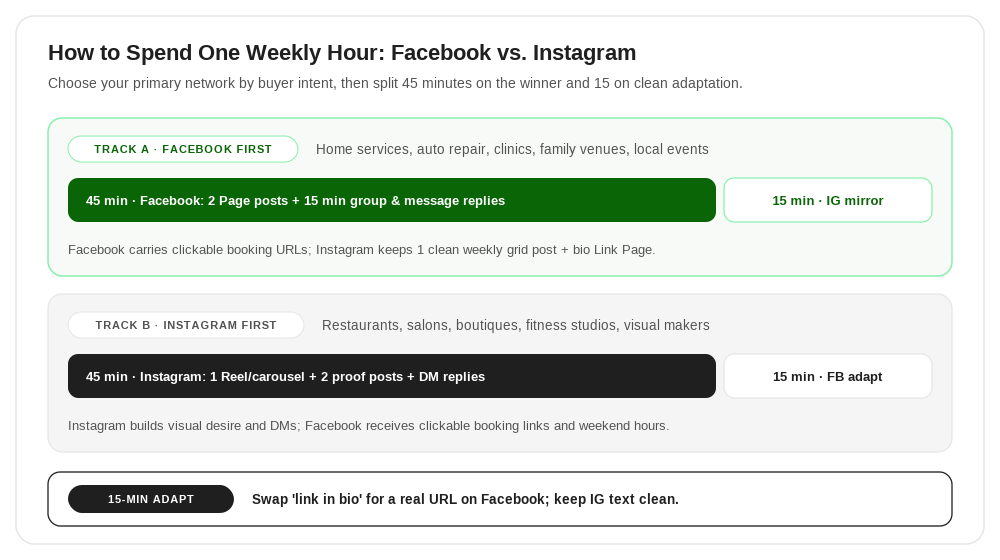
Track A: The 45/15 Facebook-first hour
Use Track A if you run a home service company, auto shop, clinic, pet care business, local office, or family-centered venue where neighborhood trust and direct links drive revenue.
- Minutes 1 to 15 (Draft two clear Facebook Page posts with links): Write one practical proof post (a completed repair, seasonal maintenance reminder, or finished local project with one clean daylight photo) and one direct-action post (open slots this week, seasonal inspection checklist, or local Event listing). Include your exact neighborhood, hours, and a clickable booking or estimate URL.
- Minutes 16 to 30 (Helpful presence in 2 to 3 local Facebook Groups): Scan the neighborhood groups where you are an active resident or permitted local member. Answer two genuine homeowner or neighbor questions with helpful, zero-pitch advice first. Only share your business Page when a neighbor explicitly asks for a referral or during the group’s official local-business promotion day.
- Minutes 31 to 40 (Answer Messenger, comments, and check reviews): Reply warmly to every Page comment, Messenger quote request, and new Facebook recommendation. Save two short text templates on your phone for your most common questions (service area, typical appointment window, and booking link) so mid-week replies take thirty seconds.
- Minutes 41 to 45 (Quick weekly event or pinned check): Confirm that your pinned Facebook post reflects this week’s actual hours, holiday schedule, or seasonal offer so referred visitors from groups land on current information.
- Minutes 46 to 60 (15-minute clean Instagram adaptation): Take your sharpest photo from the week, crop it cleanly to 4:5 portrait, trim the caption to two crisp paragraphs, replace the raw URL with a pointer to your bio Link Page, add your city location tag plus 3 local hashtags, and post it to Instagram along with one quick Story carrying a clickable booking sticker. Your Instagram profile now looks active, trustworthy, and intentional without stealing your evening.
Track B: The 45/15 Instagram-first hour
Use Track B if you run a restaurant, bakery, coffee shop, salon, barber shop, boutique, florist, fitness studio, or visual maker where customers judge quality with their eyes first.
- Minutes 1 to 20 (Build one hero visual piece): Create either one short 20 to 40 second vertical Reel (a fresh pour, finished haircut reveal, unpacking new seasonal stock, or a 3-step FAQ) OR one clean 5-slide carousel answering a real customer question. Keep daylight bright and wipe your phone lens first.
- Minutes 21 to 35 (Prepare two quick proof posts plus Story plan): Pick two real photos from the shop floor (a signature dish, styled table, clean retail shelf, or smiling team member who agreed to appear). Write tight opening lines under 125 characters so the key detail shows above the fold, tag your city location, and add 3 to 5 specific local tags.
- Minutes 36 to 45 (Answer DMs, comments, and refresh Highlights): Respond warmly to every DM, Story reaction, and grid comment. Check that your bio Link Page and pinned Highlights (Hours, Menu or Services, Booking) match this week’s specials or open chairs.
- Minutes 46 to 60 (15-minute clean Facebook adaptation): Take your hero photo or clip and your best proof post and adapt them natively for Facebook. Delete every phrase that says “Link in bio”, paste your actual clickable reservation, menu, or booking link right under the opening lines, remove the Instagram hashtag cluster, tag any neighboring host venue or community partner, and check Facebook Messenger for family or group inquiries.
How to cross-adapt one photo and caption without blind duplicate dumping
Meta makes it tempting to toggle automatic cross-posting inside linked Facebook and Instagram accounts so every post blasts to both feeds untouched. That shortcut quietly undermines local credibility because readers spot lazy cross-dumps instantly.
Blindly mirroring from Instagram to Facebook leaves four giveaways: the caption tells Facebook users to tap a “link in bio” that Facebook does not emphasize, @instagramhandles turn into broken plain text when the partner uses a different Facebook Page name, a wall of hashtags looks robotic in a neighborhood feed, and vertical Story crops cut off key words. Mirroring the reverse direction dumps unclickable https:// links into Instagram captions where nobody can tap them.
Instead of rewriting from scratch, keep one core idea and one clean photo, then spend two minutes adjusting three elements: the opening hook, the link format, and the tags. Here is how the exact same local business update adapts cleanly across both channels.
Example 1: Local HVAC and plumbing business (Facebook primary, Instagram secondary)
Facebook version (clickable estimate link and neighbor tone):
Hearing your furnace cycle on and off every ten minutes this week? Before the first real cold snap hits Westside and Brookview, a dirty flame sensor or clogged filter is usually the culprit.
We opened four morning tune-up slots for Thursday and Friday. No surprise fees, plain checklist before we leave, and same-week scheduling online here: https://example-hvac.com/tuneup
Questions about an older unit? Drop a comment or send us a quick message with your neighborhood.
Instagram adaptation (visual hook, bio Link Page pointer, 3 local tags):
Furnace cycling on and off every 10 minutes? Nine times out of ten it starts with a clogged filter or dusty flame sensor (swipe to see what we pulled out of a Brookview unit this morning).
Four Thursday and Friday tune-up slots are open for Westside and Brookview homes. Tap “Book a Tune-Up” in our profile Link Page or message us TUNEUP for times.
#WestsideHomeowners #BrookviewLocal #HVACMaintenance
Example 2: Neighborhood bakery or cafe (Instagram primary, Facebook secondary)
Instagram version (sensory hook, bio menu pointer, Story sticker pairing):
Brown-butter pear tarts just came off the rack at 7:30 AM, still crisp around the edges and boxed in twos or sixes until they sell out.
Open today until 3:00 PM on Cedar Avenue with fresh batch brew pouring all morning. Tap the link in our bio to pre-order a weekend box before Friday noon.
#CedarAvenueEats #LocalBakery #WeekendPastry
Facebook adaptation (clickable pre-order URL, hours, weekend parking note):
Fresh brown-butter pear tarts just came out of the oven on Cedar Avenue (open today until 3:00 PM, free street parking right behind the library lot).
Hosting family this weekend? Reserve a box of six online before Friday at noon so we set yours aside before Saturday’s rush: https://example-bakery.com/weekend-box
Notice that neither rewrite took ten minutes, yet both read like a real owner speaking natively to the people actually using each app.
Ask explicit permission before sharing customer faces or homes
Local proof builds trust fast, whether you are posting a happy salon reveal on Instagram or a completed patio repair on Facebook. Always ask customers and team members for explicit verbal or written permission before photographing or publishing identifiable faces, children, license plates, house numbers, or interior home details. When a customer prefers privacy, focus tightly on the finished plate, manicured nails, crisp haircut from behind, new electrical panel, or spotless front porch with zero identifying street numbers in frame.
Four-week field test to verify your winner with real inquiries
Debating channel strategy in the abstract wastes weeks. Run a calm four-week field test using your chosen 45/15 split, then let local customer behavior settle the argument for good.
- Set up two clean tracked links before week one. Create one short link for your Facebook posts and a separate short link for your Instagram Link Page (or tag each with simple UTM labels) pointing to the exact same booking, quote, or menu page.
- Add one five-second intake question at the counter or phone. Train everyone who answers calls, DMs, or checkout to ask warmly: “By the way, how did you hear about us?” Tally Facebook, Instagram, Google, and Word of Mouth on a simple notepad or spreadsheet.
- Run four uninterrupted weeks of your 45/15 plan. Resist switching strategies on day nine because one post got quiet likes. Give neighborhood group replies, Reels distribution, and Event reminders a full month to cycle through local feeds.
- Score real actions, not vanity counts, on day 30. Compare tracked link clicks, qualified DMs or Messenger threads that led to bookings, and front-desk mentions. If your secondary channel unexpectedly out-converts your primary pick by two to one, flip the 45/15 ratio next month and keep the exact same 60-minute total cap.
If you are still deciding whether to add Google Business Profile, TikTok, or LinkedIn alongside Meta, read our guide on how many social media platforms a small business should use and keep your daily habit light with a 15-minute daily social media routine.
Honest Spica Post trade-offs for Facebook and Instagram
If you are comparing tools to help run a calm weekly workflow across Facebook, Instagram, and your other local channels, here is the exact November 2026 standing of Spica Post for small businesses and creators:
- What is live today: Spica Post gives you a fast, branded Link Page (ideal for your Instagram bio, holding your booking button, hours, custom announcement boxes, and a printable SVG QR code for your counter), click-tracked
/l/short links that let you measure real Facebook vs. Instagram link clicks separately with zero visitor tracking cookies, voice-consistent drafting and caption adaptation, and live direct publishing plus Auto-crosspost across X, Bluesky (including live Unified Inbox replies), LinkedIn personal profiles, and Mastodon. - What is built and completing network approval: Spica Post’s publishing, carousel, Reels, and Unified Inbox comment connectors for Instagram and Facebook Pages are built and currently completing Meta App Review (alongside Google Business Profile awaiting its first live service-area verification, TikTok in review, and YouTube completing its API compliance audit). Until Meta’s direct publishing opens across all workspaces, small businesses can still use Spica Post today to run their Instagram bio Link Page, generate separate
/l/tracked links for Facebook and Instagram, draft clean platform-adapted captions in one sitting, and paste each into Facebook and Instagram in under five minutes. You can check current flat workspace plans anytime on our pricing page and track live network capabilities on our platforms overview.
Stop splitting your energy down the middle and feeling behind on both apps. Choose the one channel that matches how your local buyers actually hire or visit you, guard 45 focused minutes for it every week, adapt cleanly in 15 minutes for the second, and let thirty days of real inquiries confirm your mix.
Questions people ask
- Should a local business pick Facebook or Instagram if it only has one hour a week?
- Pick one primary winner based on how your neighbors buy, give it 45 minutes a week, and spend the final 15 minutes adapting your best update cleanly to the other network. Facebook usually wins for home services, clinics, auto repair, and local family events; Instagram usually wins for food, salons, boutiques, fitness, and visual professions.
- Why do clickable links work so differently on Facebook and Instagram?
- Facebook lets you paste a clickable booking, menu, or estimate link directly inside any feed post caption, making it easy for busy homeowners to tap straight to your site. Instagram feed captions do not make typed URLs clickable, so Instagram relies on Story link stickers, direct messages, and a fast mobile Link Page in your bio.
- Is it bad to turn on automatic cross-posting between Instagram and Facebook?
- Blind one-click mirroring hurts both pages because each audience expects different formatting. An Instagram caption pushed unchanged to Facebook often leaves awkward 'link in bio' instructions with no clickable URL, broken @mentions, and hashtag blocks that Facebook readers scroll past. Spending five minutes adapting the caption fixes every one of those leaks.
- Do Facebook neighborhood groups still bring real local customers in 2026?
- Yes, especially for professions built on local trust such as plumbing, roofing, HVAC, auto repair, pet care, and pediatric or dental clinics. Neighbors regularly ask groups for first-hand recommendations, and business owners who answer questions helpfully within group guidelines earn far more inquiries than those dropping promotional flyers.
- How can I tell after 30 days whether Facebook or Instagram is actually bringing bookings?
- Track three real signals instead of likes: clicks through separate tracked short links for each platform, direct messages that turn into booked appointments or quotes, and a single front-desk question asking every new customer where they heard about you. Thirty days of those three counts will reveal your clear winner.
Sources
- Pew Research Center: Social Media Fact Sheet (US adult platform use by age and community)
- Meta Business Help Center: Link your Facebook Page and Instagram account
- Meta Business Help Center: About using a Facebook Page to interact in Groups
- Instagram Help Center: Add links to your profile bio and Stories
- Spica Post Platform Guides: Facebook, Instagram, and channel limits