Strategy
How Many Social Media Accounts Should a Small Business Have?
Two active platforms beat six neglected profiles. Use this simple capacity rule and business-type table to pick the exact accounts worth running.
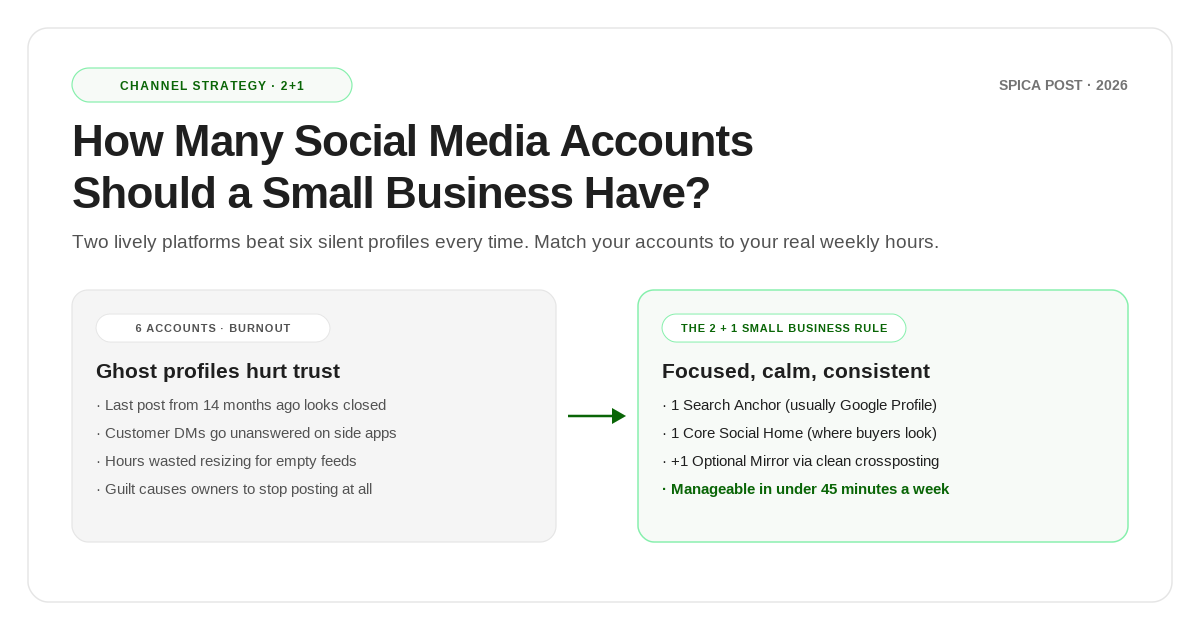
Most small businesses should actively run two core platforms plus at most one low-effort mirror (the 2+1 rule), not six or seven accounts. Pair one search anchor (usually your Google Business Profile for local businesses, or LinkedIn and your website for B2B services) with one primary social home where your real customers already browse before buying, and add a third channel only when it mirrors cleanly without stealing extra hours from your week.
Trying to be active on Instagram, Facebook, TikTok, YouTube, LinkedIn, X, Threads, Pinterest, and Bluesky at the same time is the fastest way to burn out by week three. Two lively, accurate profiles where you post twice a week and answer every message bring far more calls and orders than six dusty profiles whose newest post is from last winter.
This guide explains why abandoned “ghost accounts” quietly cost you customers, how to scale the 2+1 rule to your real weekly hours, the exact channel pairings for seven different small business types in 2026, how to clean up old profiles safely, and where smart crossposting expands your reach without adding busywork.
Why trying to be “everywhere” actively hurts small businesses
Every few months a new headline warns owners that if they are not dancing on TikTok, pinning daily on Pinterest, and posting threads twice a day, they are falling behind. That advice assumes you have a full-time marketing team. For a real owner running a shop, a van, a kitchen, or a solo practice, opening six accounts causes three immediate problems:
- Ghost profiles make you look closed. When a careful customer searches your business name, clicks your old Facebook or X page, and sees your last post was a “Happy Holidays 2024” graphic, their gut reaction is “Are they still open?” Silence on a public profile is worse than never linking to that profile at all.
- Customer messages fall into dark corners. Every extra account creates another inbox you forget to check. Leaving a real quote request sitting unanswered in TikTok DMs or LinkedIn messages for three weeks loses a buyer who was ready to pay.
- Formatting fatigue kills consistency. Square carousels, 9:16 vertical videos, 300-character threads, and long professional updates all demand different work. Stretching two hours of marketing time across six networks leaves every single profile half-baked.
Even broad U.S. adoption data from the Pew Research Center Social Media Fact Sheet shows that audiences cluster heavily around a handful of major platforms by age and habit rather than spreading evenly across every app. You only need to meet your buyers where they already check businesses like yours.
The 2+1 rule matched to your real weekly hours
Start from the honest number of minutes you can protect every single week, even during your busiest month of the year, not during a quiet January afternoon.
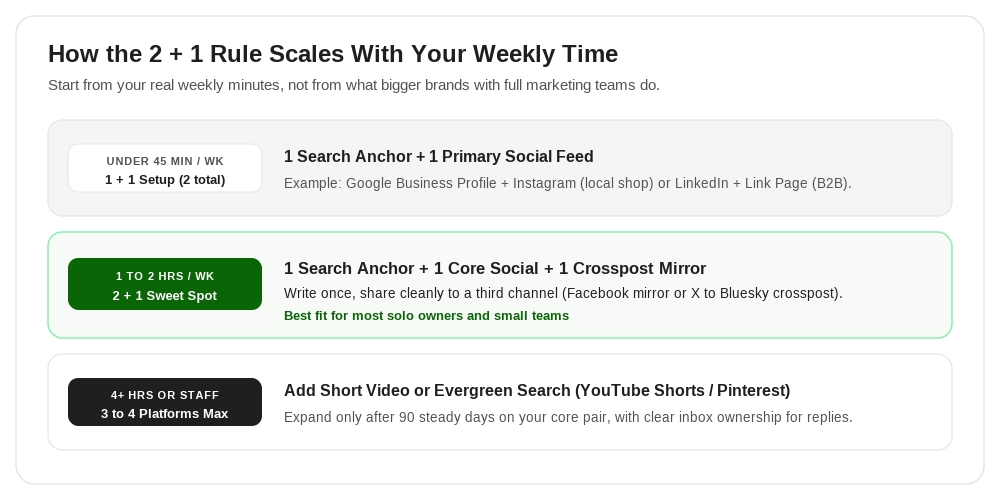
Under 45 minutes a week: run 1 + 1 (2 platforms total)
If you wear every hat in your business and can spare only half an hour on Sunday evening, stop at two accounts:
- Your Search Anchor: For any business serving local customers, that is your Google Business Profile (updating hours, replying to reviews, and uploading one fresh photo a week, aligning with Google’s local ranking basics). For remote B2B services, that anchor is your clean website plus LinkedIn.
- Your Primary Social Home: Pick the single social network where your typical buyer already verifies your craft before calling or booking. Post two real updates per week and answer every comment.
1 to 2 hours a week: the 2 + 1 sweet spot (3 platforms)
Once your first two accounts run smoothly for a full quarter without feeling stressful, add one low-effort mirror:
- A local salon or restaurant running Google Business Profile + Instagram mirrors those same three weekly photos cleanly to a Facebook Page for neighborhood families.
- A solo consultant, SaaS founder, or indie creator running LinkedIn + X adds Bluesky (or Mastodon) through clean Auto-crosspost so one well-written update reaches a second engaged audience in zero extra minutes.
4+ hours a week or dedicated staff: 3 to 4 platforms max
Only when someone owns social media on their actual weekly calendar (and checks every inbox daily) does adding a fourth channel like YouTube Shorts, TikTok, or Pinterest pay off consistently. Even established local brands with staff rarely gain much from juggling more than four active networks.
Exact platform picks by business type in 2026
Use this table to pick your starting 2+1 combination based on how people actually buy from your profession, rather than guessing from online hype.
| Business type | 1 · Search Anchor | 2 · Core Social Home | +1 · Optional Low-Effort Mirror | Safely skip at first |
|---|---|---|---|---|
| Home services & local professions (plumbers, HVAC, cleaners, roofers) | Google Business Profile | Facebook Page (neighborhood proof & local groups) | Instagram or YouTube Shorts (simple 20s job-site tips) | X, Threads, Pinterest |
| Restaurants, cafes & bakeries | Google Business Profile (hours + fast menu) | Instagram (window-lit dishes & specials) | Facebook Page (regulars & events) or TikTok | LinkedIn, X |
| Hair salons, barbers & wellness | Google Business Profile (services + reviews) | Instagram (portfolio + open-chair Stories) | Facebook Page or TikTok (15s cut reveals) | LinkedIn, X, Bluesky |
| Local retail & boutiques | Google Business Profile | Instagram (new arrivals & styling) | Facebook Page or Pinterest (evergreen gifts) | LinkedIn, X |
| B2B services & consultants (bookkeepers, agencies, lawyers, coaches) | LinkedIn (personal profile) | Website / Blog + Newsletter or Link Page | X or Bluesky (short industry notes & threads) | TikTok, Pinterest |
| Creators who sell & indie makers | Branded Link Page + Storefront | Instagram, YouTube Shorts, or Bluesky/X (depends on visual vs. text craft) | Auto-crosspost pair (e.g., X + Bluesky + Mastodon, or Pinterest for gifts) | Any network whose format drains you |
| Real estate agents & local advisors | Google Business Profile (individual practitioner) | LinkedIn or Instagram (neighborhood proof + Q&As) | Facebook Page or YouTube Shorts (street tours) | Pinterest, Mastodon |
Notice a steady pattern across almost every row: local service and storefront businesses almost always anchor on Google Business Profile, while B2B professionals and creators anchor on LinkedIn, Bluesky/X, or a visual portfolio paired with one clean Link Page.
When to add a platform (and four signs you have too many)
Adding a network should feel like opening a second checkout lane because the first lane is busy, never like opening a second store because the first store is empty.
Three green lights to expand
- Ninety steady days on your core pair. You have posted two to three times a week for three straight months without dreading it.
- Real buyer pull. Actual customers keep asking “Are you on TikTok?” or “Do you share updates on Bluesky?” or your niche clearly relies on searchable evergreen formats like Pinterest or YouTube.
- One repeatable source file. You already take vertical clips or write clear weekly updates that repurpose naturally into the new channel without starting from a blank page.
Four red flags that you should cut back now
- You have not posted on one of your active accounts in more than thirty days.
- You routinely discover unanswered customer comments or DMs a week after they arrived.
- You skip posting anywhere because thinking about updating five platforms feels exhausting.
- You cannot name a single call, booking, referral, or sale that came from a side channel over the last six months.
Cutting an underperforming platform is not quitting; it is giving your best two channels the attention they need to actually bring business.
What to do with old, abandoned social media accounts
If you already opened six accounts two years ago and want to drop down to a calm 2+1 setup, you have two clean options:
Option A: Park the handle cleanly (recommended for brand protection)
Claiming and keeping your exact business handle stops squatters or copycats from taking your name later. Turn a retired account into a clean signpost in two minutes:
- Update the bio to say plainly where you are active (for example: “For weekly hours, specials, and direct bookings, visit us on Instagram @YourShop or at yoursite.com”).
- Pin one tidy welcome post with your current website, phone number, or Link Page, and turn off misleading auto-replies.
- Remove that retired social icon from your website footer and email signature so you stop sending new visitors to a parked page.
Option B: Delete cleanly when it creates confusion
If an old duplicate Facebook Page, test TikTok account, or outdated storefront profile has wrong addresses or zero followers, delete or unpublish it completely so searchers never land on old hours or broken phone numbers.
How crossposting changes the math (and honest Spica Post trade-offs)
Crossposting is what makes the “+1” in the 2+1 rule realistic for busy owners. When two networks share a compatible format, writing one clean draft and automatically publishing tailored versions lets a solo owner maintain three channels in the time it normally takes to manage one.
The key is respecting each network’s native character limits, image crops, and culture (which you can review on our crossposting overview and platforms guide) and never crossposting into an inbox you ignore.
Honest trade-offs if you use Spica Post for your 2+1 stack
As of November 2026, here is how Spica Post matches different 2+1 combinations honestly:
- Strongest live fit today: If your 2+1 mix leans on LinkedIn personal profiles, X, Bluesky, and Mastodon plus a branded Link Page and blog, Spica Post publishes live directly across all four networks today, supports Auto-crosspost (for instance, write once on X or Bluesky and mirror cleanly across your paired feeds), chained threads (up to 24 follow-ups), and a Unified Inbox for Bluesky replies.
- Built and completing platform verification/review: If your local 2+1 mix centers on Google Business Profile (API approved and enabled in production, awaiting first live service-area profile verification), Instagram, Facebook Pages, Threads, TikTok, Pinterest, or YouTube, those Spica Post publishing connectors are built and completing official platform review/verification. Until Meta, Google, and video connectors finish rolling out across every workspace, you can draft your weekly calendar and run your branded Link Page inside Spica Post while posting your 2 or 3 weekly updates natively to Google and Meta, or check current availability and flat workspace tiers on our pricing page.
Audit your own accounts today: circle your Search Anchor, circle your one Primary Social Home, decide whether one Mirror earns its keep, and park the rest cleanly. Showing up steadily in two right places beats disappearing from six.
Questions people ask
- How many social media platforms should a small business actively use?
- Most small businesses do best with two active platforms plus at most one low-effort mirror (the 2+1 rule): one search anchor such as Google Business Profile, one primary social network where customers already check your work, and one optional crossposted mirror that takes almost zero extra work.
- Does having an inactive social media account hurt a small business?
- Yes. When a prospective customer checks your Facebook, X, or Instagram page and sees the newest post is fourteen months old, many assume you closed down or ignore messages. Keeping two live accounts updated every week builds far more trust than six silent profiles.
- Should a small business claim its brand handle on platforms it does not plan to use?
- Yes, claiming your brand name on major platforms prevents impersonation. Just keep any unused profile clean: add your accurate website link, state plainly where customers can find your active updates, and leave zero broken promises about 'posting soon'.
- When is a small business actually ready to add a third or fourth platform?
- Only after you have posted steadily on your first two platforms for at least ninety days without scrambling, you have a reliable habit for answering comments and messages, and customers or buyers actually look for your profession on that next channel.
- Does crossposting let a solo business owner run more platforms safely?
- Crossposting helps when the formats genuinely match, such as mirroring short updates between X, Bluesky, and Mastodon or sharing clean neighborhood posts between Instagram and Facebook. It backfires if you dump identical posts into channels you never check for replies.