HVAC
Social Media for HVAC Companies: Seasonal Posts That Book Jobs (2026)
Fill slow spring and fall shoulder months before heat waves hit. Use a 4-season HVAC calendar, Google Business Profile, and 4 ready captions.
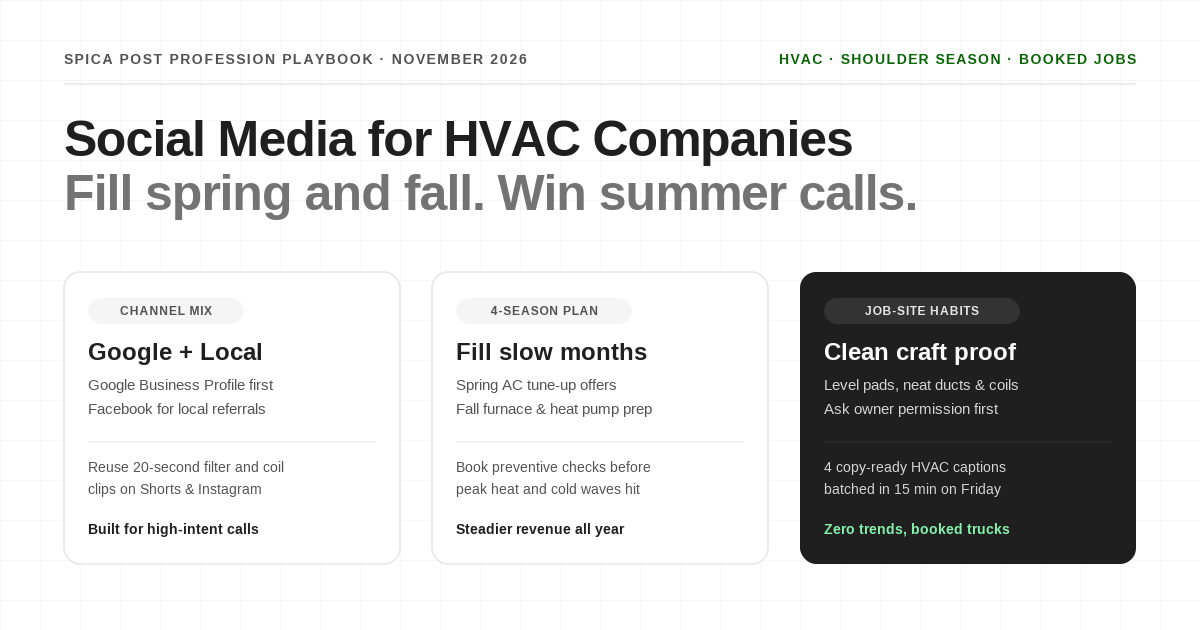
Effective social media for HVAC companies is built around one operational goal: filling quiet spring and fall shoulder seasons with scheduled tune-ups so your trucks stay booked before summer heat waves and winter freezes hit. By pairing an active Google Business Profile with two honest weekly posts on Facebook and short searchable video clips, heating and cooling teams earn steady preventive bookings all year without filming scripted skits or chasing viral trends.
Every HVAC owner knows the brutal swing of the calendar. In July or January, phones ring nonstop and dispatchers scramble to fit no-cool and no-heat emergencies onto packed routes. Then April or October arrives with mild 68-degree afternoons, and half the schedule suddenly looks empty. Waiting until those slow weeks arrive to start posting is too late; homeowners book preventive maintenance when you remind them cleanly three to four weeks ahead of the weather shift and show real proof that your technicians are neat, local, and trustworthy inside their homes.
Snapshot verified November 2026 against Google Business Profile service-area guidelines, U.S. Department of Energy maintenance guidance, and ENERGY STAR seasonal checklists. This playbook covers the exact HVAC channel mix worth your time, a four-season posting calendar focused on shoulder months first, clean job-site photo and homeowner privacy habits, four copy-ready HVAC captions, and a 15-minute Friday routine built for busy dispatch teams.
Why shoulder-season posting decides your HVAC year
Peak-season emergency calls find you mainly through Google Maps, star ratings, and speed to answer. Social media and weekly Google updates earn their keep primarily in two quieter moments: filling March-to-May cooling tune-ups and September-to-November heating checkups, and giving cautious families visual reassurance before they trust you with a five-figure system replacement.
How preventive tune-up posts smooth cash flow and prevent summer burnout
A preventive tune-up booked in April accomplishes three valuable jobs at once:
- Keeps skilled technicians earning steady hours during mild spring and fall weeks so you retain good installers year-round.
- Catches aging capacitors, dirty coils, clogged condensate lines, and cracked heat exchangers on a calm weekday morning instead of a 102-degree Saturday night.
- Builds first-name familiarity with homeowners so when a 16-year-old unit eventually needs replacement, your crew is the only quote they ask for.
Instead of slashing tune-up prices to unsustainable teaser rates that attract bargain hunters, position shoulder-season offers around calm priority scheduling and real checklist thoroughness: checking refrigerant pressures, clearing condensate drains, inspecting electrical connections, verifying thermostat accuracy, and documenting findings with plain photos.
The HVAC channel mix that actually books trucks
A two-truck or twelve-truck heating and cooling company does not need six social accounts. Concentrate strictly where local homeowners look when comfort breaks or when they compare installation quotes:
| Channel | Real job for an HVAC company | Weekly time needed | What performs best |
|---|---|---|---|
| Google Business Profile | #1 driver of urgent no-cool/no-heat calls and Maps clicks | 5 minutes (1 update or Offer + review replies) | Shoulder-season tune-up Offer posts, clean condenser install photos, verified service cities |
| Facebook Page | Reaches homeowners, neighborhood groups, and repeat maintenance customers | 4 minutes (mirror weekly posts + answer local questions) | Seasonal prep checklists, crew introductions, tidy before/after installs |
| YouTube Shorts & Instagram | Searchable 20-second answers and visual proof of tidy ductwork and installs | Optional 6 minutes (reuse one un-watermarked phone clip) | Filter direction demos, thermostat reset tips, clean line-set craftsmanship |
| Nextdoor (free business page) | Local recommendations when neighbors ask who services furnaces or heat pumps | Keep profile accurate and thank neighbors who tag you | Honest service cities, emergency hours, responsive replies |
| LinkedIn / Bluesky / X | Helpful for commercial HVAC, property managers, restaurants, and facility directors | Mirror clean commercial rooftop or mini-split jobs weekly | Commercial preventative contracts, fast weather advisories |
Per Google Business Profile’s service-area business guidelines, if you dispatch trucks from a home base or private warehouse rather than running a walk-in showroom, hide your residential street address cleanly and declare up to 20 realistic service areas (cities, counties, or postal codes within about two hours of driving time). Pair that with our full Google Business Profile setup checklist and local SEO basics guide so Maps searches route straight to your phone.
The four-season HVAC posting calendar (shoulder months first)
Heating and cooling worries follow the thermometer predictably every year. Schedule each season’s core reminder three to four weeks before temperatures swing so homeowners book before the rush starts.
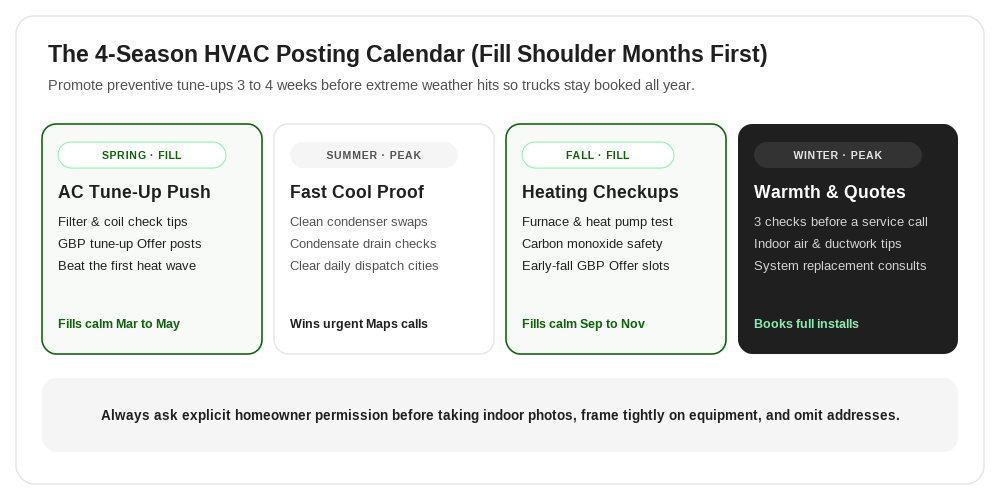
| Season | Main business priority | What homeowners worry about | High-return post & Google Offer angles |
|---|---|---|---|
| Spring (Mar to May) | Fill shoulder season with scheduled AC tune-ups | First hot afternoon blowing warm air, winter leaves packed around outdoor condenser, allergy dust | GBP Offer post for spring cooling checkup; 20-second filter and outdoor-clearance tip; coil cleaning before/after |
| Summer (Jun to Aug) | Win urgent calls and show dependable local capacity | Breakdowns in peak heat, sky-high electric bills, leaking attic condensate pans, hot upstairs bedrooms | Same-day dispatch city reminder; tidy condenser swap proof; plain explanation of condensate drain line checks |
| Fall (Sep to Nov) | Fill shoulder season with furnace & heat pump tune-ups | Burning dust smell on first startup, carbon monoxide safety, uneven rooms, older furnace reliability | GBP Offer post for fall heating safety check; test-your-heat-early tip on a mild afternoon; ductwork sealing proof |
| Winter (Dec to Feb) | Book emergency heat and planned full replacements | Sudden no-heat nights, dry indoor air, high gas/electric bills, deciding repair vs. full system upgrade | “3 quick checks before calling for no-heat” post (breaker, filter, thermostat batteries); clean heat pump or furnace install; replacement financing/timeline FAQ |
Anchoring tips in trusted U.S. energy guidance
Homeowners save and share maintenance tips that feel genuinely educational rather than salesy. Ground your practical posts in primary homeowner guidance from the U.S. Department of Energy and ENERGY STAR:
- Filter checks every month during peak cooling and heating (and replacing filters at least every three months, or sooner in homes with pets or dust) keep airflow strong and protect blower motors and evaporator coils.
- Outdoor condenser clearance: Clearing grass clippings, mulch, weeds, and leaves back around the outdoor unit helps heat reject properly instead of forcing compressors to run hot.
- Condensate drain awareness: Explaining why algae or sludge plugs AC drain lines and triggers float-switch shutdowns teaches homeowners why preventive flushing avoids ceiling stains.
- Pre-season thermostat tests: Reminding families to switch systems from cooling to heating on a mild October afternoon lets them spot ignition or reversing-valve issues weeks before the first freezing night.
Technician job-site photo and homeowner permission habits
Homeowners rarely understand SEER2 ratings or static pressure readings, yet every single person recognizes clean craftsmanship instantly. A level composite pad, crisp UV-protected line-set insulation, neat low-voltage wiring tucked cleanly into a disconnect, straight sheet-metal plenum transitions, and spotless shoe covers or drop cloths tell a family in two seconds that your crew takes pride in their home.
Five strict job-site privacy habits for every technician
Because HVAC technicians work inside bedrooms, hallways, attics, closets, and backyards, protecting client privacy safeguards your reputation and neighborhood referrals:
- Always ask the homeowner for explicit permission first before taking or posting any photo or short video inside their house, mechanical closet, attic, or yard.
- Frame tightly on the equipment itself (the outdoor condenser, clean furnace cabinet, tidy PVC venting, fresh thermostat on a blank wall, or sealed plenum) so personal belongings, mail, laundry, family portraits, kids, and pets stay completely outside the shot.
- Never include house numbers, street signs, license plates, alarm panels, or customer full names in photos, video backgrounds, or caption text.
- Wipe the lens and tap for bright exposure. Mechanical rooms and attics are dim; turning on a small work light turns a muddy phone snapshot into crisp proof of workmanship.
- Never mock neglected equipment or messy homes. Showing a heavily clogged filter or leaf-packed coil calmly as a helpful reminder (“Here is what a restricted coil looks like after two seasons without cleaning”) educates without embarrassing the homeowner who hired you.
Four copy-ready HVAC captions you can use all year
Swap the bracketed city names, dates, and links for your own service area. When posting to Google Business Profile, leave phone numbers out of the body copy because Google displays its own Call button and may automatically reject post text containing a phone number per Google Business Profile post limits.
Caption 1: Spring shoulder-season AC tune-up (Google Offer + Facebook)
Spring AC tune-up slots are open across [City 1], [City 2], and [City 3] before the first 90-degree week hits.
Every scheduled checkup covers outdoor coil inspection, condensate drain clearing, capacitor and electrical checks, temperature split testing, and a fresh look at airflow so small wear gets fixed on a calm weekday instead of a July weekend.
Book a morning or afternoon shoulder-season slot through [End Date] at [link] or tap Call on our Google listing.
Caption 2: Clean system swap proof (Workmanship post)
Wrapped up a clean heat pump and air handler swap in [Neighborhood / Town] this afternoon.
New level pad outside, crisp insulated line set, neat condensate trap with a safety float switch, sealed plenum transitions, and the hallway vacuumed spotless before we loaded the van.
Thinking about replacing an aging system before peak weather arrives? Request an honest, no-pressure sizing visit in [Service Area] at [link].
Caption 3: High-save homeowner tip (Filter + outdoor clearance)
Two five-minute checks from ENERGY STAR and our techs that prevent half of summer AC service calls:
Notice weak airflow at the vents or an outdoor unit running nonstop? Schedule a clean diagnostic check across [City] at [link].
Caption 4: Fall heating readiness & safety check (Shoulder-season fill)
Mild October afternoons are the best time to turn your thermostat to Heat for ten minutes and make sure everything fires cleanly before the first freezing night arrives.
Our fall furnace and heat pump tune-ups verify burners or reversing valves, inspect heat exchangers, check safety switches, and confirm clean airflow while our schedule still has open weekday mornings.
Grab your fall heating checkup in [Town 1] and [Town 2] at [link].
Turning one 20-second clip into months of local search
If a technician finishes a neat install or holds up a clean vs. clogged filter (with explicit homeowner permission on site, or filmed back at your own shop bench), record one steady 20-second vertical phone clip explaining one plain fix: “How to check which way your HVAC air filter arrow should point” or “Three things to check before calling for no-heat”. Upload that clean, un-watermarked clip to YouTube Shorts with the literal question in the title and your service cities in the description, then share the same clip on Instagram Reels and Facebook. Unlike feed posts that vanish in 48 hours, practical troubleshooting clips keep showing up in local search for months (see our YouTube Shorts guide for small businesses).
The 15-minute Friday routine for busy HVAC owners
Complex social calendars collapse the first week temperatures hit 95 degrees. Run this six-step routine every Friday afternoon so your Google listing and social accounts stay active without pulling anyone off service calls:
- Collect two clean photos from the week’s routes (shared in a quick team photo folder, strictly from jobs where the homeowner gave explicit permission).
- Pick one photo for Monday’s workmanship post showing tidy equipment, straight ductwork, or a stocked morning service van.
- Pair Thursday’s post with the upcoming weather shift, rotating between filter tips, shoulder-season tune-up reminders, thermostat FAQs, and honest explanations of how estimates work.
- Post Monday’s workmanship shot or your active seasonal Offer to Google Business Profile without putting a phone number inside the description text.
- Reply calmly to every new Google review from the past seven days so homeowners scanning Maps see an attentive local team (follow our fast Google review reply templates).
- Schedule both posts across your active channels and shut the laptop before the weekend begins.
Keep HVAC posts moving without living at a desk
Most heating and cooling owners know steady updates fill shoulder months, yet nobody wants to spend Friday evening formatting photos and writing captions after ten hours on roofs and in attics.
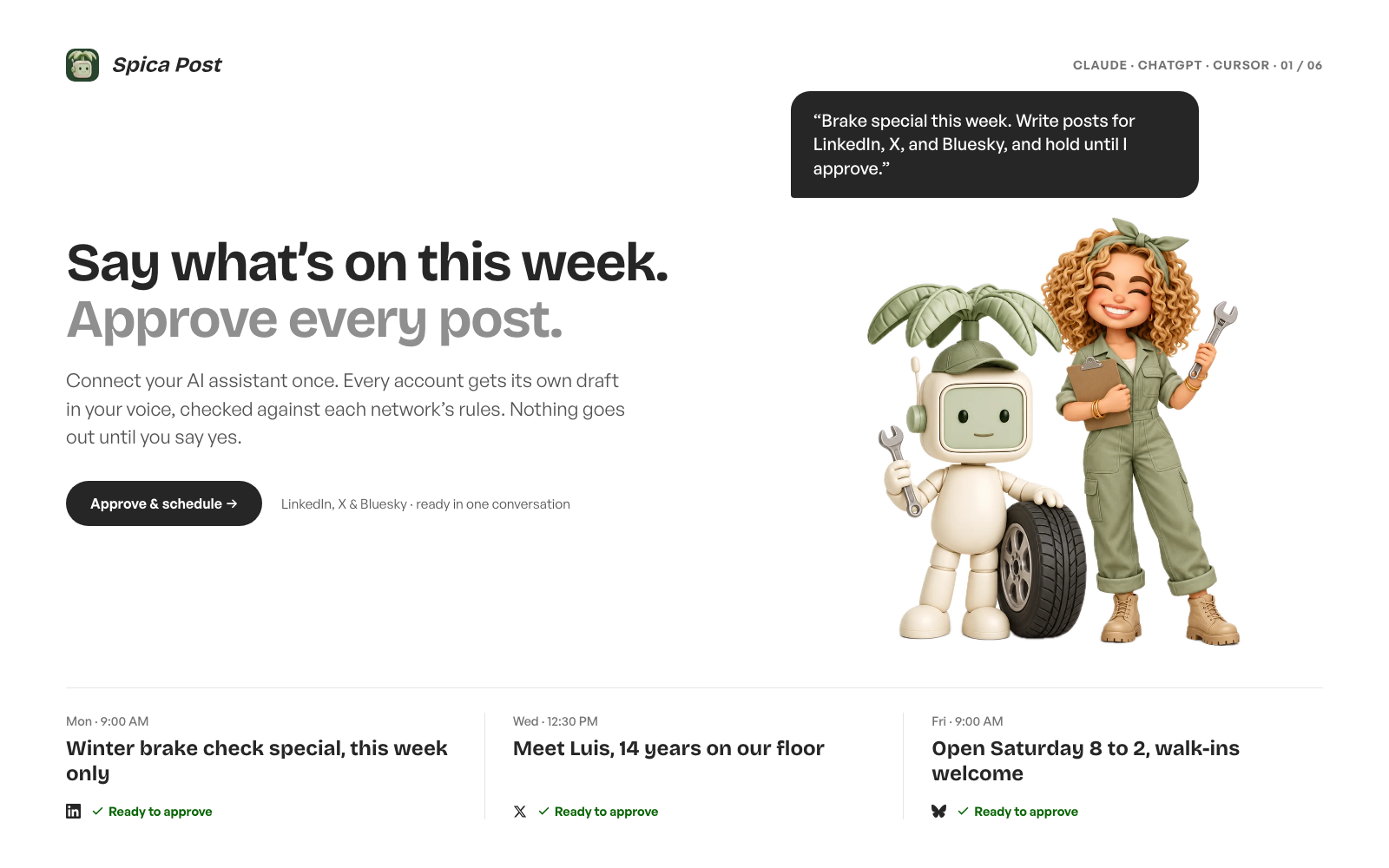
With Spica Post for HVAC companies, small businesses and creators snap two permission-approved job photos during the week, send one plain sentence to the AI assistant they already use (“Installed a new 3-ton condenser in Mesa with fresh line-set insulation, remind homeowners spring tune-up slots are open”), and review channel-checked drafts tailored to each network’s limits before anything hits the calendar.
To be completely upfront on current network status and real trade-offs (verified November 2026): Spica Post publishes live today to X, LinkedIn personal profiles, Bluesky, and Mastodon (helpful for commercial HVAC accounts, property managers, and local facility partners), alongside live branded Link Pages with open-now hours, hosted blogs, /l/ tracked short links, and Unified Inbox live on Bluesky. Integrations for Google Business Profile (API approved and enabled in production, awaiting our first live service-area verification), Facebook Pages, Instagram, Threads, TikTok, Pinterest, YouTube, and LinkedIn Company Pages are built and completing platform review and verification. Spica Post cannot take job-site photos for your crew or replace great field service, yet once a technician snaps two honest shots, turning them into steady seasonal visibility takes minutes instead of hours. Compare flat workspace plans anytime on our pricing page.
Start with one simple win this week: check your Google Business Profile service cities, ask permission on two crisp installations, schedule your next shoulder-season tune-up reminder three weeks ahead of the forecast, and reply to every recent customer review.
Questions people ask
- Which social media platforms bring the most booked jobs for an HVAC company?
- Google Business Profile brings the highest-intent emergency and scheduled calls because homeowners open Maps the minute their AC blows warm air or their furnace stops. Facebook is the strongest companion for local homeowners, neighborhood referrals, and seasonal tune-up reminders, while YouTube Shorts and Instagram work well for short 20-second filter and equipment clips.
- When should an HVAC company start posting spring and fall tune-up offers?
- Start posting three to four weeks before your local weather shifts: late February or March for spring cooling tune-ups, and late August or September for fall furnace and heat pump checkups. Starting early fills quiet shoulder-season dispatch boards before peak summer heat waves or winter freezes flood the phone.
- How often should a heating and cooling business post on social media?
- Two steady posts a week are plenty for a busy HVAC crew: one clean workmanship or team photo and one practical seasonal maintenance tip or tune-up reminder. Posting twice a week all year builds far more homeowner trust than posting daily in July and disappearing until winter.
- Can HVAC technicians share photos taken inside a customer's attic, basement, or yard?
- Only after getting explicit permission from the homeowner first. Ask politely before taking any photo or short video on site, frame tightly on the air handler, condenser pad, or thermostat, and keep family portraits, personal items, house numbers, street signs, and license plates completely out of frame.
- Should an HVAC company include its phone number in a Google Business Profile post?
- No. Google Business Profile already displays a prominent Call button on your listing and may automatically reject post text containing a phone number. State your service cities, tune-up window, and booking link plainly and let Google's built-in Call button handle the tap.