Auto repair
Social Media for Auto Repair Shops: Proof That Earns Neighborhood Trust
End driver fear of upselling: share 15-second worn-vs-new part clips, clean bay tours, seasonal checklists, and Google replies while hiding plates.
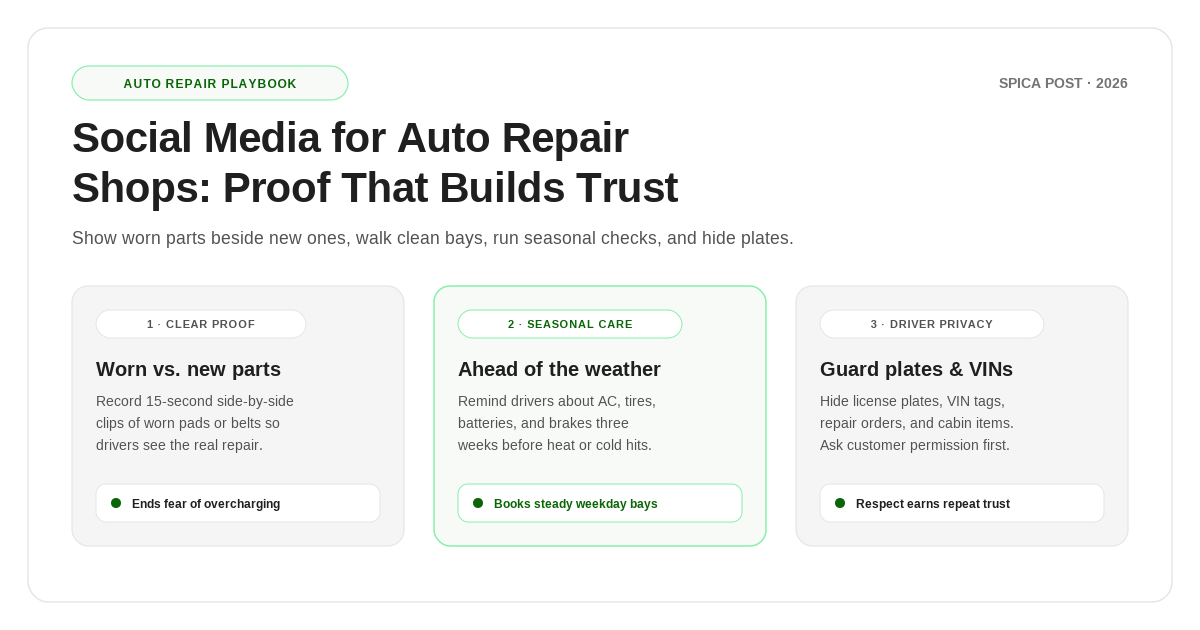
Social media for auto repair shops succeeds when every post answers the one silent fear almost every neighborhood driver carries before calling a mechanic: “Will this shop show me what is actually worn, explain the repair in plain English, and charge me fairly without inventing extra work?” Independent mechanics, tire bays, auto AC specialists, and mobile techs do not win steady weekday appointments with flashy supercar photos or gimmicky coupons; they win by showing real worn-versus-new parts, tidy bays, timely seasonal checklists, and respectful Google review replies.
Think about how a normal family chooses a repair shop. Few drivers wake up excited to spend $600 on brakes or an alternator. According to FTC consumer auto repair advice, drivers are actively coached to look for written estimates, clear diagnostic explanations, and permission before extra work begins. When a check-engine light turns on or an AC vent blows warm air in traffic, people open Google Maps, scan star ratings and recent photos, glance at your Facebook or Instagram page to verify you look organized and local, and call the shop that feels calmest and most transparent.
Snapshot verified November 2026 against Google Business Profile photo guidance, Google review reply guidelines, and NHTSA tire and vehicle maintenance guidance. This guide covers four profile blockers to clear first, which platforms actually bring local bays booked in 2026, the weekly trust-building content loop, strict license plate and vehicle privacy habits, four copy-ready shop captions, a four-season preventive calendar, and a 20-minute weekly routine built around lift schedules.
Clear four profile blockers before turning a wrench on content
Inspect your Google Business Profile, Facebook Page, Instagram bio, and website on your phone like a stranded commuter sitting in a grocery parking lot with a grinding brake rotor. Four minor gaps send high-intent callers straight to a chain franchise down the road.
1. Vague bios missing city, vehicle types, and specialties
A bio reading “Quality Automotive Service Since 2008” forces callers to guess what you actually fix. Put your city, neighborhood landmark, makes you service, and core specialties in the first two lines: for example, “Independent Auto Repair in Marietta · Brakes, AC, Diagnostics, Tires & Scheduled Maintenance for Domestic, Asian & European Vehicles · Written Digital Inspections.” If you specialize in one area, say it loudly, whether you run auto repair bays, tire shops, auto AC shops, auto body shops, or mobile mechanics.
2. Dark, cluttered exterior shots on Google Maps
An outdated Street View shot from four years ago or a dimly lit photo of stacked old tires makes cautious first-time drivers hesitate before pulling into your lot. Upload six bright daylight photos to your Google Business Profile: your clean street sign and entrance driveway, tidy parking drop-off lane, swept service bays with lifts clear, bright waiting counter and chairs, diagnostic scan bench, and smiling service writers or technicians (with staff consent). Clean visuals signal meticulous wrenching before a single bolt turns.
3. Friction-heavy appointment requests instead of one mobile Link Page
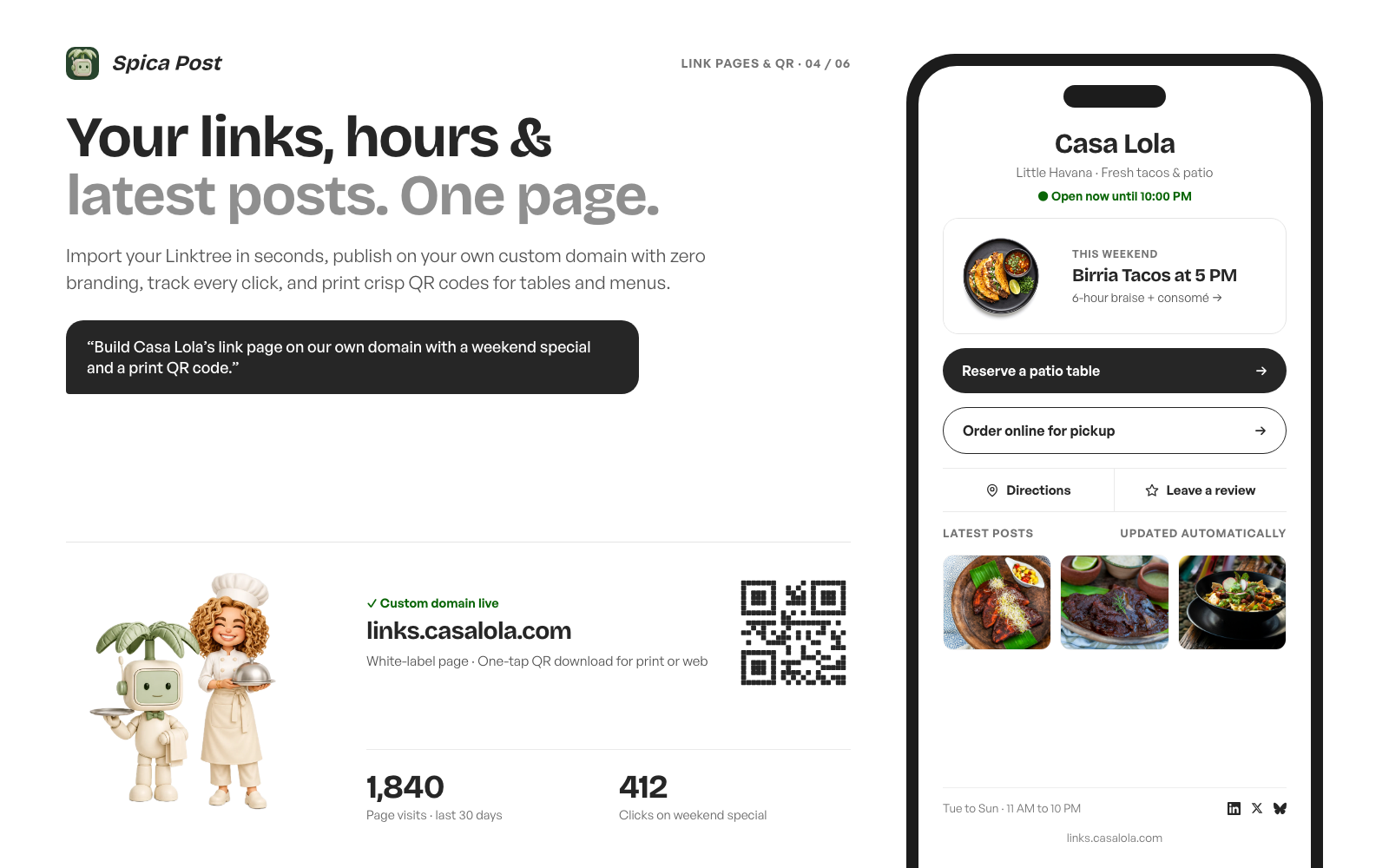
When someone spots your seasonal AC post on lunch break, they want to book or call in two taps, not navigate five slow tabs. Place one fast mobile Link Page in every social bio and print its QR code on your service counter and oil-change reminder stickers with four clear buttons:
- Request an Appointment or Diagnostic Slot (direct link to your booking form or scheduler).
- Call the Service Desk (one-tap phone number with exact shop hours).
- After-Hours Key Drop & Directions (plain parking instructions and map pin).
- Seasonal Checklist & Warranties (your parts-and-labor warranty and current preventive inspection details).
4. Unanswered Google reviews and hidden diagnostic policies
Silence on reviews makes busy shops look indifferent. Answering every five-star and three-star review promptly proves a real owner stands behind every repair order. Equally important, state plainly on your profiles how your diagnostic process works (for example, that every vehicle receives photo-backed findings and a written estimate for approval before work begins). That single sentence dissolves half of a new customer’s guard.
Where local drivers actually look before booking a bay in 2026
Service advisors and lead techs do not have spare afternoons for six social apps. Put your energy strictly where nearby motorists search during a breakdown or compare preventive service options.
| Channel | What the local driver does here | Best weekly job for an auto shop | Current Spica Post status (Nov 2026) |
|---|---|---|---|
| Google Business Profile | Searches “mechanic near me”, “brake repair”, “AC recharge”, reads reviews and hours | 1 clean bay or seasonal update photo weekly, accurate holiday hours, fast review replies | Built and enabled in production; awaiting first live service-area profile verification |
| Branded Link Page | Taps from social bios or counter QR to request a bay, call, or find night key drop | Always live in every bio and printed at the service counter and waiting room | Live today in Spica Post with custom announcement boxes and printable SVG QR codes |
| Facebook Page & neighborhood groups | Local families, commuters, and neighbors asking “Who is an honest mechanic nearby?” | Mirror 2 weekly trust posts (worn-vs-new proof + seasonal check) and answer questions helpfully | Built; completing Meta App Review |
| Checks clean bays, technician faces, and quick 15-second part comparisons | 2 weekly posts: bench part comparisons, clean bay tours, plain diagnostic Q&As | Built; completing Meta App Review | |
| YouTube Shorts / TikTok | Drivers Googling “why do my brakes squeak” or “how often replace cabin filter” | Optional: 1 short 15 to 30 second bench explanation per week naming your city | Built; TikTok in review, YouTube OAuth approved and completing compliance audit |
| LinkedIn (personal profile) | Local fleet managers, plumbing/HVAC owners, and experienced certified technicians | Twice-monthly commercial fleet maintenance posts and hiring updates for skilled techs | Live direct publishing today |
| X / Bluesky / Mastodon | Fast local alerts: storm closures, same-day bay openings, winter cold-snap warnings | Quick two-line operational or weather battery/tire alerts pointing to your Link Page | Live direct publishing and Auto-crosspost today (Bluesky Unified Inbox live) |
For almost every independent garage, Google Business Profile, Facebook, Instagram, and one mobile Link Page carry daily car count, while LinkedIn quietly wins commercial work-van fleets and recruits qualified mechanics who want a clean, organized shop.
The weekly auto repair trust loop: show, prevent, and answer
Drivers rarely trust abstract claims like “Honest service you can count on.” They trust visual proof they can verify with their own eyes in fifteen seconds. Running this three-part loop takes under twenty minutes a week and steadily builds a reputation no cut-rate oil chain can copy.
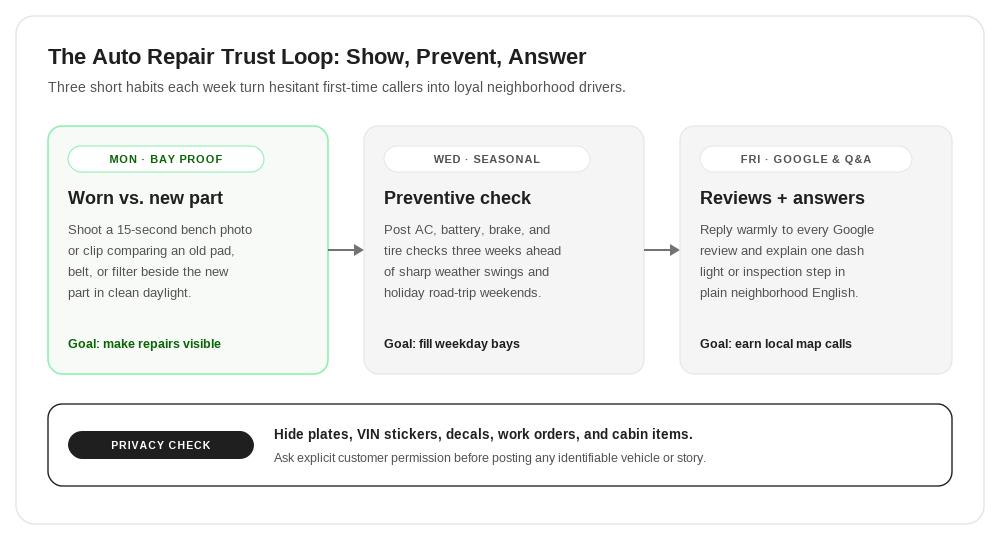
Step 1: 15-second worn-part versus new-part bench comparisons
This single format outperforms nearly everything else an independent shop can post. Once a week, lay a genuinely worn removed part (a cracked serpentine belt, a 2 mm brake pad, a clogged cabin air filter packed with leaves, a corroded battery terminal, or a unevenly worn tire showing misalignment) cleanly on a wiped workbench right beside the fresh replacement part.
Record a steady 15-second vertical clip or take one sharp top-down photo in daylight near the open bay door. Point calmly with a clean gloved finger and explain three facts in plain English: what the driver noticed (weak airflow, squealing on light braking, slow morning cranking), what the comparison shows, and how catching it early prevented a bigger roadside bill. Notice there is zero shaming of the vehicle owner and zero fear-mongering, just calm education that makes your shop look like the straight-shooting neighbor everyone recommends. For framing and daylight shop lighting habits, see our job-site photography guide.
Step 2: Clean-bay walkthroughs and transparent diagnostic explanations
Many people picture repair garages as chaotic, greasy mysteries where bills double behind closed doors. Break that stereotype twice a month with a crisp 20-second morning walkthrough before the first customer arrives: swept epoxy floors, organized toolboxes, diagnostic scanners, alignment rack, and clean customer seating.
Pair those shop glimpses with plain-English explanations of common confusion points:
- Why a flashing check-engine light means pull over safely while a steady light means schedule a proper scan soon.
- What actually happens during a paid electrical or drivability diagnostic versus a free parts-store code pull (explaining kindly that a code names a circuit, not a guaranteed part).
- How NHTSA tire tread and pressure checks work using a simple gauge and why regular rotations double tire life.
- What your digital vehicle inspection (DVI) report looks like (using a blank sample or a shop-owned demo vehicle, never a customer’s live record) so callers know they get real photos before approving any estimate.
Step 3: Timely seasonal reminders and respectful Google review replies
Every Friday, spend five minutes answering every new Google review and queuing one practical preventive check aligned with local weather. When a neighborhood parent sees your shop reminding drivers about battery load tests three weeks before the first freeze, they remember your name the exact morning their minivan hesitates in the driveway. Follow our local SEO beginner guide to make sure every weekly update reinforces your service cities cleanly.
Strict customer privacy: plates, VINs, work orders, and permission
Nothing ruins hard-earned neighborhood trust faster than a customer scrolling Instagram and spotting their own car’s license plate, open work order, or backseat child seats posted without their consent. Make this five-point privacy sweep mandatory across every technician and service writer before a single shutter clicks:
- Ask explicit customer permission first. If you want to share a specific vehicle restoration, interesting classic car, or identifiable customer story, ask the owner plainly in person or via text and get a clear yes before filming or posting. If you only need a worn-versus-new part clip, photograph the removed part alone on the bench so zero vehicle details appear at all.
- Blur or frame out every license plate. That includes the featured vehicle AND any customer vehicles parked in background bays or across the lot.
- Hide VIN stickers, registration tags, and state inspection decals. Windshield corners, door-jamb stickers, and diagnostic scanner screens displaying a full 17-character VIN should never appear legibly in frame.
- Clear repair orders, key tags, and shop whiteboards. Work tickets hanging from mirrors, clipboards on fenders, and dispatch boards in the background frequently show customer names, phone numbers, and home addresses.
- Keep vehicle interiors and personal belongings out of sight. Never film messy cabins, mail on passenger seats, garage openers, school parking passes, or family bumper stickers.
Respecting a driver’s car and privacy on camera proves you respect their property inside the bay too.
Four copy-ready captions for auto repair shops
Keep these four templates saved for your service desk and swap the bracketed facts with your shop name, city, and current open slots.
1. Worn-part versus new-part bench proof
Here is why a quick inspection saves far bigger repairs down the road. On the left is a [Worn Part, e.g., clogged cabin air filter / 2 mm brake pad / cracked serpentine belt] we pulled during routine service; on the right is the fresh replacement.
Drivers usually notice [Simple Symptom, e.g., weak AC airflow / a light squeak when slowing down] weeks before a full failure. Hearing a new noise or overdue for a check in [City]? We send clear inspection photos and a written estimate before turning a single wrench. Tap our bio link to request a calm weekday slot.
2. Seasonal preventive checklist (3 weeks ahead of weather)
[Season, e.g., Summer heat / Winter cold] arrives in [City] in a few weeks, and our bays always book solid the exact week temperatures swing. Here is the 4-point check we recommend knocking out early:
- [Check 1, e.g., AC vent temperature and condenser airflow check]
- [Check 2, e.g., Battery cold-cranking load test]
- [Check 3, e.g., Tire tread depth and pressure across all four corners]
- [Check 4, e.g., Brake pad thickness and fluid condition]
Book a calm weekday inspection at [Shop Name] via the Link Page in our bio before the rush starts.
3. Plain-English diagnostic myth buster
Quick honesty check from our bays in [City]: plugging in a free code reader tells you which sensor or circuit triggered your check-engine light, not automatically which part needs replacing.
Swapping parts based on a single code often costs drivers twice as much in the end. Our diagnostic process tests wiring, fuel trims, and live data first, then sends you clear findings and a written estimate before you approve anything. Questions about a light on your dash? Call our desk or tap our Link Page in bio.
4. Pre-road-trip inspection and family safety reminder
Hitting the highway out of [City] for [Holiday / Summer Break / Spring Travel]? A 30-minute pre-trip check is the cheapest peace of mind you can pack.
We inspect tires (including your spare), brakes, battery health, belts, hoses, wipers, and fluid levels, and give you a plain red-yellow-green report so you know what needs attention now and what can safely wait until next oil change. We have [Number] open weekday slots left this week: tap our bio link to grab one.
Four-season preventive calendar and five habits to skip
Timing your posts three to four weeks ahead of temperature swings fills Tuesday and Wednesday lifts smoothly instead of leaving you buried in Friday emergencies.
| Season | What drivers actually worry about | High-converting weekly shop posts |
|---|---|---|
| Spring (Mar to May) | Pothole alignment damage, spring rain wipers, early summer AC performance | Alignment and suspension wear photos; wiper and tire tread demos; “Check your AC before the first 90-degree week” |
| Summer (Jun to Aug) | Road-trip breakdowns, overheating cooling systems, teen back-to-school cars | Pre-trip 6-point checklist; worn hose or coolant comparison; back-to-school student vehicle safety check |
| Fall (Sep to Nov) | Weak batteries before first frost, holiday highway travel, wet-leaf stopping distance | 3-minute battery load test clip; brake pad wear comparison; Thanksgiving road-trip bay booking reminders |
| Winter (Dec to Feb) | Dead morning batteries, heater core warmth, salt corrosion, post-holiday budgets | Cold-morning battery tips; tire pressure light explanation (“Why TPMS turns on when temperatures drop”); honest maintenance prioritization |
Skip these five habits that quietly cost independent shops local calls:
- Posting only discount oil-change graphics. Endless “$19.99” race-to-the-bottom flyers attract price-only shoppers and undervalue your certified diagnostics. Lead with workmanship and clear warranties instead.
- Shaming customers for neglected cars. Mocking a dirty engine bay or worn rotor online makes everyday drivers terrified to bring their older car to you for fear of being judged. Educate kindly instead.
- Leaving plates, VINs, or repair orders in shot. One careless photo containing a customer’s license plate and phone number erodes years of goodwill.
- Hiding shop hours, drop-off policies, and makes serviced. State clearly whether you offer night key drop, local shuttle or loaners, and whether you service European, hybrid, diesel, or fleet vehicles.
- Arguing line by line under a negative Google review. Stay calm, offer a direct manager phone line to look over the invoice together, and let your professionalism speak to the next hundred readers.
A 20-minute weekly routine and honest Spica Post trade-offs
Build social media right into your existing shop rhythm so nobody stays past closing to figure out captions:
- Monday morning (5 minutes): Ask one lead tech to set aside one clear worn-part versus new-part comparison on a clean bench before lunch. Snap one well-lit photo or 15-second clip with zero customer identifiers anywhere in frame.
- Wednesday midday (10 minutes): Draft and schedule next week’s two core posts (bench proof + seasonal checklist or plain diagnostic Q&A) and check that your Link Page hours and holiday notices are current.
- Friday afternoon (5 minutes): Reply warmly to every new Google review from the week and double-check that your shop’s counter QR sticker points cleanly to your booking Link Page.
Honest trade-offs if you consider Spica Post
If you are evaluating Spica Post for auto repair shops, here is the exact November 2026 breakdown for small businesses and creators:
- Live today: Spica Post gives your shop a fast branded Link Page (with editable seasonal announcement boxes, direct appointment and phone buttons,
/l/click-tracked short links, and printable SVG QR codes for your service desk and waiting room), voice-matched drafting through your connected assistant (MCP) or built-in composer, team roles with approval queues so an owner approves shop posts before anything goes live, and direct publishing plus Auto-crosspost across X, LinkedIn personal profiles (strong for winning local commercial work-van fleets and hiring technicians), Bluesky (with live Unified Inbox replies), and Mastodon. - Built and completing network review: Because Google Business Profile, Facebook Pages, and Instagram drive the bulk of neighborhood repair calls, note plainly that Spica Post’s connectors for Google Business Profile (approved and enabled in production, awaiting first live service-area profile verification), Facebook Pages, Instagram, Threads, TikTok, and YouTube (OAuth approved, completing compliance audit) are built and finishing platform review or verification. While Meta and Google direct publishing complete rollout across all workspaces, run your service-counter Link Page, QR code, LinkedIn fleet posts, X/Bluesky alerts, and weekly copy drafting inside Spica Post, then paste your two approved weekly posts natively to Google Business Profile, Facebook, and Instagram in two minutes. See current flat workspace plans on our pricing page.
Next Monday morning, wipe down one clear corner of the workbench, set one genuinely worn brake pad or belt beside its new replacement, snap a sharp photo with zero customer details in sight, and explain in three plain sentences why catching it early mattered. That single habit builds more neighborhood loyalty than a thousand flyers ever could.
Questions people ask
- What kind of social media posts actually bring cars into an independent auto repair shop?
- Posts that remove fear of being overcharged convert far better than discount coupons or stock car photos. Short 15-second clips comparing a worn brake pad, cracked belt, or clogged cabin filter beside the new replacement part, clean-bay walkthroughs, plain explanations of dashboard lights, and timely seasonal AC, battery, and tire reminders show drivers your shop is honest before they ever hand over their keys.
- Do auto repair shops need to blur license plates and ask permission before posting customer cars?
- Yes, every single time. Always ask explicit customer permission before photographing or posting an identifiable vehicle or sharing a repair story, and frame out or blur license plates, windshield VIN stickers, state inspection decals, hanging repair orders with phone numbers, and personal belongings inside the cabin. Protecting customer privacy builds trust with cautious drivers.
- Which social platforms matter most for a local mechanic, tire shop, or auto AC bay?
- Google Business Profile is number one because drivers search 'auto repair near me', 'brake shop', or 'AC recharge' the moment a noise starts. Facebook is the strongest companion for neighborhood homeowners and family referrals, Instagram and YouTube Shorts work well for 15-second worn-part clips, and one fast mobile Link Page makes requesting a quote or drop-off slot effortless.
- How early should an auto shop post seasonal maintenance reminders?
- Post seasonal checklists three to four weeks before extreme weather or major travel weekends arrive: late April or May for summer AC and cooling system checks, late July or August for back-to-school brake and tire inspections, and October for winter battery load tests and wiper or tire tread checks. Early reminders fill calm weekday bays before emergency breakdowns crowd your schedule.
- How should a repair shop handle a frustrated customer review on Google?
- Respond calmly within 24 to 48 hours without arguing over invoice details in public. Thank the driver for flagging their concern, invite them to call the service manager directly so you can review the repair order together, and keep your tone steady. Future customers reading your reviews judge how respectfully you handle friction just as closely as your five-star praise.
Sources
- National Highway Traffic Safety Administration (NHTSA): Tire Safety and Maintenance
- Federal Trade Commission (FTC) Consumer Advice: Auto Repair Basics
- Google Business Profile Help: Manage photos and videos for your Business Profile
- Google Business Profile Help: Read and reply to reviews on Google
- Spica Post for Auto Repair Shops: weekly posting examples and setup