Creators
Cross-Posting for Creators: Post Everywhere Without Burning Out
Post once on your anchor channel and adapt cleanly to spokes without copy-paste slop: skip tags, thread splitting, video limits and energy guardrails.
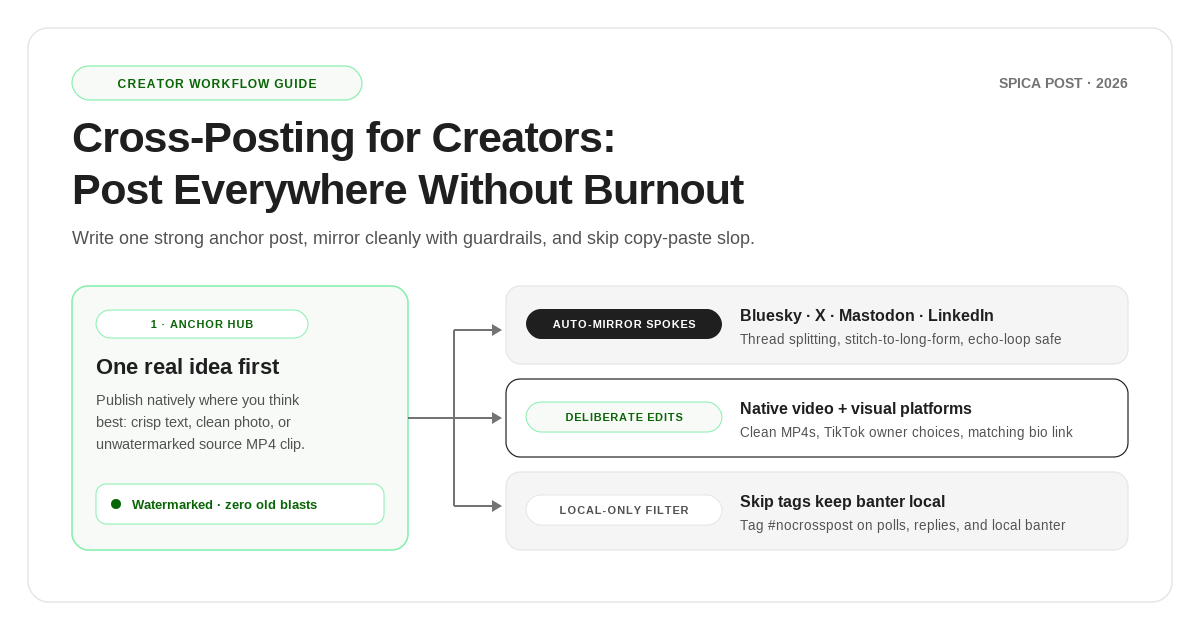
Cross-posting for creators works when you stop treating every social platform like a separate creative department and run a disciplined hub-and-spoke workflow instead: publish one strong anchor idea on the channel where you think clearest, let guardrailed mirroring carry clean text and photos to compatible spokes automatically, reserve deliberate manual edits for visual and video networks, and spend your reclaimed energy replying to real people. Done carelessly, cross-posting reads like robotic copy-paste slop; done with clear technical guardrails, it doubles or triples your distribution while protecting the creative energy that actually keeps people following you.
Independent creators and small businesses operate inside a fragmented audience map in 2026. Your readers, buyers, and peers are spread across Bluesky, X, Mastodon, LinkedIn, Instagram, TikTok, and YouTube Shorts, and very few followers check all seven apps every morning. Trying to invent original native concepts for five feeds every single day leads straight to hollow filler posts and mid-quarter burnout. Yet abandoning secondary networks quietly surrenders discovery, newsletter signups, and product orders you already earned through your core craft.
The solution is neither exhausting manual re-creation nor blind syndication dumps. This guide walks through the hub-and-spoke creator workflow, exactly when native Auto-Crosspost mirroring beats deliberate edits (and when it does not), character and thread mechanics across major platforms, skip tags and echo-loop safety, clean video reuse alongside TikTok’s owner-choice policy, copy-ready cross-platform adaptation examples, and a sustainable weekly energy budget.
Snapshot verified November 2026. Platform character limits, TikTok Content Posting API guidelines, and Spica Post Auto-Crosspost capabilities reflect published documentation verified in November 2026. Check Spica Post’s pricing page for current plan options and allowances.
Why creators burn out trying to feed every platform from scratch
Creators rarely quit because they ran out of ideas; they quit because distribution friction swallows the hours meant for making the work itself. Spending two hours writing a thoughtful breakdown, shooting a studio prototype, or recording a tutorial is rewarding. Spending the next ninety minutes re-formatting that same takeaway into six dashboards, hunting down broken aspect ratios, fixing mangled URLs, and rewriting six versions of the exact same hook is what drains morale.
The two traps that destroy audience trust
When energy dips, most creators swing between two broken extremes that both erode trust with their followers:
- Trap 1: The silent abandonment spiral. You try to run five native calendars by hand, hit one intense client week or product launch, fall behind on three platforms, feel guilty looking at dusty profiles, and eventually stop posting everywhere for a month.
- Trap 2: Unfiltered copy-paste slop. You wire up a blunt bridge that sprays every stray reply, platform-specific poll, raw
t.colink, mismatched@handle, and watermarked video clone onto every profile. Followers on Bluesky, Mastodon, or LinkedIn spot immediately that nobody is home, mute the account, and stop clicking your work.
Avoiding both traps requires separating creative authorship (which happens once per idea) from channel formatting (which follows predictable, repeatable technical limits). Once those two jobs stop fighting each other, posting across three or four platforms stops feeling like a second full-time job.
The hub-and-spoke workflow for sustainable creator cross-posting
The hub-and-spoke model gives every piece of content one home base and clear routing paths. Instead of asking “What do I owe six apps today?”, you ask “What is my one anchor idea today, and which spokes deserve an adapted version?”
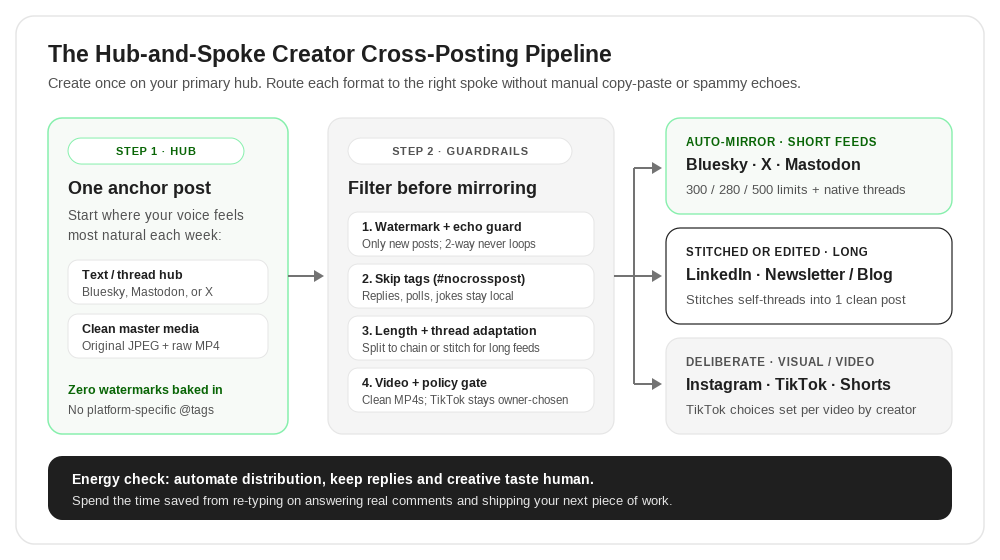
Step 1: Pick one primary anchor hub where your voice lives
Choose a single hub aligned with how you naturally create. Writers, newsletter authors, software builders, and consultants usually do best starting on a fast open text hub such as Bluesky, Mastodon, or X (note that starting natively on Bluesky or Mastodon avoids metered X read ceilings while mirroring outward cleanly). Visual makers, craftspeople, designers, and educators who teach on camera usually anchor around one clean master media folder: high-resolution JPEGs and unwatermarked vertical or horizontal MP4 exports saved before any social app touches them.
Step 2: Classify every spoke into two lanes (mirror vs. deliberate edit)
Not every platform accepts the same mechanics, and forcing one rigid workflow onto all of them causes friction. Split your spoke accounts into two clear lanes so you always know what runs automatically and what earns three minutes of deliberate care:
| Spoke lane | Best-fit platforms | What moves automatically vs. deliberately | Main technical limit to respect |
|---|---|---|---|
| Lane A: Guardrailed Auto-Mirror | Bluesky, X, Mastodon, LinkedIn (personal destination) | Text, expanded clickable links, up to 4 clean photos, compatible MP4 clips, native thread splits, and stitched self-threads | X 280 weighted chars (URL=23); Bluesky 300 graphemes / 3,000 bytes; Mastodon 500 chars; LinkedIn 3,000 chars |
| Lane B: Deliberate Visual / Video Spokes | Instagram, TikTok, YouTube Shorts, Pinterest | Reuse your clean raw photo or unwatermarked MP4 master, then tailor the opening hook, cover frame, bio pointer, and native privacy choices | Instagram JPEG/MP4 + bio link; TikTok per-post owner choices; YouTube 100-char title + visibility |
| Lane C: Local-Only Banter (Never Cross-Post) | Whichever app you are currently chatting in | Replies to other people, platform polls, live audio rooms, algorithm meta-jokes, and handle-specific shoutouts | Filtered out automatically via excluded replies/reposts plus #nocrosspost skip tags |
Keeping your ecosystem capped at one hub plus two or three active spokes is plenty for almost every solo creator. Adding a fifth or sixth spoke only makes sense once your existing lanes run smoothly and you still have five minutes a day to answer comments there.
Native Auto-Crosspost mirroring vs. deliberate edits
The biggest decision in creator cross-posting is knowing where automatic mirroring saves real hours without hurting quality, and where a two-minute manual or AI-assisted edit pays off significantly.
When native Auto-Crosspost mirroring wins
Native auto-crossposting shines for spontaneous, conversational, text-and-photo ideas: observations from your workbench, build-in-public progress shots, newly published articles, workshop dates, or short tactical threads. If you type a sharp three-sentence insight inside the native Bluesky or X app while waiting for coffee, opening three other apps to paste and tweak it kills the momentum. With a guardrailed cross-poster watching your hub, that native post arrives cleanly on your compatible spokes minutes later, complete with expanded link cards and properly uploaded images.
Modern cross-posting engines also solve a problem that used to force manual rewriting: source thread stitching. If you publish a four-part native self-reply thread on Bluesky, Mastodon, or (opt-in) X walking through how you priced a client project or solved a design problem, a thread-stitching mirror chains your self-replies onto the root post (while ignoring replies to other users) and either preserves the exact native reply chain on short-form spokes or stitches the paragraphs into a single clean, cohesive LinkedIn post. You write the thought once in a conversational thread and get a readable long-form LinkedIn update without opening a second tab.
When deliberate edits beat automatic mirroring
Automatic mirroring is the wrong tool for four specific creator posts:
- Product launches and sales threads with specific calls to action. On Bluesky, Mastodon, X, and LinkedIn, clickable links sit cleanly inside the post body or reply; on Instagram and TikTok, readers need an exact button name pointing to your bio Link Page (see our creator posts-to-orders guide). Spend three minutes tailoring the call to action for each destination instead of pasting “link in bio” onto LinkedIn or dropping a raw URL into an Instagram caption where nobody can tap it.
- Posts centered around tagging specific collaborators or brands. A creator’s handle on X (
@maramakes), Bluesky (@maramakes.com), Mastodon (@mara@mastodon.social), and Instagram (@mara.makes.ceramics) almost never matches character for character. Mirroring a thank-you post full of raw@handlesleaves broken mentions or accidentally pings strangers on another network. Either tag#nocrosspostand write quick native shoutouts, or write collaborator names in plain English with their website link. - High-stakes client proof, case studies, or customer stories. Whenever a post features a client’s name, face, home, project, or direct quote, double-check that you have explicit written or verbal permission from that customer or collaborator for every channel where the story will appear. Some clients are delighted to be featured on LinkedIn but prefer not to appear on public X or TikTok feeds.
- Long-form essays or multi-slide visual carousels. A 10-slide Instagram educational carousel loses its punch if mirrored as four flat photos with half the context missing. Keep visual carousels intentional and link back to your full hosted article or Link Page across your text hubs.
Four technical guardrails that prevent copy-paste slop
Good intentions do not stop awkward cross-posts; technical guardrails do. Before connecting your primary creator accounts to any mirroring workflow, confirm four protections are active from minute one.
1. Length and thread adaptation across mismatched counters
Platform length limits look deceptively similar on paper until links, emoji, and accented characters enter the draft:
- X caps standard posts at 280 weighted characters, counting every URL as a flat 23 characters regardless of its real length while weighting many emoji and CJK characters at 2 (per X character counting documentation).
- Bluesky enforces 300 grapheme clusters and 3,000 UTF-8 bytes, counting the full visible link string and requiring explicit UTF-8 byte-offset rich-text facets so URLs stay clickable (per Bluesky ATProto rich-text documentation).
- Mastodon defaults to 500 characters on standard servers (with per-instance variations documented in Mastodon’s posting guide) and puts strong community weight on descriptive alt text for every image.
- LinkedIn allows up to 3,000 characters in a single post, folding text behind a “see more” button after roughly 210 characters.
Because an X post containing a 90-character link fits easily inside X’s 280 limit yet overflows Bluesky’s 300-grapheme limit once expanded, set an explicit length adaptation mode on every mirroring rule: split into a native chained thread (cleanly breaking at paragraph or sentence boundaries so no link gets chopped in half), trim neatly with an ellipsis, or skip short-limit destinations altogether. You can inspect exact character, grapheme, and byte math before publishing with our free Character Counter.
2. Skip tags, reply exclusion, and UTM hygiene
Every creator needs an effortless escape hatch for posts that belong strictly on one network. Keep replies to other users and plain reposts excluded at the source poller so your spoke followers never see half of a side conversation. Then standardize two or three case-insensitive skip tags (starting with #nocrosspost, plus optional tags like #xonly or #poll). Dropping #nocrosspost anywhere inside a post (or any part of a stitched thread) keeps it strictly on the hub where you typed it.
Watch your links too. If you cross-post a URL carrying ?utm_source=twitter from X onto Bluesky and LinkedIn, your website analytics misreport Bluesky and LinkedIn readers as X traffic, and the extra query string eats precious graphemes. Use short tracked links (such as /l/ short links) or neutral campaign parameters like utm_campaign=fall_workshop across mirrored updates, and leave “Originally posted on X” backlinks switched off on normal updates so your spoke posts read natively rather than advertising that they are leftovers.
3. Creation watermarking and two-layer echo-loop safety
Two classic automation disasters ruin creator reputations overnight:
- Back-catalog blasts: Turning on a new cross-posting rule and watching it dump your last twenty old posts onto Mastodon or Bluesky in sixty seconds. A properly built engine watermarks the rule at creation time, recording the current anchor point so zero historical posts ever mirror.
- Two-way ping-pong loops: Creators who enjoy posting natively on both Bluesky and X often set up a two-way mirror (Bluesky to X and X to Bluesky). Without strong loop protection, a mirrored copy looks like a “brand new post” on the destination and bounces right back to the origin. Confirm your tool enforces two-layer echo-loop protection: matching stored delivery receipts first, and comparing a 24-hour normalized text hash across both single posts and thread replies second.
4. Clean video reuse vs. TikTok’s owner-choice policy
Short-form vertical video is where creators save the most hours by cross-posting cleanly, provided they follow two non-negotiable habits:
- Always export and store one clean, unwatermarked master MP4. Never upload to TikTok, download the TikTok-watermarked file from your phone, and re-upload that logo-stamped video to Instagram Reels, YouTube Shorts, or Bluesky. Platforms downrank or flag visible rival logos, and your work looks recycled. Keep your raw edited MP4 inside your own media folder or asset library first.
- Respect TikTok’s per-post owner-choice policy. Under TikTok’s Content Posting API UX guidelines, third-party apps are prohibited from silently auto-posting videos with pre-selected defaults. The creator must explicitly review and choose each video’s visibility setting (public, friends, or private), comment/duet/stitch toggles, and commercial content disclosures before publishing. That is why a responsible cross-poster can mirror clean MP4 clips automatically to compatible feeds like Bluesky, X, Mastodon, LinkedIn, Instagram, Threads, Facebook, and YouTube (formatting titles neatly within YouTube’s 100-character limit) while intentionally skipping automatic background posting to TikTok so you set every TikTok video’s choices deliberately on the posting screen.
One anchor idea adapted cleanly across four spokes (copy-ready examples)
Notice how the core facts stay identical below while the opening line, length, and link behavior match how real people read each feed.
Anchor hub post (Bluesky or Mastodon, ~260 chars + 1 clean work photo)
Finished testing three matte glazes on this month’s stoneware pour-over cones after last batch crazed slightly along the rim. Switching to a slower cool-down cycle fixed it cleanly. 24 cones go into Friday’s kiln drop at 11 AM ET: [short link] (alt text: Three matte cream ceramic pour-over coffee cones resting on a wood studio table in daylight)
Auto-mirrored short spoke (X, fits cleanly under 280 weighted chars)
Finished testing three matte glazes on this month’s stoneware pour-over cones after last batch crazed slightly along the rim. Switching to a slower cool-down cycle fixed it cleanly. 24 cones go into Friday’s kiln drop at 11 AM ET: [short link]
Stitched or expanded long spoke (LinkedIn personal profile)
Small kiln tweaks usually solve bigger quality problems than buying expensive new materials.
Last month, four stoneware pour-over cones from our small-batch run developed faint hairline crazing along the top rim. Instead of scrapping the glaze recipe, I ran three test tiles this week and slowed the final cooling ramp by two hours. Every single test cone came out smooth and watertight.
Sharing the glaze test notes for fellow ceramicists and makers who run small electric kilns, plus early access details for Friday’s 24-cone drop: [short link]
Deliberate visual spoke (Instagram caption paired with the same daylight JPEG)
Fixed the rim glaze on Friday’s pour-over batch, and the matte finish finally looks right.
Last run had tiny hairline cracks on four cones, so I slowed the kiln cool-down by two hours this week. All 24 new cones passed inspection and go live Friday at 11 AM ET.
Tap “Friday Kiln Drop” at button #1 on my link page if you want a reminder ten minutes before doors open.
Notice that zero lines sound generic, zero links are broken on Instagram, descriptive alt text stays intact for Mastodon and Bluesky readers, and writing all four took under five minutes from one real studio update.
Protecting your energy and audience trust long term
Distribution tools exist to give you back studio hours, not to turn your accounts into automated noise machines. Three lightweight boundaries keep both your audience and your nervous system healthy.
Use Native Auto-Repost sparingly for other time zones
Reverse-chronological feeds like Bluesky and Mastodon move quickly, which means a useful tutorial or release posted at 9:00 AM Eastern vanishes before readers in Europe or Asia-Pacific open their phones. Instead of manually copying the same post twice (which makes your profile look repetitive), use Native Auto-Repost carefully on Bluesky, Mastodon, or X: boost eligible original posts once roughly 8 to 14 hours later, cap daily boosts conservatively, require a minimum gap between reposts, optionally add a minimum-likes threshold so only posts readers genuinely enjoyed get a second pass, and tag time-sensitive announcements (like “Live stream starting now”) with #norepost.
Keep replies and community presence 100 percent human
Audiences forgive an automated mirror immediately when the creator shows up warmly in the replies. Audiences unfollow fast when every comment goes unanswered for three weeks. Take ten minutes you saved by not manually re-posting across four tabs and spend those ten minutes replying to real questions inside your comments or a unified inbox. If you ever screenshot a follower’s encouraging reply or repost a customer holding your product, ask their explicit permission first before turning their words or face into content across other networks.
Run a 5-minute cross-posting audit every month
Once a month, open your three active spoke profiles as a stranger would and check four fast details:
- Link check: Do links resolve cleanly with real previews, zero
t.coleftovers, and accurate click tracking? - Thread check: Did any split thread cut awkwardly in the middle of a sentence or URL?
- Skip-tag check: Did any platform-specific joke, poll, or mismatched
@mentionleak onto another network? If so, add that word or hashtag to your skip-tag list. - Energy check: Are all active spokes bringing real replies, clicks, or orders? If one spoke feels draining and produces zero conversation after 90 days, pause that rule without guilt and focus on the channels that reward your craft.
Honest Spica Post trade-offs for creators (November 2026)
If you are weighing Spica Post Auto-crosspost alongside standalone cross-posters or manual schedulers, here is the exact November 2026 status for small businesses and creators:
- What is live today: Spica Post pairs planned studio/MCP scheduling with native Auto-Crosspost and Native Auto-Repost across X, Bluesky, Mastodon (any public server via dynamic OAuth + PKCE), and LinkedIn personal profiles (destination). Rules watermark on creation, share one poll per source account, enforce two-layer echo-loop protection, support
#nocrosspostskip tags, per-route appended hashtags, native thread splitting, source thread stitching (stitchThreads), quote-post controls, up to four photos, and MP4 video crossposting (automatically skipping TikTok auto-post to honor TikTok’s owner-choice policy). You also get a branded Link Page,/l/click-tracked short links, whole-account Bluesky analytics sync, and Bluesky replies inside the Unified Inbox. - Real trade-offs to weigh plainly: Background Auto-Crosspost and Native Auto-Repost are included on recurring plans (Studio, Pro and Agency) rather than the one-time Starter tier; check our pricing page for current rule caps, check intervals, and account allowances. Personal LinkedIn profiles work as destinations only because LinkedIn restricts personal feed reading (Company Page reading unlocks once LinkedIn review clears). Direct publishing and cross-posting connectors for Instagram, Facebook Pages, Threads, TikTok, YouTube, Pinterest, and Google Business Profile are built and completing platform approval or compliance audits; until those approvals clear across all workspaces, run your text-hub mirroring, Link Page, and planned campaigns in Spica Post while uploading native Reels and owner-configured TikToks from your clean master MP4s.
Pick your single anchor hub today, write down your two highest-value spokes, turn on creation watermarking and #nocrosspost filters, and reclaim the hours that belong back in your actual creative work.
Questions people ask
- Does cross-posting hurt creator engagement or reach on social platforms?
- Cross-posting hurts engagement only when it looks careless: broken t.co links, truncated sentences, irrelevant platform mentions, or baked-in competitor watermarks on video. When you adapt length cleanly, strip rival video logos, filter out platform-only banter with skip tags, and still reply to comments personally, audiences engage with the idea rather than worrying about where you typed it first.
- What is the hub-and-spoke workflow for creator cross-posting?
- In a hub-and-spoke workflow, you choose one anchor platform where your voice flows naturally and publish your strongest original idea there first. From that single anchor post, guardrailed mirroring pushes clean versions to compatible text spokes while visual or video spokes receive deliberate, format-matched adaptations from your clean source media.
- How do I stop an auto-crossposter from blasting my old posts or looping infinitely?
- Choose a cross-poster that sets a creation watermark the moment you activate a rule so zero historical back-catalog posts ever publish. For two-way rules (such as Bluesky to X and X to Bluesky), verify it uses two-layer echo-loop protection combining stored delivery receipts with a 24-hour normalized text fingerprint.
- Why should creators handle TikTok video publishing differently from automatic cross-posting?
- TikTok's Content Posting API enforces an explicit owner-choice policy on every video: the creator must choose visibility level, comment settings, duet and stitch permissions, and commercial content disclosures directly rather than letting an unattended background job pick defaults. Reuse your clean unwatermarked source MP4 across channels, and set TikTok choices intentionally per video.
- How do I keep platform-specific polls, replies, or jokes off my other social accounts?
- Exclude replies and reposts at the source level so casual back-and-forth stays where it started. For standalone updates that belong on one network alone, add a skip tag such as #nocrosspost (or custom tags like #xonly or #poll) so your mirroring rule logs the post as skipped automatically.
Sources
- TikTok Developer Docs: Content Posting API UX and Sharing Guidelines
- X Developer Docs: Counting characters and weighted URL lengths
- Bluesky ATProto Docs: Rich text, 300-grapheme and 3,000-byte limits
- Mastodon Documentation: Posting and status character limits
- Spica Post Auto-crosspost: live simulator, guardrails and network status