Crossposting
How to Cross-Post from X to Bluesky Automatically (2026 Guide)
Learn how to cross-post from X to Bluesky without breaking links, burning X read limits, blasting old posts, or causing two-way echo loops.
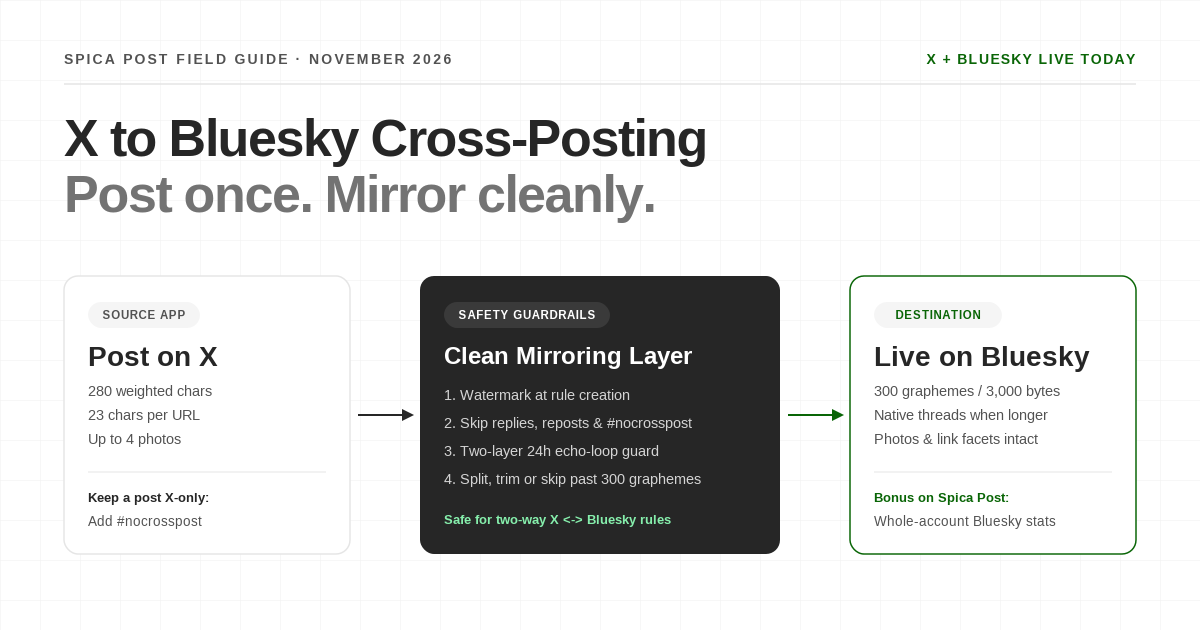
To cross-post from X to Bluesky automatically in 2026 without duplicating old tweets, clipping URLs or triggering ping-pong loops, connect both accounts to a watermarked native cross-poster such as Spica Post Auto-crosspost or MicroPoster, exclude replies and reposts on the X source, enable #nocrosspost skip tags, and configure a 300-grapheme adaptation rule (native thread splitting, clean trim or skip) so every X update lands on Bluesky looking native.
Small businesses and creators face a real split in 2026. Part of your audience, industry peers and press contacts never left X, while another fast-growing segment moved daily conversation to Bluesky. Writing the same update twice takes the spontaneity out of short-form posting, yet abandoning either network quietly cuts your reach in half.
The tricky part is not moving plain text from point A to point B. The tricky part is everything that breaks on week two: X shortening links behind t.co, Bluesky enforcing graphemes plus UTF-8 byte offsets, X metering API reads per returned post, and two-way rules echoing the same post back and forth until followers mute both accounts.
Snapshot verified November 2026. Platform character rules, API parameters and competitor prices reflect published documentation at verification time. Check each provider’s pricing page before subscribing, and check Spica Post’s pricing page for current plan tiers, poll cadences and account allowances.
Why naive X to Bluesky bridges break in 2026
A basic “when new tweet, post to Bluesky” zap or weekend script looks fine on its first three-word test and falls apart as soon as you publish real updates with links, emoji, photos or quotes. Every reliable X-to-Bluesky workflow has to solve four technical mismatches between the two networks.
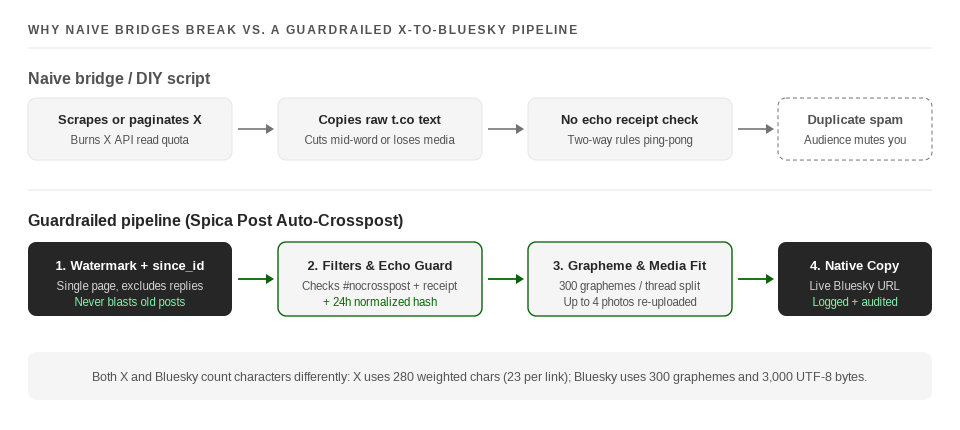
1. Character math does not match (weighted chars vs graphemes and bytes)
At first glance, Bluesky’s 300-character limit looks more generous than X’s 280-character limit. In reality, an ordinary X post can easily overflow Bluesky because the two networks measure length differently:
- X measures weighted characters. Every standard Latin character counts as 1, CJK characters and most emoji count as 2, and every URL counts as a flat 23 characters regardless of how long the actual destination address is (according to X’s character counting specification). A 245-character X post with one 90-character UTM link fits inside X’s 280 limit with room to spare.
- Bluesky measures graphemes and UTF-8 bytes. Bluesky’s ATProto
app.bsky.feed.postschema caps a post at 300 grapheme clusters AND 3,000 UTF-8 bytes, and clickable links require explicit UTF-8 byte-offsetfacetsrather than automatic raw text matching. Expand that same 90-character link out oft.coand your 245-character X post suddenly becomes 312 graphemes on Bluesky.
A naive bridge either fails with a 400 InvalidRecord error from Bluesky or brutally chops your URL in half, leaving a dead link on your profile. You can test exact strings across both counters right now in our free Character Counter.
2. Back-catalog blasts and X API read billing
X API v2 charges applications per post returned on timeline reads. If a bridge forgets to set a watermark on creation, or paginates backward across your timeline every few minutes, two bad things happen at once:
- Follower flood: Turning on a new rule blasts your last 10 to 50 old X posts onto Bluesky in a single burst, looking like a spam bot.
- Quota burn: Paginating timeline pages or pulling retweets and replies burns through X read allowances on posts you never intended to mirror.
A sound X poller sets a creation watermark immediately (reading zero history at setup), always requests since_id or start_time with exclude=retweets,replies, limits each poll to a single bounded page (max_results=10), and shares one poll per source account even if five different rules fan out from that same X profile.
3. Two-way ping-pong echo loops
Many founders and businesses want true flexibility: post natively in X when they are on X, post natively in Bluesky when they are on Bluesky, and have each side mirror the other. Without echo-loop protection, rule A copies post 1 from X to Bluesky, and ten minutes later rule B sees post 1 as a “brand new Bluesky post” and copies it right back to X.
Tracking only provider post IDs is not enough when posts get split into threads or trimmed slightly for length. Reliable two-way cross-posting needs two layers of echo protection:
- Layer 1 (Delivery receipt match): Every mirrored post stores the exact destination provider ID returned at publish time, so the reverse poller skips that ID immediately.
- Layer 2 (Normalized text fingerprint): Every outbound mirrored post (and every individual part of a mirrored thread) stores a 24-hour SHA-256 hash of normalized text with URLs and whitespace stripped. Even if a post changes slightly or wraps into a thread reply, the reverse rule recognizes its own echo and skips it.
4. Raw t.co links, dropped photos and reply noise
Nothing screams “lazy bot mirror” on Bluesky faster than a post ending in https://t.co/xyz123 with no link preview, a missing image attachment, or a stray @someone totally agree! reply torn out of context from an X conversation. Clean mirroring resolves expanded URLs into proper Bluesky link facets, downloads and re-uploads attached photos as native Bluesky blobs (up to four images per post), and filters out replies and reposts before they ever touch your Bluesky feed.
Never connect a cross-poster to your main brand accounts until you confirm four safeguards: creation watermarking, exclude=retweets,replies, expanded link facets with photo re-upload, and two-layer echo-loop protection.
Five ways to cross-post from X to Bluesky compared
Not everyone needs the same machinery. A solo creator who posts three spontaneous thoughts a day has different needs from a five-brand agency that mixes scheduled campaigns with live founder updates. The table below compares the five realistic approaches in 2026.
| Method | Best fit | Native X -> Bluesky auto-mirror | Thread split & skip tags | Echo-loop safe (2-way) | Published entry cost (Nov 2026) |
|---|---|---|---|---|---|
| Spica Post | Multi-brand teams, businesses & AI-assisted workflows | Yes (Studio, Pro and Agency) | Yes (up to 25 parts, 10 skip tags) | Yes (2-layer receipt + 24h hash) | Recurring plans (see pricing) |
| MicroPoster | Solo text-first creators (especially with Mastodon) | Yes (all plans) | Yes (#nocrosspost, #keephere, video) |
Yes | $12/mo Creator (4 accounts) |
| Central schedulers (Buffer) | Planned posts written in one dashboard | No (composer-first, not native X polling) | Composer-managed | N/A (publish-out only) | Free (3 channels); $6/mo per channel |
| Bridgy Fed | Open-web Mastodon <-> Bluesky bridging | No (X is not natively bridged via Bridgy Fed) | Protocol bridge, not X rules | Built for ATProto <-> ActivityPub | Free / donation-supported |
| DIY scripts / Zapier | Engineers maintaining custom single-account glue | Partial (requires own X API billing + ATProto code) | Custom code required | Easy to misconfigure | X API fees + automation tasks |
1. Spica Post Auto-crosspost
Spica Post combines native auto-crossposting with an AI-assisted publishing studio (over MCP and REST API), brand kits, team approvals and multi-brand isolation under one flat subscription. You post directly inside the native X app whenever inspiration strikes; Spica Post polls on a bounded cadence, applies your adaptation and skip rules, re-uploads up to four photos, and mirrors the post to Bluesky and LinkedIn (personal profile destination) automatically.
Where it fits best:
- You want both spontaneous mirroring and planned campaigns: Keep spontaneous X thoughts flowing to Bluesky via Auto-crosspost while planning promotions, carousels and approved client campaigns in the studio or via Claude, ChatGPT or Cursor over MCP.
- You run multiple brands or client accounts: Manage isolated brands and dozens of connected accounts under one login without paying per-channel multipliers, with an audit log tracking every mirrored URL and skip reason.
- You want built-in Bluesky growth visibility: Alongside mirroring, Spica Post syncs whole-account Bluesky posts and daily follower snapshots (using Bluesky’s public AppView) straight into Results, and lets you reply to Bluesky comments inside the Unified Inbox.
Real trade-offs:
- Not available on the one-time Starter tier: Background source polling runs on recurring plans only (check pricing for current Studio, Pro and Agency allowances and poll intervals).
- Current format boundaries: Auto-crosspost supports text, expanded links, quote-post controls, up to 4 photos, up to 10 skip tags, up to 10 per-route appended hashtags, and automatic native thread splitting up to 25 parts on X and Bluesky. It does not yet cross-post video files automatically or stitch an existing multi-tweet X thread into one long LinkedIn post.
- Remaining networks in review: X, Bluesky, Mastodon (any public server via OAuth dynamic registration) and LinkedIn (personal destination) require no waiting on central platform review. Instagram, Facebook Pages, Threads, Google Business Profile, YouTube, TikTok and Pinterest unlock as official app reviews clear.
- Monthly X read guardrails: Because X bills per returned post, Spica Post enforces a quiet login-wide monthly X-read ceiling on X-source polling so runaway usage never surprises you; if hit, X-source polling pauses cleanly until the next billing period while Bluesky-source rules keep running.
2. MicroPoster
MicroPoster is a focused native cross-poster built for solo writers across X, Threads, Bluesky, Mastodon (any custom instance) and LinkedIn (destination-only). You keep posting inside your favorite native app and MicroPoster mirrors eligible posts automatically.
Where it fits best: Solo creators who want a $12/month Creator entry tier (4 accounts, 7-day no-card trial), live Mastodon and Threads support today, video cross-posting, source thread-to-LinkedIn joining, and monthly logged-out shadowban reports (0 to 100 score).
Real trade-offs: MicroPoster tops out at 12 accounts on its $59/month Power tier, lacks team seats, internal approvals, brand isolation and an MCP server, and its /api page is still a waitlist as of November 2026 (see our side-by-side Spica Post vs MicroPoster comparison).
3. Central schedulers like Buffer
If you dislike posting inside the X app altogether, a central composer such as Buffer (free for 3 channels, then $6/month per channel on Essentials) lets you write a post once inside the scheduler, customize the Bluesky copy side by side, and push to both networks at the same timestamp.
Where it fits best: Teams that never post natively inside X and want 100% of publishing to start from a web calendar.
Real trade-offs: Central schedulers do not mirror what you type spontaneously inside the native X app on your phone. If half your best updates happen live inside X, a composer-only scheduler leaves your Bluesky account quiet until you remember to log in and paste them manually.
4. Bridgy Fed and Fediverse bridges
Bridgy Fed is a respected, open-source bridge that connects Bluesky (ATProto), Mastodon (ActivityPub) and independent IndieWeb sites so accounts can follow and reply across open protocols.
Where it fits best: Creators connecting Bluesky and Mastodon natively across open protocols at zero cost.
Real trade-offs: Bridgy Fed does not bridge X to Bluesky because X is a closed, metered API rather than a federated protocol. It solves Bluesky-to-Mastodon, not X-to-Bluesky.
5. DIY scripts, IFTTT and Zapier
Technically inclined operators sometimes wire up a cron job calling X API v2 and Bluesky’s com.atproto.repo.createRecord endpoint directly, or chain webhook automations in Zapier or Make.
Where it fits best: Developers who already pay for an X API developer tier for other products and want custom transformation logic (for example, pulling prices from an internal database before mirroring).
Real trade-offs: You pay X API developer fees directly, maintain OAuth 2.0 token refresh and Bluesky session rotation, write your own UTF-8 byte-offset facet parser for mentions and URLs, upload image blobs separately, and maintain your own echo-loop state table. For most small businesses and creators, maintaining custom bridge code costs more time in month two than a dedicated subscription costs all year.
Step-by-step: set up X to Bluesky auto-crossposting
Setting up a clean X-to-Bluesky rule takes about five minutes once both accounts are ready. Below is the exact workflow on Spica Post, whether you prefer clicking in the web studio, asking Claude or ChatGPT over MCP, or scripting against the /v1 REST API.
1. Connect X and Bluesky cleanly
Before creating any rule, connect both destination and source accounts under the right brand on your account page:
- Connect X via OAuth: Sign in with the exact X account you want to watch. If you manage multiple brands, sign out of X in your browser between connections so each brand links to the right handle.
- Connect Bluesky with an App Password: Generate a dedicated Bluesky App Password inside Bluesky Settings (under Privacy and Security -> App Passwords) rather than reusing your master account password. That way you can revoke access per tool at any time without locking yourself out of Bluesky.
Before turning mirroring on, run your Bluesky handle through our free Bluesky Visibility Checker to confirm your profile is publicly indexed, carries no unexpected moderation labels and resolves cleanly from Bluesky’s AppView.
2. Create a watermarked rule (Web, MCP or REST API)
On Spica Post, you can build the exact same rule three ways:
- In the web studio: Open
/crosspost, click New rule, choose your connected X account as the Source, and check your Bluesky account (and optionally LinkedIn) under Destinations. - From Claude, ChatGPT or Cursor over MCP: Ask your assistant: “Create a crosspost rule from my X account to my Bluesky account, split long posts into native threads, skip quote posts, and ignore anything tagged #nocrosspost.” Your assistant calls
crossposts_saveafter confirming your brand and accounts. - Over the
/v1REST API: Send a single authenticated request toPOST /v1/crosspostsusing your brand’s Bearer key:
POST /v1/crossposts
Authorization: Bearer sp_live_...
Content-Type: application/json

{
  "sourceAccountId": "acc_x_primary",
  "destinationAccountIds": ["acc_bsky_primary"],
  "adaptMode": "thread",
  "quoteMode": "link",
  "skipTags": ["#nocrosspost", "#xonly"],
  "appendTags": [],
  "includeBacklink": false,
  "enabled": true
}
The moment the rule saves, Spica Post writes a creation watermark. Zero historical tweets are read or copied, and X API read cost at creation time is $0.
3. Configure thread splitting, skip tags and quote posts
Before clicking save, review four settings that decide whether your Bluesky feed reads like a thoughtful human or a noisy mirror:
- Length adaptation (
adaptMode): Pickthreadto automatically split posts that exceed 300 graphemes (or 3,000 UTF-8 bytes) into a clean, native Bluesky reply chain (up to 25 parts),truncateto trim cleanly at a word boundary with an ellipsis, orskipto leave over-length posts off Bluesky entirely. - Skip tags (
skipTags): Keep#nocrosspostas your default and add up to 9 extra case-insensitive tags (for example#xonlyor#poll) for thoughts that only make sense on X. - Quote posts (
quoteMode): Picklinkto mirror your commentary plus a clean link to the quoted X post, orskipif your quote posts mostly reference X-only drama or inside jokes that confuse Bluesky followers. - Original backlink (
includeBacklink): Leave this off for everyday updates. AppendingOriginally on X: https://x.com/...to every Bluesky post hurts engagement on Bluesky and eats into your 300-grapheme budget. Turn it on only when citing an X-hosted poll or Spaces announcement.
4. Turn on safe two-way X and Bluesky rules
If you split your time natively between both apps, create a second rule with Bluesky as the Source and X as the Destination. Because Bluesky reads run against Bluesky’s public AppView at $0 read cost, mirroring Bluesky to X uses zero X-read allowance (destination writes count toward your standard monthly X posting allowance).
With both rules active, two-layer echo-loop protection keeps every post strictly single-hop: post on X and it lands once on Bluesky; post on Bluesky and it lands once on X; neither side ever bounces back.
If you plan to post frequently and want lower X API read consumption, flip your primary habit: write native posts on Bluesky first and mirror them to X. Bluesky source polling costs zero X reads, and 300-grapheme posts split cleanly at X’s 280 weighted limit when needed.
How text, links, photos, threads and quotes actually translate
Seeing how each format transforms before you turn on live automation prevents awkward formatting surprises on day one. You can also test real sample copy interactively in the browser simulator on our Auto-crosspost page.
| Source post type on X | What happens on Bluesky | Recommended rule setting |
|---|---|---|
| Standard text post (under 260 chars, no URL) | Mirrors 1:1 as a single native Bluesky post | Any adaptMode works identically |
| Post with long URL (fits X’s 23-char link weight, exceeds 300 graphemes expanded) | Expands URL into a clickable Bluesky facet; splits into 2-part thread or trims | adaptMode: "thread" (or shorten URLs with /l/<code> short links) |
| Post with 1 to 4 JPEG/PNG photos | Downloads and re-uploads up to 4 images as native Bluesky embeds | Default automatic behavior |
| Post with native X video | Video is not yet auto-mirrored by Spica Post’s crosspost engine | Publish video posts directly from composer/MCP or use MicroPoster |
| Reply to another user or plain repost/retweet | Excluded automatically at poll time (exclude=retweets,replies) |
Keep excluded so Bluesky stays clean |
| Quote post | Mirrors your commentary + quoted link, or skips completely | quoteMode: "skip" for casual banter; "link" for commentary on news |
Post tagged #nocrosspost |
Logged as skipped; never touches Bluesky | Keep #nocrosspost in skipTags |
Long post with appended hashtags (appendTags) |
Appends non-duplicate hashtags up to 10 tags, then adapts to 300 graphemes | Keep appendTags sparse (0 to 2 niche tags max) |
Handling URLs, UTM parameters and click tracking
Long tracking links like ?utm_source=twitter&utm_medium=social&utm_campaign=fall_launch are the number one reason X posts spill past Bluesky’s 300-grapheme limit. Worse, if you cross-post a utm_source=twitter link onto Bluesky, your website analytics misattribute Bluesky traffic to X.
Two clean habits fix both problems at once:
- Use clean, short links. Shortening a 110-character product URL to a short branded link saves 80+ graphemes on Bluesky while giving you click counts on networks that hide outbound link metrics.
- Avoid platform-specific UTM tags inside cross-posted copy. Use a campaign-level parameter (such as
utm_campaign=winter_tuneup) or a tracked link page instead of hardcodingutm_source=twitterinto a post headed for Bluesky.
Handling @mentions across different handles
Your X handle (@acmebakery) and your Bluesky handle (@acmebakery.bsky.social or @acmebakery.com) rarely match another person’s handle identically. If you write a post thanking @partnerhandle on X, that exact @handle will not link to the right person on Bluesky, and may accidentally ping an unrelated account.
When a post centers around tagging specific people on X, add #nocrosspost and write a quick native version on Bluesky with their real Bluesky handle, or use their business name in plain text instead of an @ handle.
Keeping your Bluesky audience engaged (not feeling like a mirror)
Bluesky users notice immediately when an account treats the network as a cold syndication dump. Cross-posting saves you the mechanical re-typing, not the human presence. Three habits make mirrored accounts actually grow on Bluesky.
1. Filter out network-specific chatter aggressively
Posts about X algorithms, X polls, X Spaces reminders, or replies complaining about X features feel jarring on Bluesky. Train yourself to drop #nocrosspost at the end of anything platform-specific. Better yet, add custom skip tags like #spaces or #xpoll to your rule once so you never have to remember.
2. Use Native Auto-Repost responsibly for global time zones
A single post in a reverse-chronological feed like Bluesky disappears within hours for followers in Europe, Latin America or Asia-Pacific. Rather than posting the same link twice (which clutters your profile), use Native Auto-Repost (available on Spica Post Studio, Pro and Agency, as well as MicroPoster) to boost eligible Bluesky posts once after a chosen delay (for example 8 to 14 hours later).
Set conservative guardrails: a low daily cap, minimum spacing between boosts, an optional minimum-likes filter so only posts people actually responded to get surfaced a second time, and a #norepost skip tag for time-sensitive announcements like “flash sale ends at 5 PM.”
3. Show up in replies and measure whole-account Bluesky growth
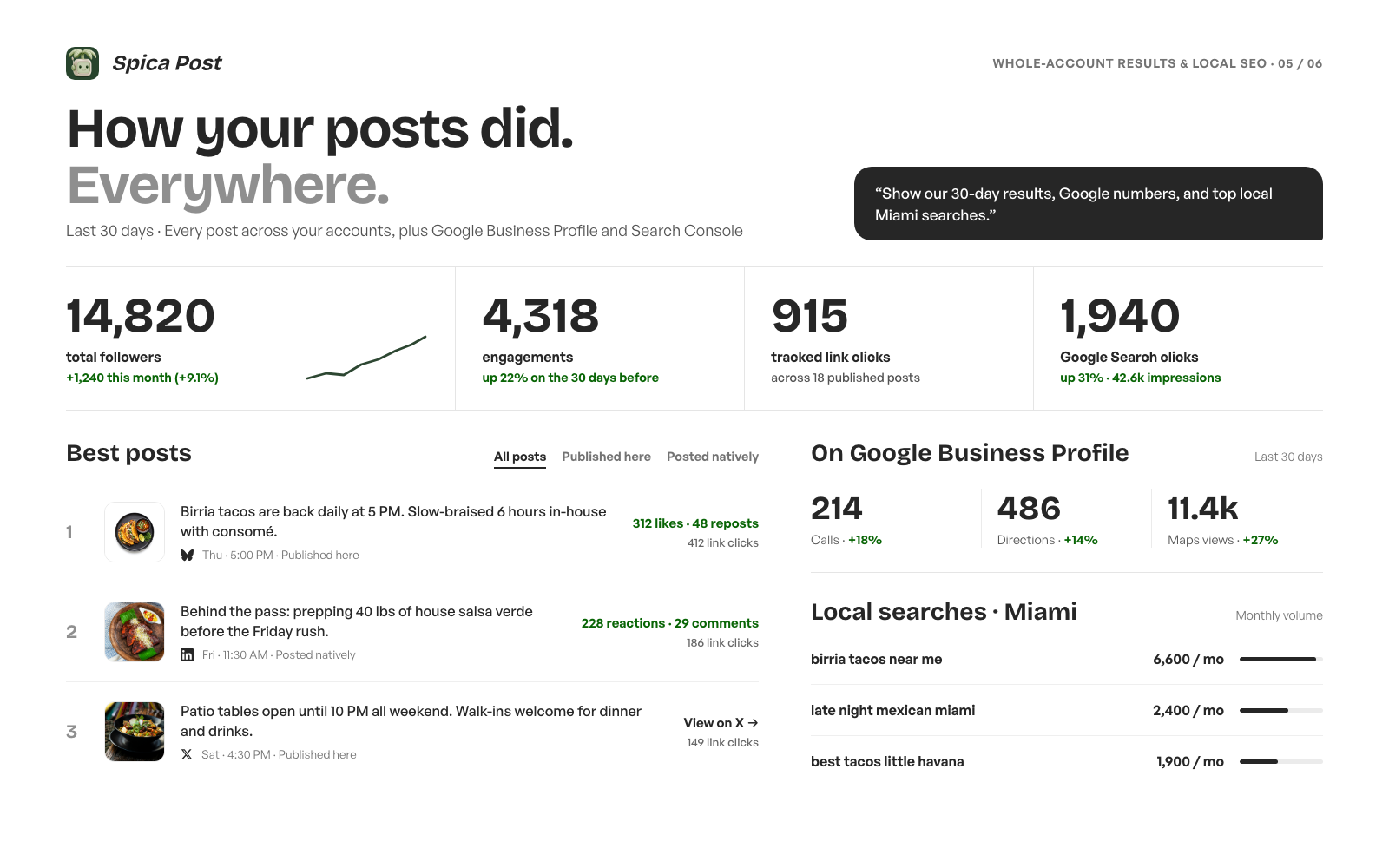
Cross-posting gets your updates onto Bluesky; replying to people who respond turns impressions into customers and followers. Because Spica Post pulls Bluesky comments into the Unified Inbox and runs whole-account Bluesky analytics sync (capturing both Spica-published and natively posted updates, daily follower growth snapshots, engagement rates and best-performing formats), you can spend ten minutes a day answering real Bluesky conversations and seeing which topics actually move your follower curve.
Automate publishing, never automate genuine conversation. Spend the 15 minutes you save from copy-pasting each week replying to Bluesky comments and following peers in your niche.
Which setup should you pick? (Shortlist)
Match your daily routine to the cleanest option:
- You run a small business, creator brand or multi-brand agency and want X -> Bluesky auto-crosspost plus AI-assisted planning, team approvals, link pages and analytics in one flat plan: Start with Spica Post (see Auto-crosspost and pricing).
- You are a solo text-first creator who needs Mastodon, live Threads, video cross-posting or monthly shadowban checks today at a $12/month entry price: Start with MicroPoster (compare details on our MicroPoster comparison page).
- You never write inside the native X app and prefer drafting every post inside one web calendar for three or fewer channels: Start with Buffer’s free tier.
- You only want to bridge Bluesky and Mastodon across open protocols (no X): Use Bridgy Fed.
5-step safety test before turning on live cross-posting
Run this five-minute validation sequence before leaving any cross-posting rule unattended on a customer-facing brand:
- Audit your Bluesky handle first. Run your handle through the Bluesky Visibility Checker to confirm public indexing and clean label status.
- Test your rule settings on sample copy. Paste a short update, a 270-character post with a long URL, and a
#nocrosspostdraft into the browser simulator on /crosspost/ to verify whetherthread,truncateorskipproduces the output you expect. - Turn on one-way X -> Bluesky first and verify watermarking. Save the rule, wait one poll cycle, and check the activity log to verify zero historical tweets were mirrored.
- Publish two controlled live tests on X. Post one short update tagged
#nocrosspost(confirm it shows as Skipped in the log) and one normal photo post with a link (confirm the Bluesky copy carries the expanded clickable link facet and crisp uploaded image). - Only then add the reverse Bluesky -> X rule (if needed). Wait two full poll cycles after one test post from Bluesky to confirm the mirrored X post never echoes back onto Bluesky.
Questions people ask
- Does auto cross-posting from X to Bluesky republish all my old tweets?
- Not if the tool watermarks your rule at creation time. A properly built cross-poster records the current timestamp or latest post ID when you turn the rule on and ignores everything published earlier, so your Bluesky followers never get flooded with back-catalog posts.
- Can I run two-way cross-posting between X and Bluesky without creating an infinite loop?
- Yes, provided the engine uses echo-loop protection. Spica Post combines two layers: it checks every polled post against stored Spica delivery receipts and compares a 24-hour normalized text hash across both single posts and thread replies, so a mirrored post is never copied back to its origin.
- What happens when an X post with links or emoji goes over Bluesky's 300-grapheme limit?
- Because X counts every URL as 23 weighted characters while Bluesky counts the full expanded URL against 300 graphemes and 3,000 UTF-8 bytes, a post that fits X can overflow Bluesky. Choose an adapter mode: split automatically into a chained Bluesky thread, trim cleanly with an ellipsis, or skip that destination.
- How do I keep an X-only reply, poll or inside joke off Bluesky?
- Good X source pollers exclude replies and reposts by default so casual conversations stay on X. For standalone posts that belong on X alone, include a skip tag such as #nocrosspost anywhere in the text and the rule skips that update automatically.
- Do photos and quote posts carry over from X to Bluesky?
- Up to four attached photos can be fetched and re-uploaded cleanly to Bluesky as native image embeds. For quote posts, pick a rule setting that either mirrors your commentary with a link to the quoted post or skips quote posts completely. Native video auto-crossposting depends on the tool and is not yet supported in Spica Post's crosspost engine.
Sources
- X Developer Docs: Counting characters and weighted URL lengths
- X Developer Docs: X API v2 user timelines and exclude parameters
- Bluesky ATProto Docs: Rich text, 300-grapheme and 3,000-byte limits
- Spica Post Auto-crosspost architecture and supported controls
- Spica Post live pricing, plans and allowances
- MicroPoster pricing, accounts and cross-posting features (verified Nov 2026)
- Buffer pricing and per-channel scheduling tiers (verified Nov 2026)
- Bridgy Fed documentation: decentralized social network bridging