Insurance agents
Social Media for Insurance Agents: Plain Explainers That Win Trust
Move past dry rate ads. Win local referrals with plain-English coverage explainers, LinkedIn and Google habits, and clean compliance guardrails.
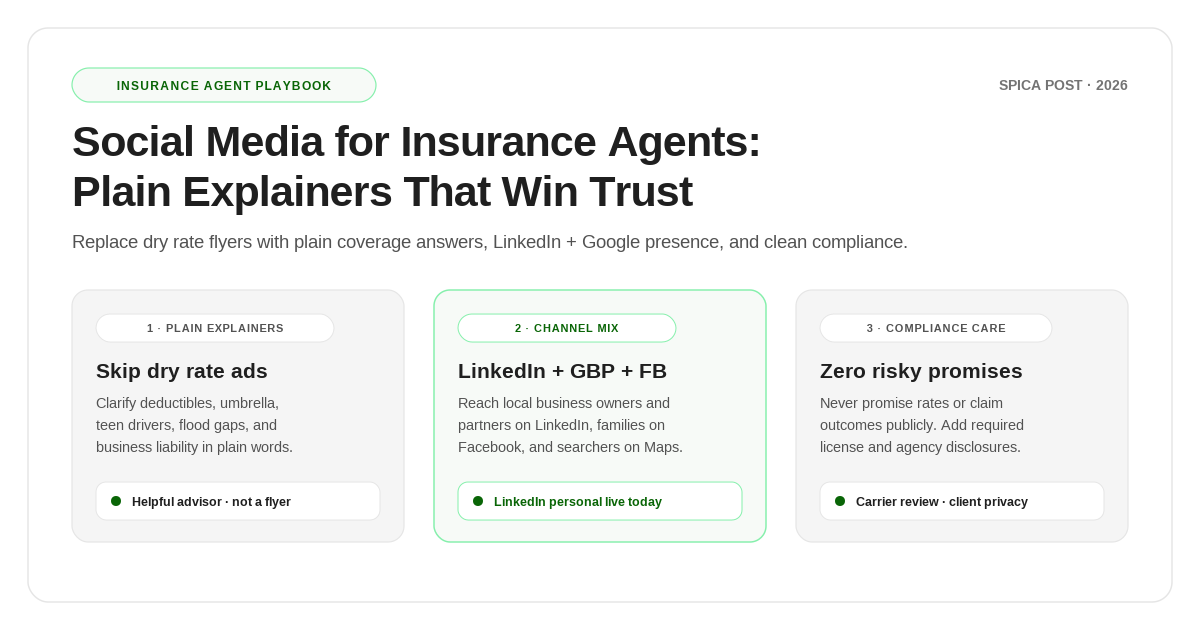
Social media for insurance agents earns warm calls and steady referral partners when you retire stock graphics saying “Bundle and Save! Call for a Free Quote!” and publish plain-English coverage explainers on LinkedIn, Google Business Profile, and Facebook. Homeowners, parents, and small business owners rarely enjoy shopping for policies, yet they constantly worry about gaps they only discover after a roof claim, a flooded basement, or a teen driver’s first fender-bender.
The insurance profession rests on credibility, plain communication, and strict compliance. Writing two short posts a week that translate deductible math, umbrella limits, flood exclusions, and commercial auto gaps into everyday language builds quiet authority months before renewal notices arrive. Pair that voice with clean state and carrier compliance guardrails plus one secure intake link, and locals reach out to you directly instead of submitting their phone number to noisy quote aggregators.
This guide covers four profile trust leaks to fix first, the 2026 LinkedIn, Google Business Profile, and Facebook mix, a 10-post trust content framework, compliance and privacy guardrails, four copy-ready educational captions, a four-season coverage calendar, and a 25-minute weekly routine.
Fix four profile and trust leaks before posting another update
Inspect your social profiles and Google listing like a cautious homeowner or local mortgage lender checking you out after hearing your name at a neighborhood meeting:
- Unclear licensed states, cities, and lines of coverage. Generic slogans like “Protecting what matters” tell nobody where you are licensed. Put your lines and geography in bio line one (for example, “Licensed Home, Auto & Small Business Insurance Agent · Serving Austin & Licensed in TX · [Agency Name]”).
- Missing agency identity and required disclosures. Display your full legal agency name, independent or carrier affiliation, licensed state(s), and any required license number cleanly across your bios and Link Page per your state department of insurance standards.
- An outdated Google Business Profile or careless review replies. Local searchers check reviews before dialing an agent (see Google Business Profile guidelines for individual practitioners to confirm how your office structures agency and practitioner listings). Reply warmly to every review while never confirming private policy details, claim facts, or coverage status publicly (see our Google review response guide).
- No secure, calm next step. Asking prospects to “DM me your policy!” creates privacy and compliance risk. Use one clean Link Page in every bio holding three buttons: Book a 15-Minute Coverage Review, Upload a Declarations Page Securely (linking to your agency’s encrypted portal), and Office Phone & Hours.
The LinkedIn, Google Business Profile, and Facebook channel mix in 2026
Commercial accounts and neighborhood families live on different networks. Matching each platform to its real audience keeps your effort calm and focused.
| Channel | Who is actually paying attention | Best weekly job for an insurance agent | Current Spica Post status (Nov 2026) |
|---|---|---|---|
| LinkedIn (personal profile) | Small business owners, contractors, real estate agents, lenders, CPAs | Weekly plain-English commercial liability, umbrella, and risk explainers + partner shoutouts | Live direct publishing today |
| Google Business Profile | Locals comparing agents, checking reviews, hours, and licensed lines | 1 weekly seasonal readiness or coverage note + privacy-safe review replies | Built and enabled in production; awaiting first live service-area profile verification |
| Facebook Page | Local homeowners, parents of teen drivers, retirees, neighborhood groups | Family coverage explainers, severe weather checklists, local community notes | Built; completing Meta App Review |
| Bluesky / X / Mastodon | Local news followers, civic voices, small businesses and creators | Timely storm-prep checklists, plain FAQ threads, links to educational guides | Live direct publishing and Auto-crosspost today (Bluesky Unified Inbox live) |
| Instagram / YouTube Shorts | Visual learners and younger first-time homebuyers | Optional: 30-second talking-head answer to one common coverage myth | Built; Meta App Review and YouTube compliance audit completing |
| Branded Link Page | Curious readers checking credentials or requesting a review | Holds Secure Intake Portal, 15-Min Review Calendar, Licensed States, Disclosures | Live today in Spica Post on your own link or custom domain |
For most local producers, LinkedIn personal profiles, Google Business Profile, and Facebook form the strongest three-part engine. While dozens of agents paste identical carrier flyers onto Facebook, very few show up weekly on LinkedIn helping business owners, realtors, and lenders spot coverage gaps (see our LinkedIn guide for small business owners).
The 10-post trust mix beyond rate flyers
When every post begs for a quote, locals mute you. When nine of ten posts clarify everyday coverage questions, readers save them, share them with family, and call your office first when renewals climb.
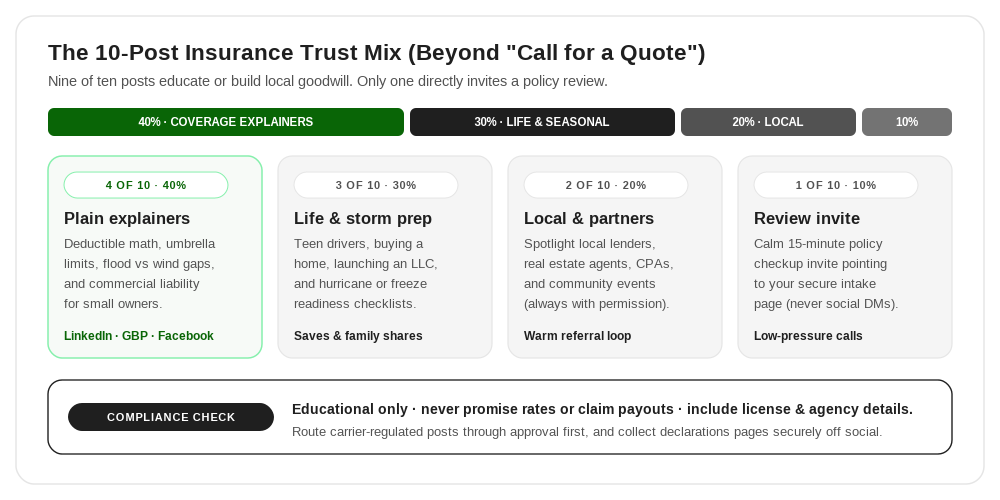
4 of 10 posts: plain-English coverage explainers
Turn real desk questions into crisp 120-to-180-word educational posts grounded in consumer basics like the NAIC consumer insurance guides:
- Deductible math: Explain how a flat $1,500 deductible differs from a 2 percent wind/hail deductible calculated on a $400,000 dwelling limit ($8,000 out of pocket, subject to policy terms).
- Personal umbrella liability: Explain when standard auto and home liability limits can run out during a multi-car crash or backyard injury, and how an umbrella layer sits above underlying policies.
- Storm, wind, and separate flood gaps: Clarify why standard homeowners policies generally exclude rising surface water and flood damage, and note that separate flood policies often carry waiting periods.
- Small business liability and commercial auto: Explain why personal auto policies frequently exclude regular deliveries or LLC-titled work vans, and what a landlord’s certificate of insurance (COI) requires before handing over keys.
3 of 10 posts: life-event and seasonal checklists
Build short, shareable checklists around moments that trigger policy reviews: adding a newly licensed teen driver, buying a first home or remodeling a kitchen, starting a home-based business, or preparing for hurricane, hail, wildfire, or winter pipe-freeze season.
2 of 10 posts: local community and referral partner spotlights
Highlight a respected local real estate agent, lender, CPA, roofer, or community drive twice a month (always with their explicit welcome and permission). Warm local spotlights deepen referral partnerships far better than cold pitches, matching the playbook in our real estate agent social media guide.
1 of 10 posts: calm agency introduction and review invite
Once a month, describe simply how your 15-minute review works, which states and lines you serve, and how prospects send declarations pages through your secure portal rather than social DMs.
Compliance, carrier approval, and client privacy guardrails
Insurance is a regulated profession where one sloppy social claim invites state department complaints, carrier contract trouble, or E&O risk. Apply three firm guardrails before anything goes live.
Never guarantee coverage outcomes or promise specific rates publicly
Under state insurance marketing standards and federal truthfulness principles (FTC advertising and marketing basics), never write blanket promises like “Save 30 percent guaranteed” or “Every storm claim paid in full.” Rates, eligibility, exclusions, and claim outcomes always depend on underwriting, state filings, and the issued contract. Frame every post clearly as general education noting that terms and availability vary by state and carrier.
Follow licensing disclosures and carrier advertising review
- Show required identification: Include your name, full agency name, licensed states, and license number wherever your state or carrier requires it.
- Route regulated lines through compliance review: Captive agents, agencies using carrier logos, and producers touching heavily regulated products (such as Medicare Advantage/Part D under CMS marketing standards or variable life/securities under FINRA) must obtain formal carrier or compliance pre-approval before publishing.
- Maintain an agency archive and review trail: In multi-producer agencies, route drafts through a principal or compliance reviewer before publishing and keep clean records per state recordkeeping requirements.
Protect client privacy and obtain explicit written permission
- Never collect personal details in comments or social DMs: Route driver’s licenses, VINs, dates of birth, SSNs, and declarations pages strictly to your encrypted agency portal or phone line.
- Require explicit written permission for client stories or photos: Never publish identifiable client names, photos, claim details, or reviews without explicit written consent and state testimonial checks. Better yet, strip all identifiers and frame lessons as general illustrative examples.
Four copy-ready captions for insurance agents
Adapt every bracketed line to your licensed states, attach your required disclosure footer, and route through carrier or compliance review whenever required.
1. Plain-English deductible explainer (homeowners)
Quick 60-second check before storm season in [State]: does your homeowners policy carry a flat deductible or a percentage wind/hail deductible?
A flat $1,500 deductible stays $1,500. A 2 percent wind/hail deductible is generally calculated on your home’s insured dwelling limit, not the repair estimate (for instance, 2 percent of a $400,000 dwelling limit equals $8,000 out of pocket, subject to policy terms).
Checking page one of your declarations page today takes two minutes and prevents surprises later. Want a calm 15-minute walkthrough? Use the secure booking link in my bio.
[Educational overview only; policy terms, exclusions, and availability vary by state and carrier. Your Name · Agency Name · Licensed in State(s) · License # if required.]
2. Storm and flood coverage gap checklist
One surprise homeowners frequently meet after heavy rain in [City / County]: standard homeowners policies generally exclude flood damage from rising surface water.
Three quick checks while skies are clear:
Questions about how your current policy reads? Grab a calm review slot at the secure link in my bio.
[General educational information; review your policy contract for exact terms. Agency Name · Licensed in State(s) · License #.]
3. Adding a teen driver (family life-event post)
Counting down to a newly licensed teen driver in [City] this spring? Four practical steps before their first solo drive:
- Notify your agent promptly upon learner’s permit or full licensure so household driver records stay accurate.
- Ask which education-based credits (such as good-student or approved driver-training discounts) may be available with your carrier in [State].
- Review your auto liability limits and whether a personal umbrella policy makes sense as household exposure grows.
- Set clear family driving agreements around night hours, passengers, and phone-free dashboards.
Planning ahead for a new driver? Tap my bio link for a no-pressure planning call.
[Informational purposes only; eligibility and discounts vary by carrier and state. Agency Name · Licensed in State(s) · License #.]
4. Small business liability explainer (built for LinkedIn personal profiles)
Note for local small business owners and contractors in [City] signing a commercial lease or adding a work vehicle this quarter:
Two coverage gaps surface constantly during commercial reviews:
Expanding a shop, hiring a crew, or renewing coverage in [State]? Glad to walk through your declarations page in plain English. Secure review link in my profile.
[Educational overview only; actual coverage is governed by issued policy terms. Your Name · Agency Name · Licensed in State(s) · License #.]
Four-season calendar and five common mistakes
Post two to three times weekly (Tuesday explainer on LinkedIn and Google, Thursday checklist or partner spotlight on Facebook and LinkedIn, plus an occasional review invite).
| Season | What families and business owners face | Timely educational themes |
|---|---|---|
| Winter (Jan to Mar) | Frozen pipes, heater safety, tax-season LLC launches, annual audits | Pipe-freeze prep; home-office & small business checks; reading renewal letters calmly |
| Spring (Apr to Jun) | Severe hail storms, teen graduations, peak home-buying season | Flat vs percentage hail deductibles; homebuyer binder checklist; teen driver planning |
| Summer (Jul to Sep) | Hurricane/wildfire readiness, flood waiting periods, boats/RVs, dorms | 2-minute cloud home inventory; on- vs off-campus college renters; rental car basics |
| Fall and Holidays (Oct to Dec) | Year-end commercial renewals, kitchen safety, high-value gifts | Scheduling jewelry/gifts on home policies; commercial year-end payroll/fleet updates |
Avoid these five frequent missteps:
- Pasting identical carrier flyers with zero personal voice. Two short plain paragraphs in your everyday voice outperform clip art every time.
- Dropping jargon without a plain example. Translate “coinsurance”, “actual cash value”, or “split limits” in one concrete sentence immediately.
- Discussing private quote facts in public comments. Move personal inquiries straight to your secure booking link or office phone line.
- Ignoring LinkedIn personal profiles. Commercial accounts, real estate agents, lenders, and CPAs live on LinkedIn every weekday.
- Skipping pre-publish compliance checks during busy weeks. Batching two weeks of educational drafts ahead keeps review calm and consistent.
A 25-minute weekly routine and honest Spica Post trade-offs
- Log real questions (3 minutes): Jot down one genuine coverage question a caller asked this week, stripping all identifying details.
- Draft and compliance-check (20 minutes): Write two or three plain explainers with your disclosure footer, confirm zero rate or payout promises, route through principal or carrier review if required, and queue them.
- Reply safely (2 minutes): Answer new Google reviews without private policy details and leave two helpful comments on local partners’ LinkedIn posts.
Honest trade-offs if you consider Spica Post
If you are evaluating Spica Post for insurance agents, here is the transparent November 2026 status for small businesses and creators:
- Live today: Spica Post publishes directly to LinkedIn personal profiles (ideal for commercial producers and referral networks), plus X, Bluesky (with live Unified Inbox replies), and Mastodon, with Auto-crosspost,
/l/click-tracked short links, a branded Link Page holding your secure intake link, review calendar, and license disclosures, and an internal approval queue with workspace audit logs (on Studio, Pro and Agency) so agency principals can review producer drafts before anything publishes. - Built and completing network review: Because Google Business Profile and Facebook Pages also serve local families heavily, note plainly that Spica Post’s connectors for Google Business Profile (approved and enabled in production, awaiting first live service-area profile verification), Facebook Pages, Instagram, Threads, TikTok, Pinterest, YouTube, and LinkedIn Company Pages are built and finishing platform review/verification. Until Meta and Google direct publishing open across every workspace, run your LinkedIn personal workflow, approvals, and Link Page in Spica Post while copying your approved weekly explainer natively to Facebook and Google in two minutes. Review flat workspace plans on our pricing page.
Publish one clear 150-word explainer this week answering the single coverage question clients asked you most last month, attach your disclosure footer, and share it on LinkedIn and Google. Clarity earns more trust in insurance than any slogan ever could.
Questions people ask
- Why do generic 'Call me for a free quote' posts rarely work for insurance agents?
- Most local families and small business owners only switch insurance during renewal shock, a move, a new teen driver, or starting a business. Generic rate banners give them zero reason to remember your name during the eleven months between renewals, whereas plain-English coverage explainers make you the trusted advisor they call first when life changes.
- Which social platforms bring the best clients and referrals for insurance agents in 2026?
- A strong mix pairs your LinkedIn personal profile for local business owners, real estate agents, lenders, and CPAs with Google Business Profile for active local searchers and reviews, plus Facebook for neighborhood homeowners, auto renewals, and local family questions.
- What compliance guardrails must insurance agents follow on social media?
- Never guarantee claim outcomes, imply automatic coverage, or promise specific savings or rates publicly. Keep posts clearly educational, include required agency name, licensed states, and license numbers where applicable, route carrier-regulated content through compliance approval before publishing, and never collect sensitive personal documents in public comments or standard social DMs.
- Can insurance agents share client claim stories or customer photos on social media?
- Only with explicit written permission from the client, careful redaction of private policy details, and adherence to carrier and state privacy requirements. Many agents avoid identifying specific claims altogether and instead share generalized educational scenarios clearly framed as illustrative examples.
- How many times per week should an independent or captive insurance agent post?
- Two to three thoughtful posts per week beat daily carrier stock graphics every time. Aim for one plain-English coverage explainer, one seasonal or life-event checklist, and one local community spotlight or calm policy-review invitation each week.
Sources
- National Association of Insurance Commissioners (NAIC): Consumer Insurance Guides
- Federal Trade Commission (FTC): Advertising and Marketing Basics
- Google Business Profile Help: Guidelines for representing your business (individual practitioners)
- Spica Post for Insurance Agents: weekly workflow and examples