LinkedIn for Small Business Owners Who Hate LinkedIn (2026 Plan)
A plain-spoken LinkedIn plan for owners who dislike corporate jargon: profile vs page, the 210-char fold, 5 honest post formats and a 30-min routine.
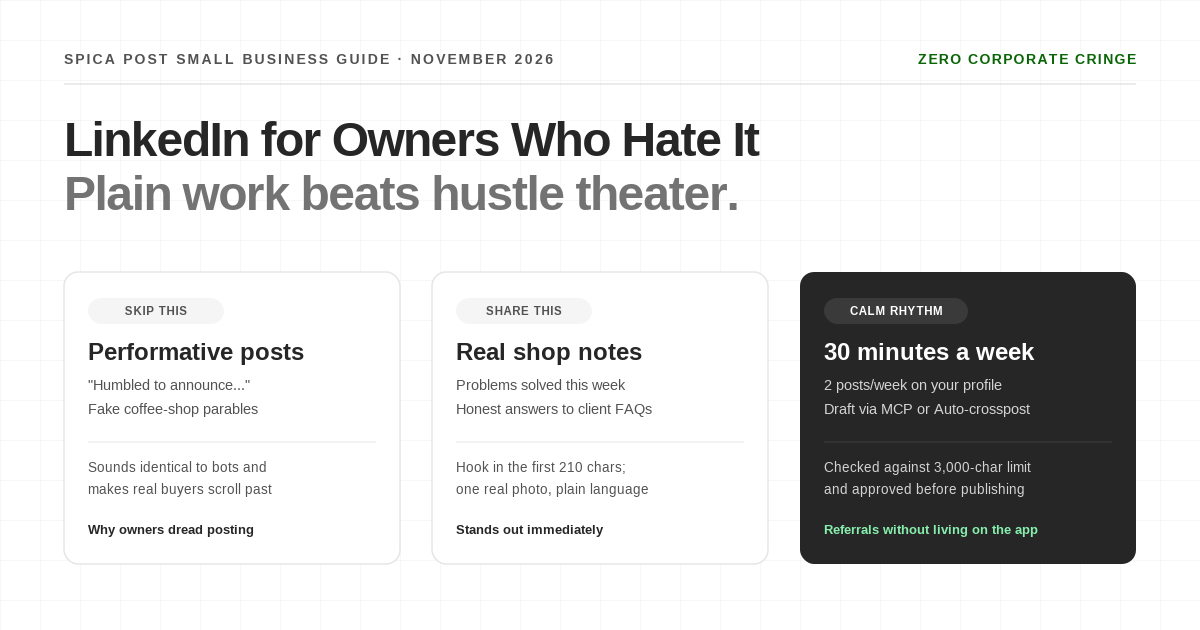
If you hate LinkedIn because the feed feels full of fake humility, one-sentence motivational clichés, and people claiming a delayed flight taught them seven lessons about B2B sales, good news: sounding like a normal, competent business owner is your single biggest unfair advantage on LinkedIn in 2026. You do not need daily hustle threads, engagement pods, or corporate buzzwords. Posting twice a week from your personal profile, putting the real point inside the first 210 characters before the “See more” fold, and cycling through five grounded post formats takes 30 minutes a week and quietly puts you top-of-mind with local referral partners, commercial clients, and buyers who never hang out on TikTok.
Most small business owners abandon LinkedIn after two awkward attempts because they try to imitate LinkedIn influencers instead of talking the way they actually talk to customers. The moment you write “I am thrilled and humbled to announce…”, your own neighbors stop reading. When you instead write “A homeowner asked us yesterday why their electric panel buzzes whenever the dryer starts. Here is the 60-second check we walk through before quoting a full replacement,” people read every word, save it, and tag a friend who needs you.
This guide gives you a realistic, zero-cringe LinkedIn operating system: whether to post from your personal profile or Company Page, how the 210-character mobile fold works, five concrete formats you can reuse all year without sounding like a brochure, a 30-minute weekly workflow, and a honest look at what LinkedIn’s API allows for scheduling today.
Snapshot verified November 2026. LinkedIn limits, media formats, and Spica Post’s live LinkedIn personal-profile vs. Company Page status are verified against current documentation and live adapter behavior as of November 2026.
Why plain-spoken owners quietly win on LinkedIn
LinkedIn has over a billion registered members, yet only a small fraction post anything original each month. Most of your prospective referral partners (property managers, accountants, commercial landlords, architects, HR managers, wedding planners, local journalists, and agency directors) scroll LinkedIn silently twice a week while drinking coffee.
They are not looking to be entertained. They are quietly scanning for someone reliable they can recommend when a colleague asks, “Hey, do you know a good [your profession] who actually shows up and explains things clearly?”
Look at what separates owners who book steady referral business from owners who feel invisible:
| Habit | “LinkedIn Influencer” style (skip this) | Plain-spoken Owner style (works) |
|---|---|---|
| Opening line | “I rejected a $500k client yesterday. Here is why…” | “Three questions to ask before signing a commercial HVAC maintenance contract.” |
| Voice | Corporate buzzwords (synergy, leverage, humbled) | Exact words you would use over the counter or on an estimate call |
| Cadence | Forced daily posting until burnout in week 3 | 2 posts per week (Tuesday + Thursday) all year |
| Proof | Vague bragging with zero detail | One real photo, checklist, number, or finished project (with permission) |
| Goal | Viral likes from strangers 2,000 miles away | Quiet trust from 200 local peers, past clients, and buyers |
If you would feel embarrassed saying a LinkedIn sentence out loud to a real customer across a table, delete it and write the plain version instead. Plain language stands out immediately in a feed full of corporate theater.
Personal Profile vs. Company Page: where to spend your time
Before you schedule your first post, decide where your energy goes so you do not split a tiny weekly time budget across two places.
| Decision area | Founder’s Personal Profile | Company Page |
|---|---|---|
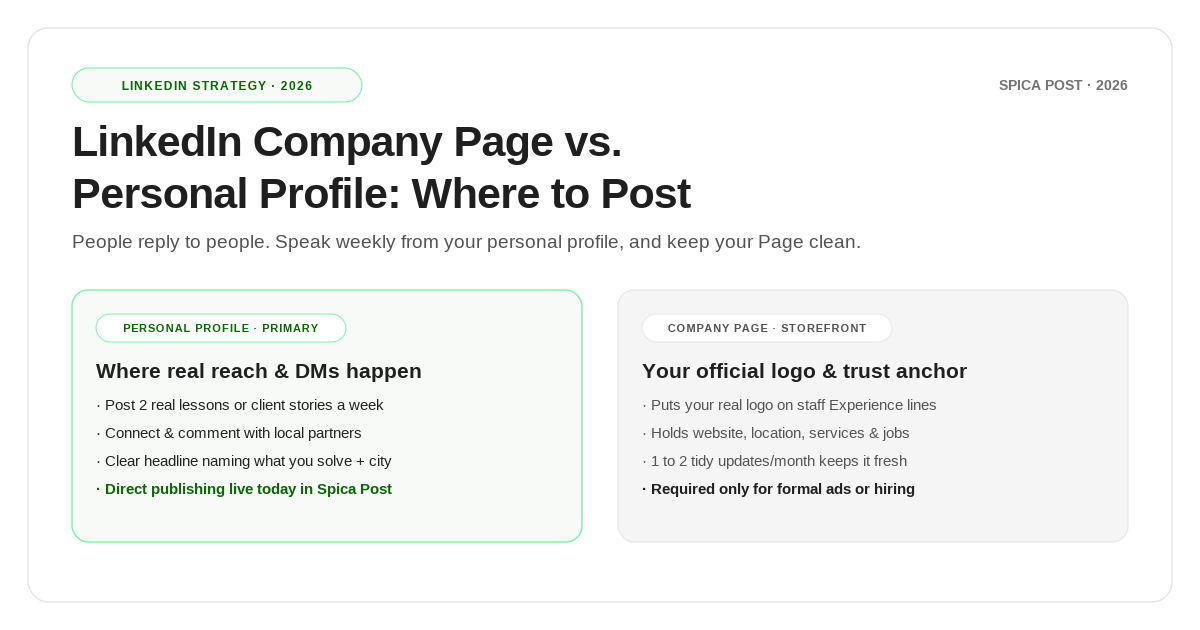
| Organic reach & trust | Much higher. LinkedIn’s feed prioritizes real people sharing firsthand knowledge, and buyers trust faces over logos. | Low organic reach unless backed by paid ads or a large employee team sharing posts. |
| What it is best for | Your 2 weekly posts, commenting on local peers’ updates, building referral trust. | Acting as your clean official directory card (logo, website, location, services, clickable link on your profile). |
| Time split | 90 percent of your weekly LinkedIn effort. | 10 percent (set up cleanly once, update quarterly or share major company milestones). |
| Spica Post support (Nov 2026) | Live today (schedule posts, up to 20 PNG/JPEG/MP4 items, Auto-crosspost destination). | Adapter built in code; awaiting LinkedIn approval on our second app (“Spica Post Pages”) before turning live. |
Even if you plan to expand to a Company Page later, spend the next ninety days building consistency strictly on your personal profile. Update your LinkedIn headline so it says plainly what you do and where you do it (“Owner at Cedar Creek Roofing · Residential & commercial roof repairs in Columbus, OH”) instead of a cryptic title like “Chief Visionary Officer”.
Respect the 210-character fold (and LinkedIn’s 2026 technical limits)
LinkedIn gives you a generous 3,000-character ceiling (roughly 450 to 500 words), plus up to 20 media items (PNG, JPEG, or MP4). However, on mobile phones and desktop feeds, LinkedIn collapses almost every post behind a “…see more” tap after roughly 210 characters (about two crisp sentences, or even shorter if you include line breaks).
Here is what happens when you write a sluggish throat-clearing intro:
- Buried lead (gets scrolled past): “Happy Tuesday everyone! It has been such a busy week over here at the shop and I was thinking this morning about something a client asked us last Thursday…” (Already at 158 characters and still zero substance.)
- Clear lead (earns the tap): “Most commercial lease renewals hide one maintenance clause that costs small shops $3,000+ a year. Here is the exact line to check before signing:” (145 characters; specific, helpful, zero clickbait.)
Test your opening lines in our free local Social Media Character & Post Checker before scheduling. It draws the exact 210-character LinkedIn fold line right inside your draft so you know immediately what readers see before tapping.
Five non-cringe LinkedIn post formats you can rotate all year
You never need to invent brand-new creative ideas from scratch. Rotate through these five simple formats (two per week means one full rotation takes two and a half weeks), and you have a full year of honest, business-building posts ready to go.
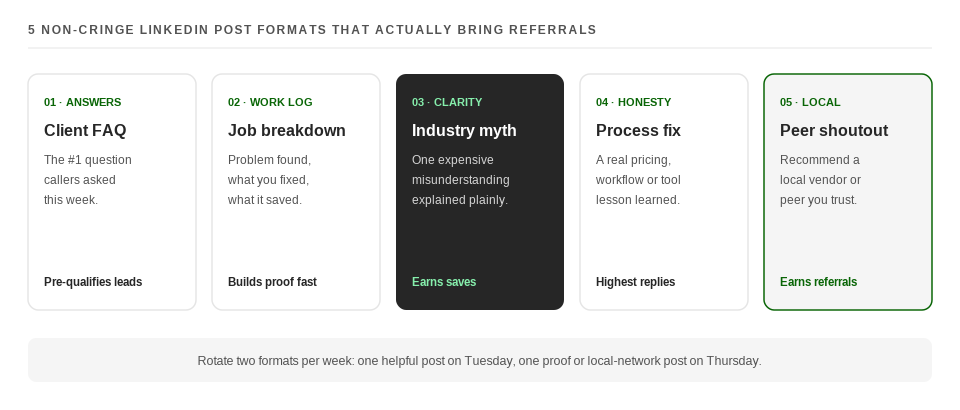
Format 1: The Question a Customer Asked This Week
Every time a customer asks you a smart question on the phone, by email, or at the counter, write down the question and your 4-sentence answer.
- Structure: State the exact question in line 1 -> Give the plain answer -> Add one quick caveat (“When to skip this / when to call a pro”).
- Example opening: “A café owner asked us yesterday whether she needs to rebuild her website before setting up Google Business Profile. Short answer: no, fix these three profile fields first.”
Format 2: The Quiet Project Breakdown (Before, Process, Result)
Show the craft behind what you actually do without bragging. People love seeing competent work explained simply.
- Structure: What the problem was -> What looked tricky or surprising -> How you solved it and why you chose that approach -> One crisp phone photo (JPEG).
- Important permission rule: Whenever a post includes a customer’s property, product, photo, or recognizable story, always ask the customer’s permission first (or keep all client identifiers completely anonymous).
Format 3: The Plain-Spoken Industry Myth (What Buyers Get Wrong)
Politely correct one expensive misunderstanding in your profession without talking down to anyone.
- Structure: Name the common myth -> Explain what actually happens in the real world -> Give one rule of thumb buyers can use immediately.
- Example opening: “Buying the cheapest bookkeeping package usually costs small businesses twice as much in March when their CPA has to recategorize twelve months of receipts.”
Format 4: The Honest Lesson or Process Fix
Share a real operational tweak you made inside your business this month. Owners and B2B buyers respect transparency infinitely more than fake perfection.
- Structure: What slowed you down or went wrong -> What you changed -> How it helped your team or customers.
- Example opening: “We used to answer quote emails whenever we got back to the office at 7 PM, and we lost half of them to faster replies. Switching to a 10-minute midday quote block doubled our callback rate.”
Format 5: The Local Peer or Vendor Shoutout
Spotlight a great printer, photographer, supplier, bakery, bookkeeper, or neighboring business you genuinely admire (with their permission if sharing a photo).
- Structure: Name the peer and tag them -> Share one specific reason they are great to work with -> Tell your network when to hire them.
- Why it works: Zero self-promotion, builds real goodwill across your local network, and almost always gets shared or commented on by the peer’s own audience.
The 30-minute weekly LinkedIn routine (plus smart cross-posting)
Hate spending an hour a day on social media? Good. You should not spend an hour a day on LinkedIn. Block 30 minutes once a week (say Monday morning or Friday afternoon) and treat it like sending invoices.
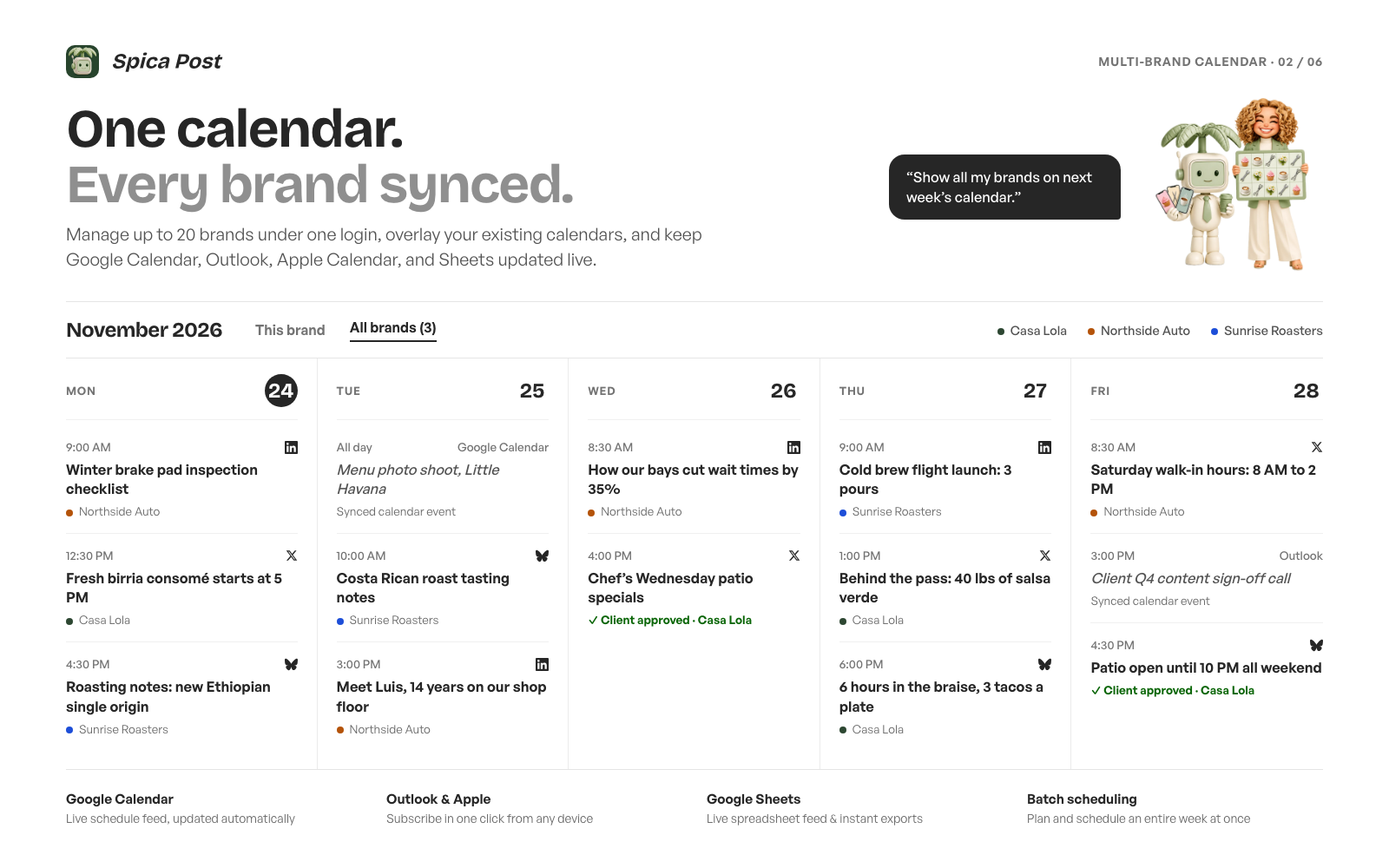
Your 30-minute weekly cadence
- Minutes 0 to 15 (Draft 2 short posts): Pick two of the five formats above. Write 120 to 220 words each in plain language, verify the first 210 characters hit the real point, attach one clean JPEG photo if helpful (skip stock clip-art), and schedule them for Tuesday and Thursday mornings in your local time zone.
- Minutes 15 to 20 (Optional smart cross-post check): If you already share quick insights on Bluesky, Mastodon, or X, let an Auto-crosspost rule send selected original updates into LinkedIn, OR expand one popular short note into a crisp 150-word LinkedIn post inside your studio.
- Minutes 20 to 30 (Leave 5 genuine comments): Scroll your feed for ten minutes and leave five thoughtful 2-sentence comments on updates from local owners, clients, or peers in your profession. Avoid one-word filler (“Great post!”); add one concrete observation from your own experience.
Five specific, thoughtful comments on peers’ LinkedIn posts will introduce you to more warm local buyers than posting seven times a week into an empty room.
How Spica Post works with LinkedIn (including honest API limits)
Spica Post lets you draft, preview, approve, and schedule posts directly to your LinkedIn personal profile alongside Google Business Profile, Instagram, Facebook, Bluesky, Mastodon, X, Threads, TikTok, YouTube, and Pinterest on flat workspace plans (check current options on our pricing page).
We prefer telling you the exact limits upfront so there are zero surprises:
- Personal profile publishing is live today: Supports up to 3,000 characters and up to 20 media items (PNG, JPEG, or MP4), both scheduled from the studio/calendar and drafted via MCP in Claude, ChatGPT, or Codex (always waiting for your approval before anything publishes).
- Destination-only for Auto-crosspost & no personal feed analytics: LinkedIn’s API restricts third-party tools from reading your personal feed or pulling personal organic post analytics. That means Spica Post can publish to your LinkedIn personal profile cleanly (including receiving cross-posts from Bluesky, Mastodon, or X), while LinkedIn cannot act as an outbound Auto-crosspost source or feed personal post impressions into our dashboard.
- LinkedIn Company Pages are waiting on LinkedIn app approval: Our Company Pages adapter is built in code against test stand-ins and awaits LinkedIn’s approval of our second app (“Spica Post Pages”). Once granted, Company Page publishing and analytics will turn on cleanly without changing your workspace setup.
Your first 30 days on LinkedIn: a low-pressure checklist
If you have avoided LinkedIn for years, do not overhaul your entire marketing strategy this weekend. Follow this four-week ramp:
- Week 1 (Fix your digital storefront in 15 minutes): Upload a clear, friendly headshot (a clean phone photo in natural daylight beats a stiff studio portrait), rewrite your headline to state what you do + who you help + where, and add a clear website or booking link in your profile header.
- Week 2 (Publish your first 2 plain posts): Post one Customer Question on Tuesday and one Local Peer Shoutout on Thursday. Neither requires talking yourself up, which makes breaking the ice effortless.
- Week 3 (Connect with 15 real people you already know): Send short personal notes to past clients, vendors, neighbors, and complementary businesses (“Hi Maya, great seeing you at the chamber breakfast; wanted to connect here too”). Never pitch in a connection note.
- Week 4 (Batch next month’s 8 posts in one sitting): Spend one quiet hour drafting eight simple posts across the five formats, double-check the 210-character fold in our Character & Post Checker, schedule Tuesday/Thursday slots in Spica Post’s LinkedIn studio, and go back to running your business.
You still do not have to love LinkedIn to let it bring you two or three great referral calls a quarter. Keep it plain, keep it useful, and keep it to 30 minutes a week.
Questions people ask
- Should a small business owner post from a LinkedIn personal profile or a Company Page?
- Start with your personal profile. On LinkedIn, people connect with, comment on, and refer real humans far more readily than logos. Keep a clean, complete Company Page as your official digital business card (address, services, website, employee links), and spend 90 percent of your posting time on the founder's personal profile.
- How often do I actually need to post on LinkedIn for it to bring business?
- Twice a week is plenty for almost every small business owner, consultant, agency, or service provider. Two plain-spoken, useful posts every Tuesday and Thursday outperform seven forced daily posts filled with generic motivational filler.
- How long should a LinkedIn post be in 2026?
- LinkedIn allows up to 3,000 characters per post, but collapses mobile feeds behind a See more tap around 210 characters (roughly two short sentences). Aim for 120 to 250 words total, and make sure your first 180 characters state the real point clearly without clickbait hooks.
- Can I cross-post to LinkedIn automatically from Bluesky, Mastodon, or a studio calendar?
- Yes, as a destination. LinkedIn restricts personal feed reading and personal organic analytics over its API, so schedulers like Spica Post publish out to your LinkedIn personal profile cleanly (including up to 20 PNG/JPEG/MP4 media items) while letting you draft in one studio or cross-post from Bluesky, Mastodon, or X.
- Does Spica Post support LinkedIn Company Pages yet?
- Today Spica Post publishes live to LinkedIn personal profiles. Our LinkedIn Company Pages adapter is built in code and is currently waiting on LinkedIn's approval of our second app (Spica Post Pages) before turning on for customer workspaces.
Sources
- LinkedIn Marketing Labs: Building an authentic presence for small businesses
- LinkedIn Help: Posts character limits and media formatting guidelines
- LinkedIn Engineering: How LinkedIn feed relevance prioritizes knowledge and advice
- Spica Post LinkedIn publishing & scheduling support
- Spica Post Free Social Media Character & Post Checker (210-char fold & 3,000-char limit)