Accountants
Social Media for Accountants and Tax Preparers: The Tax Season Plan (2026)
Win ideal tax clients from November to January, batch February to April deadline posts early, and stay strictly confidential all season.
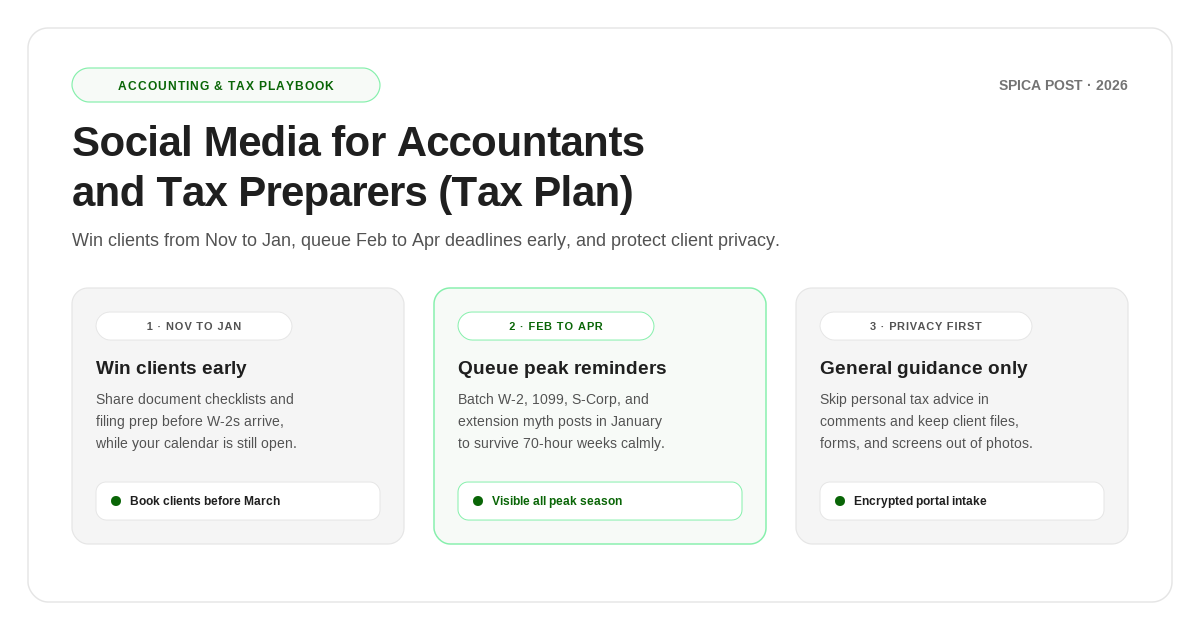
Social media for accountants and tax preparers succeeds when your posting calendar runs ninety days ahead of your workload: publish calm educational checklists from November through January to win organized clients you will not have time to speak with in March, pre-schedule your entire February through April deadline series in January so your firm stays visible through 70-hour weeks, focus on LinkedIn, Google Business Profile, and Facebook, and enforce strict general-education and data-privacy guardrails on every caption, comment, and photo.
Most CPAs, Enrolled Agents (EAs), bookkeepers, and independent tax preparers fall into the exact same seasonal trap. Between February 15 and April 15, returns pile up, phones ring off the hook, and marketing disappears completely. By late April you are exhausted, so social media stays silent through summer. Then next March arrives, and you spend half your mornings politely turning away disorganized shoebox filers while wishing you had added ten steady S-Corp or monthly bookkeeping clients back in December.
Snapshot verified November 2026 against IRS filing deadline guidance, IRS estimated tax schedules, IRS extension rules, IRS Publication 4557 on Safeguarding Taxpayer Data, and Google Business Profile representation guidelines. This guide lays out a year-round tax season social media plan built for real accounting workloads: why early-winter posting determines next year’s revenue, the exact channel mix worth keeping, a January batching schedule for peak deadlines, non-negotiable confidentiality guardrails, four copy-ready templates, and a realistic 20-minute off-peak routine.
Why November through January wins the clients you cannot talk to in March
Accounting and tax preparation have an upside-down marketing clock. The organized small business owner who reconciles monthly books, sends clean 1099s on time, and values advisory fees does not wait until April 9 to look for a new accountant. They start asking colleagues for referrals and checking LinkedIn and Google reviews between November 1 and January 20, right after closing Q3 or receiving year-end payroll notices.
By contrast, when your firm waits until late February or March to post “Now accepting new tax clients!”, two costly things happen simultaneously:
- Your calendar has zero room for calm discovery calls. You cannot spend thirty minutes evaluating a promising multi-member LLC or explaining monthly bookkeeping scope when forty existing returns are waiting on review.
- Urgency skews your incoming leads. Late-March callers are disproportionately unprepared filers needing extensions or last-minute cleanup rather than proactive year-round advisory accounts.
Posting calmly twice a week from November through mid-January solves both problems. While competitors stay quiet during the holidays, your firm shows up on LinkedIn, Google Business Profile, and Facebook explaining W-2 and 1099 readiness, clean document folders, and clear intake cutoffs. By February 1, your ideal new clients are already onboarded onto your encrypted portal, and your social channels pivot cleanly into pre-scheduled reminders that serve existing clients and build referrals for next year.
The LinkedIn, Google Business Profile, and Facebook mix for accounting firms
A solo CPA, neighborhood tax office, or ten-person law and accounting firm does not need daily TikTok dances. Focus strictly on the channels where business owners, referral partners, and local taxpayers actually evaluate professional trust.
| Channel | Who is checking your firm here | Highest-return weekly job | Current Spica Post status (Nov 2026) |
|---|---|---|---|
| LinkedIn (personal profile) | Small business owners, S-Corp founders, bookkeepers, attorneys, mortgage lenders, financial planners | 1 to 2 plain-English posts weekly on cash flow, quarterly estimated taxes, clean books, and year-end prep | Live direct publishing today |
| Google Business Profile | Local individuals and owners searching “CPA near me”, “tax preparer [City]”, or checking hours and reviews | Weekly deadline or intake status update, accurate seasonal hours, and privacy-safe review replies | Built and enabled in production; awaiting first live profile verification |
| Facebook Page | Local families, sole proprietors, real estate agents, gig workers, neighborhood groups | Mirror document checklists, extension myth explainers, and clear office drop-off hours | Built; completing Meta App Review |
| Branded Link Page | Prospects and returning clients clicking from any bio or email signature | Holds 4 calm buttons: Encrypted Client Portal, Tax Document Checklist, Book a Discovery Call, Office Hours | Live today in Spica Post with custom boxes and printable SVG QR codes |
| X, Bluesky & Mastodon | Local business voices, journalists, small businesses and creators | Crisp federal deadline reminders and links to full educational guides | Live direct publishing and Auto-crosspost today (Bluesky Unified Inbox live) |
| Instagram / YouTube Shorts | Visual learners and younger self-employed creators | Optional: 1 short 30-second talking-head myth buster per fortnight during off-peak months | Built; Meta App Review and YouTube compliance audit completing |
Four profile trust leaks to fix before January 1
Before scheduling a single post, audit your LinkedIn headline, Facebook bio, and Google Business Profile like a cautious local business owner looking for a long-term CPA or bookkeeper:
- Vague bio with no credentials or ideal client fit. Replace “Full-service accounting solutions” with plain facts: your real credentials (CPA, EA, or registered preparer where applicable), city or licensed state, and who you serve (for example, “CPA & Tax Advisory in Columbus, OH · S-Corps, Small Businesses & Families · Intake & Portal Link Below”).
- Outdated tax-season office hours on Google Business Profile. If your firm extends hours to Saturdays in March or switches to Friday half-days from May through August, set special hours cleanly on Google Business Profile so walk-ins never face a locked lobby door. Also verify practitioner vs. firm listing structure per Google Business Profile representation guidelines.
- No encrypted portal link one tap away. Never invite clients to email sensitive W-2s or send social media DMs with tax questions. Place your Encrypted Client Portal link right at the top of your branded Link Page beside a clear New Client Intake Status box (“2026 Tax Intake: Open for Small Business Returns until Feb 20” or “At Capacity for April 15; Booking Extensions & Q2 Bookkeeping”).
- Silent personal LinkedIn profiles. Company pages on LinkedIn move slowly compared to a partner’s or founder’s real profile. Clients hire an accountant they trust by name; read our LinkedIn guide for small business owners for a clean two-post weekly rhythm.
The year-round tax and accounting posting timeline
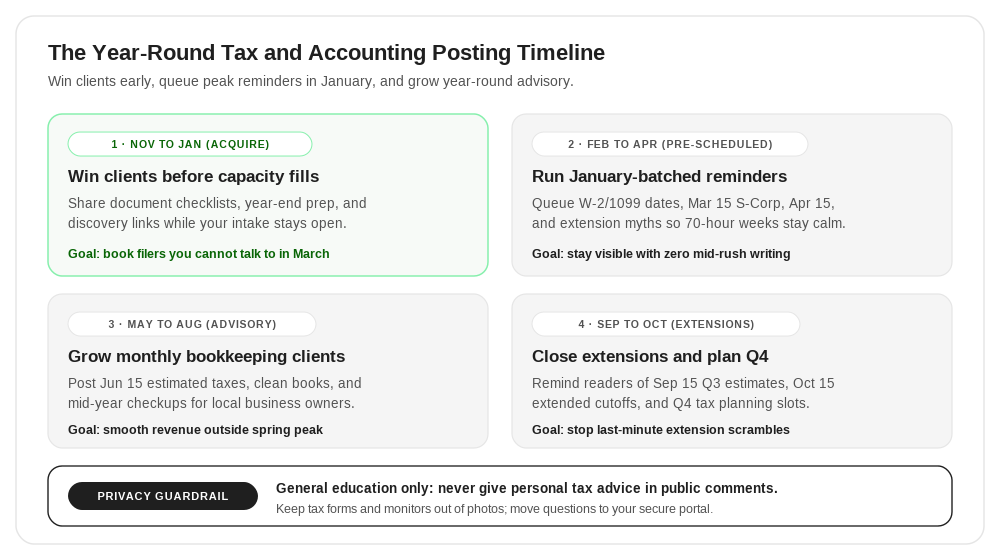
Running accounting social media across four distinct phases removes every ounce of guesswork. Instead of scrambling for ideas during busy season, you shift focus cleanly as the IRS calendar turns.
| Phase | Core business objective | Exact topics to schedule | Writing workload |
|---|---|---|---|
| Phase 1: Nov to Jan (Acquire) | Win organized new tax and bookkeeping clients before capacity closes | Year-end charitable and retirement timing (general education), W-2/1099-NEC readiness, clean document checklists, how our secure portal works, firm intake cutoffs | 25 minutes/week (live calm window) |
| Phase 2: Feb to Apr (Pre-Scheduled) | Stay visible, calm, and helpful during 70-hour weeks without writing mid-rush | All batched in early January: Mar 15 S-Corp/Partnership cutoff, Apr 15 individual/C-Corp + Q1 estimated tax date, extension myth explainer, missing-form reminders, intake cutoff updates | 0 minutes/week writing (pre-queued in January; 5 min/week scanning comments) |
| Phase 3: May to Aug (Advisory) | Convert one-time April filers into recurring monthly bookkeeping and advisory | June 15 Q2 estimated tax reminder, separating business and personal bank accounts, reading a basic P&L, mid-year tax projection invites, payroll cleanup | 20 minutes/week |
| Phase 4: Sep to Oct (Extensions & Q4) | Close extended returns calmly and open Q4 tax planning slots | Sept 15 Q3 estimated tax + extended pass-through cutoff, Oct 15 extended individual cutoff, Q4 entity and quarterly checkup invites, transitioning into Nov intake | 20 minutes/week |
How to pre-schedule February through April in one 90-minute January session
Every year, federal dates follow predictable statutory windows (remembering that when a due date falls on a weekend or legal holiday in Washington, D.C., the IRS shifts the filing deadline to the next business day; verify exact annual calendar dates each winter on IRS When to File and IRS Estimated Taxes).
Block 90 uninterrupted minutes during the first week of January (paired with the batching method in our post batching guide) to draft and queue 12 calm evergreen posts covering February 1 through April 20:
- Week 1 (Early Feb): “What documents to wait for before uploading” (W-2, 1099-NEC, 1099-INT/DIV, 1098 mortgage interest, brokerage consolidated 1099s which frequently arrive mid-February).
- Week 2 (Mid-Feb): “Why our office uses an encrypted portal instead of regular email” (builds security credibility and cuts phone calls).
- Week 3 (Late Feb): “Two-week heads-up for S-Corporations and Partnerships (March 15 statutory due date)” reminding owners of internal firm document cutoffs.
- Week 4 (Early Mar): “The biggest tax extension myth explained in 60 seconds” citing IRS extension guidance: an extension gives extra time to file paperwork, never extra time to pay tax owed.
- Week 5 (Mid-Mar): “March 15 pass-through reminder + internal firm cutoff for April 15 returns” setting calm expectations early.
- Week 6 (Late Mar): “Self-employed and side-income checklist: 4 records that save hours” (separate bank statement, mileage log summary, home-office square footage notes, estimated payment receipts).
- Week 7 (Early Apr): “April 15 reminder: federal filing, IRA/HSA contribution timing, and Q1 estimated taxes” (general overview with link to IRS guidance).
- Week 8 (Mid-Apr): “Need an extension? Here is the calm three-step process” explaining payment estimates and October timelines.
- Week 9 (April 16 to 20): “Thank you for a smooth filing season + our summer hours and Q2 bookkeeping calendar” transitioning smoothly out of peak rush.
Educational framing, compliance, and strict client privacy guardrails
Accounting is a fiduciary-adjacent, regulated profession where one careless social post, office snapshot, or comment reply can violate federal data-security expectations, Circular 230 standards, state accountancy board rules, or client trust. Build four non-negotiable guardrails into your entire team’s workflow.
1. Keep every public post strictly general education
Never write individualized tax advice in public comments, live Q&As, or unencrypted social media DMs. If someone comments “Can I write off my new SUV 100 percent under my LLC this year?”, giving a “yes” or “no” publicly ignores business-use percentage, GVWR thresholds, entity elections, and state conformity.
Use a polite, repeatable comment reply: “Great question. Vehicle deduction rules depend on business-use logs, vehicle weight thresholds, and your overall return structure, so I cannot give personal tax advice in comments. Here is our general checklist link, and you are welcome to book a private review through our secure page.” Likewise, never promise guaranteed refund sizes or specific tax savings publicly, and represent credentials (CPA, EA, bookkeeper, tax preparer) accurately per state board and professional standards.
2. Protect taxpayer data in every office photo (IRS Publication 4557)
Under IRS Publication 4557, Safeguarding Taxpayer Data, tax professionals carry strict obligations to protect taxpayer information from unauthorized disclosure. A casual “Late night at the office!” desk photo can leak a client’s name, SSN, EIN, or balance sheet sitting on a monitor or folder corner in seconds.
Enforce a clean-desk visual standard across your entire firm:
- Zero recognizable tax forms, folders, mail stacks, or live monitors in any photo or background video.
- Zero whiteboards or wall schedules displaying client names, filing statuses, or extension lists.
- Use clean architectural or lifestyle office shots instead: a tidy conference table with blank notebook and coffee cup, exterior office signage in daylight, clean branded checklists rendered as simple graphics, or portraits of staff members.
- Always ask explicit permission before photographing or tagging employees, clients, or local referral partners (attorneys, bankers, real estate brokers). Never publish a client’s face, company name, or business story without clear written permission.
3. Write strictly privacy-safe Google review replies
A happy client might leave a five-star Google review saying “Jane saved our dental practice thousands on our S-Corp return!” Even when the client volunteers details publicly, never confirm confidential engagement specifics, return types, or savings amounts in your reply.
Keep review responses warm, brief, and privacy-safe: “Thank you so much for taking the time to share a kind review. Helping local business owners stay organized and confident year-round is what our team loves most. We appreciate your trust!” That warm phrasing boosts local Google Business Profile engagement without ever breaching confidentiality.
Four copy-ready posts for accountants and tax preparers
Adapt these four templates to your credentials, city, and current intake window. Review dates annually against official IRS schedules before queuing.
1. November to January early-intake and checklist post (LinkedIn & Facebook)
Every March, organized small business owners call asking for a calm tax preparer, and most offices are already at capacity. The best time to line up your filing team is right now, before W-2s and 1099s hit the mailbox.
Four quick items to gather into one folder this month:
- Separate business bank and credit card statements reconciled through December 31
- Contractor W-9s needed to prepare 1099-NEC filings on time
- A summary of any quarterly estimated tax payments made during the year
- Notes on major life or business changes (new entity, home purchase, equipment bought, or retirement contributions)
General educational checklist only; individual filing requirements vary. Our [City] office is currently open for [Year] small business and individual consultations through [Cutoff Date]. Tap our Link Page in bio to view our checklist or book a 15-minute intro call.
2. Pre-scheduled March extension-myth explainer (LinkedIn, GBP & Facebook)
Quick tax season reminder: filing a federal tax extension gives you extra time to submit your paperwork, not extra time to pay taxes owed.
Per official IRS extension guidance, estimating and paying any expected balance by the April due date helps reduce potential interest and late-payment penalties, even when you need extra months for missing K-1s, corrected brokerage statements, or clean bookkeeping.
General tax education only, not personalized tax advice. Need to upload remaining documents or check our office’s extension cutoff date? Use our encrypted client portal link in bio (please never send tax forms through social DMs or regular email).
3. Mid-season calm capacity and secure portal reminder (Google Business Profile Update)
Tax season update from [Firm Name] in [City]: we are heads-down preparing returns for our scheduled clients through April 15.
Returning clients: please upload W-2s, 1099s, and missing statements strictly through our encrypted client portal so our team receives alerts safely. New small business or individual inquiries: our current schedule for April filing is full, and we are gladly booking extension consultations and May bookkeeping reviews.
Tap the link below for our encrypted portal, office hours, and post-April consultation calendar.
4. Post-April 15 transition into monthly bookkeeping and advisory (LinkedIn)
The hardest part of tax season is rarely the tax software; it is reconstructing twelve months of uncategorized receipts in March.
May is the calmest month of the year to fix that for good. Between clean monthly reconciliations, clear quarterly estimated tax check-ins (June 15, September 15, and January 15), and one organized cloud folder, small business owners walk into next winter knowing their numbers instead of guessing.
General financial organization tips only. If you run a [Local Profession / Small Business Type] in [City / State] and want clean monthly books before Q2 closes, tap the link in bio to schedule a calm 20-minute review.
A 20-minute weekly routine and honest Spica Post trade-offs
Outside peak tax season, keep marketing predictable and light so it survives busy client months:
- First week of January (90 minutes once a year): Write and schedule all 9 to 12 peak-season posts covering February 1 through April 20. Double-check every federal and state deadline against current-year official IRS and state department of revenue dates.
- Off-peak Mondays (15 minutes, May through January): Draft two short posts (one plain educational explainer or quarterly date reminder, one calm process or local community note) and schedule them across your active channels.
- Fridays (5 minutes, all year): Scan comments and Google reviews, answer with general guidance and privacy-safe replies, and direct specific questions to your encrypted portal or booking calendar.
Skip five frequent accounting marketing mistakes:
- Posting dense tax-code jargon nobody outside the profession reads. Translate concepts into plain owner decisions (“Why S-Corp owners run payroll” beats citing raw IRC subsections alone).
- Going completely silent from May to January. Disappearing for eight months forces you to rebuild visibility from scratch every winter.
- Asking prospects to DM sensitive numbers or email raw PDFs. Direct every intake touchpoint cleanly to your encrypted client portal.
- Waiting until March 1 to promote tax prep. Start acquisition posts in early November while business owners still have mental bandwidth to switch firms.
- Forgetting to update Google Business Profile hours in April and May. Accurate peak and off-peak hours prevent frustrated calls and one-star reviews.
Honest trade-offs if you evaluate Spica Post in November 2026
If you are comparing tools on Spica Post for tax preparers or Spica Post for bookkeepers, here is our exact November 2026 status for small businesses and creators:
- Live today in Spica Post: Direct scheduling and Auto-crosspost to LinkedIn personal profiles (your #1 channel for business owners and referral partners), X, Bluesky (with live Unified Inbox replies), and Mastodon; batch scheduling so you can queue an entire February-to-April tax series in one sitting; a branded Link Page (with custom intake-status boxes, encrypted portal links, document checklist links, and printable SVG QR codes for lobby desks); tracked
/l/short links; and team roles (Owner, Admin, Editor, Viewer) with server-enforced approval queues so partners can review junior staff drafts before publishing. - Built and completing network approvals: Because local accounting firms also depend on Google Business Profile, Facebook Pages, and LinkedIn Company Pages, be aware plainly that Spica Post’s connectors for Google Business Profile (API approved and enabled in production; awaiting first live profile verification), Facebook Pages, Instagram, Threads, LinkedIn Company Pages, TikTok, and YouTube (OAuth approved; completing compliance audit) are built and finishing network approval or verification. Until direct Google and Meta publishing finishes rollout across all workspaces, run your LinkedIn personal profile, Link Page, partner approval workflow, and X/Bluesky schedule inside Spica Post while pasting your pre-written January batch into Google Business Profile and Facebook in ten minutes. Check flat workspace plans anytime on our pricing page.
Pick one 90-minute block on your January calendar right now, list every federal and state deadline your clients ask about every spring, and queue your entire tax season before the first W-2 lands on your desk. You will spend March serving clients calmly instead of rushing posts at midnight.
Questions people ask
- When is the best time of year for accountants and tax preparers to post on social media?
- November through January is the highest-leverage window for winning organized, high-retention tax and bookkeeping clients. Business owners and families choose their preparer before W-2s and 1099s arrive; waiting until March means your calendar is already full and only last-minute rush inquiries remain.
- How can a CPA or tax preparer stay active on social media during 70-hour weeks in March?
- Batch and pre-schedule your entire February through April calendar during one quiet 90-minute session in early January. Queue general federal deadline reminders, document checklists, extension myths, and encrypted portal instructions ahead of time so your profiles stay helpful while you focus exclusively on preparing returns.
- Which social media channels bring the best clients for accounting and tax firms in 2026?
- LinkedIn personal profiles bring business owners, founders, attorneys, and financial referral partners; Google Business Profile captures high-intent local searches and reviews; and Facebook reaches local families, independent contractors, and neighborhood referrals. Pair those three with one branded Link Page holding your encrypted client portal and booking calendar.
- Can an accountant answer a follower's specific tax question in a public social media comment?
- No. Public comments lack complete facts, create professional liability risk, and invite followers to expose sensitive personal financial data. Reply politely with general educational context, note that outcomes depend on individual facts and current law, and invite them to schedule a private consultation or upload records through your encrypted portal.
- What must accountants keep out of office photos and Google review replies?
- Keep client folders, tax forms (1040, W-2, 1099, K-1), whiteboards with client names, sticky notes, and live computer screens completely out of every photo. Always ask explicit permission before photographing staff or clients, and write Google review replies that never confirm or disclose whether a reviewer is an actual client.
Sources
- Internal Revenue Service (IRS): When to file (individual and extension dates)
- Internal Revenue Service (IRS): Estimated taxes for small businesses and self-employed
- Internal Revenue Service (IRS): Get an extension to file your tax return
- Internal Revenue Service (IRS): Publication 4557, Safeguarding Taxpayer Data
- Google Business Profile Help: Guidelines for representing your business