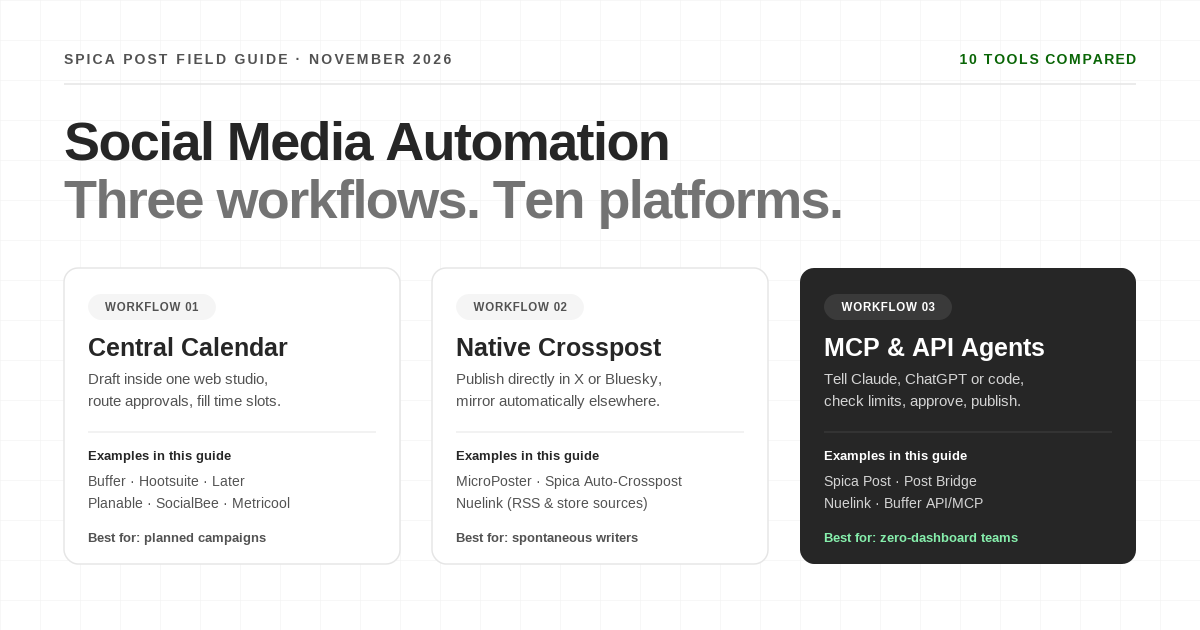
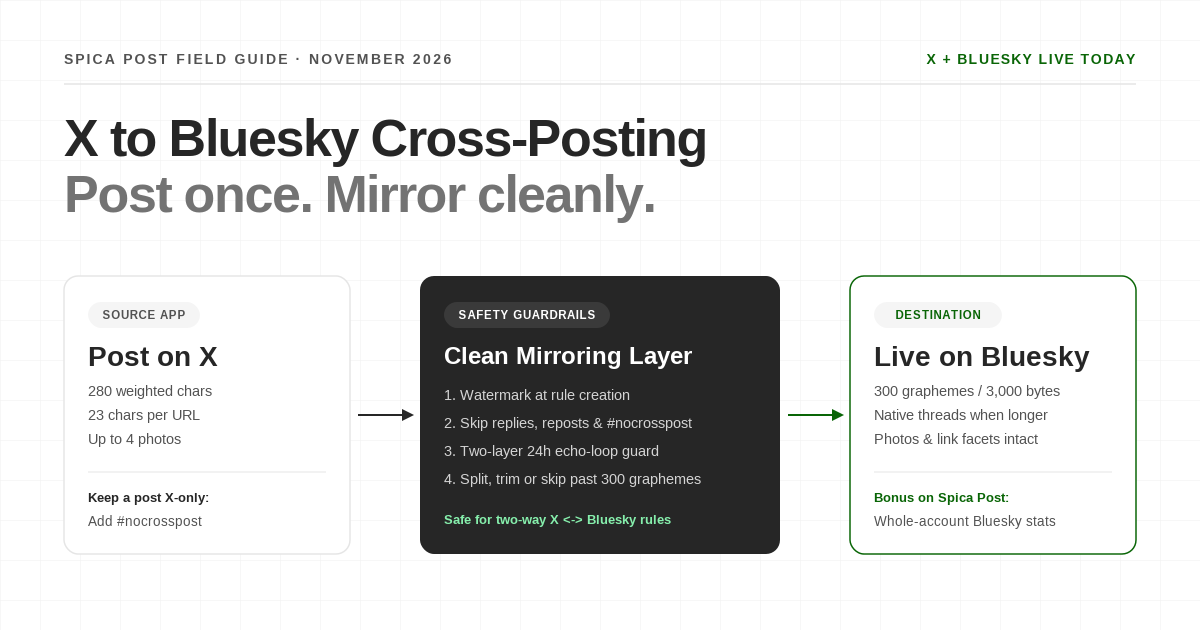
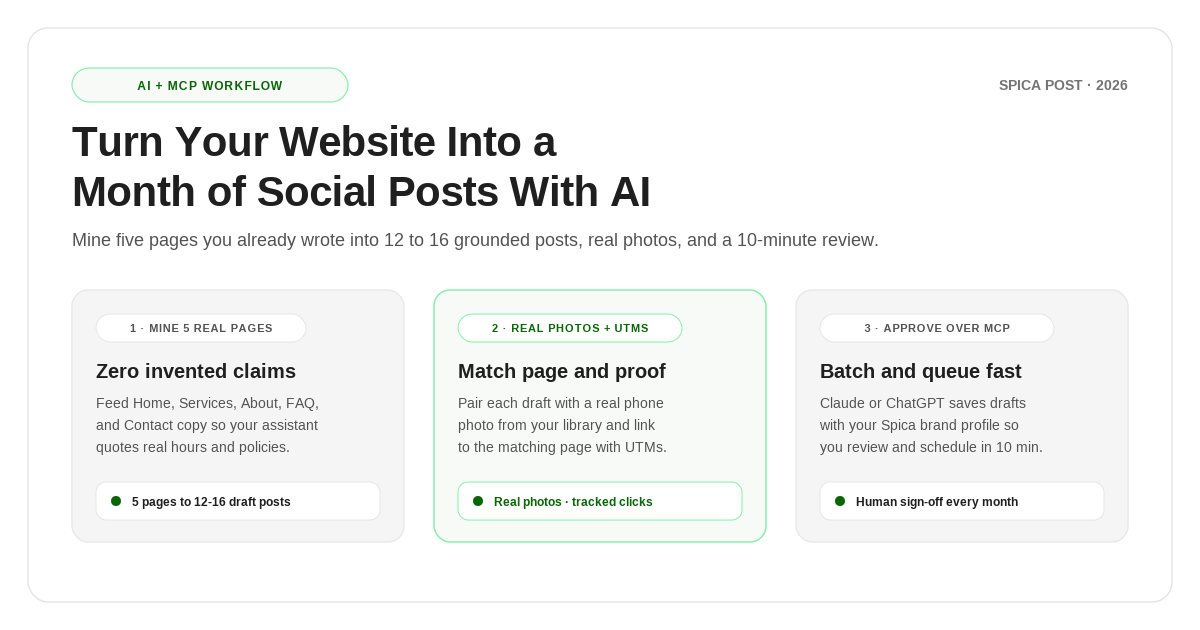
API & Webhooks
Social Media API & MCP Guide for Developers and AI Agents (2026)
Compare direct platform APIs, unified REST APIs and remote MCP servers in 2026: OAuth traps, webhooks, brand isolation, approval gates and provider trade-offs.
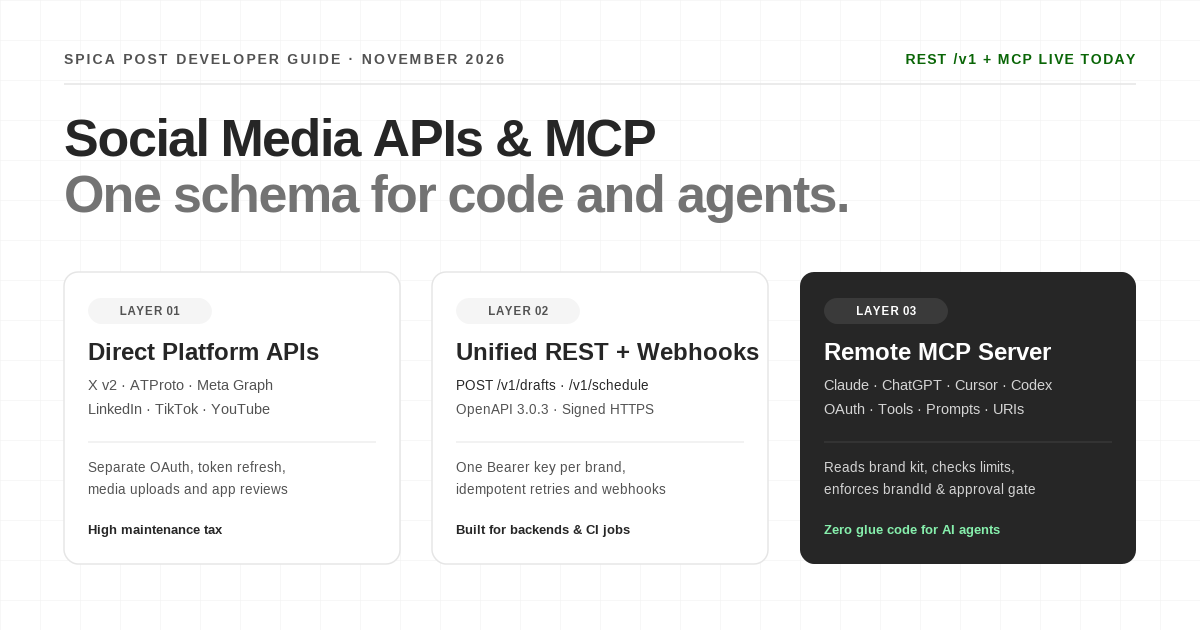
In 2026, developers and AI builders have three distinct ways to automate social publishing: wire up direct platform APIs (maximum low-level control, highest OAuth and review maintenance tax), call a unified REST API with signed webhooks (best for deterministic backend code, CMS hooks and CI jobs), or connect a remote Model Context Protocol (MCP) server (best when Claude, ChatGPT, Cursor, Codex or Gemini needs to inspect brand assets, check network limits, draft copy and stop at a human approval gate). The most durable stacks pair one unified REST /v1 contract with an MCP server running over the exact same permission and brand-isolation core.
Every engineering team starts with the same optimistic weekend estimate: “How hard can posting to four social networks really be?” Two months later, half a sprint has evaporated into Meta two-step media containers, LinkedIn 60-day token rotations, Bluesky UTF-8 byte-offset facets, X weighted URL math, broken webhook retries, and an app-review screencast rejected because a checkbox lacked a privacy disclosure.
Now add AI agents into the picture. Giving an LLM raw curl access to production OAuth tokens with no brand wall and no approval gate is one hallucinated parameter away from posting Client A’s launch announcement to Client B’s LinkedIn profile.
Snapshot verified November 2026. Competitor API tiers and prices reflect published pages at verification time; check each provider’s current pricing before committing, and check Spica Post’s pricing page for current plan limits and allowances.
The three layers: direct APIs vs unified REST vs remote MCP
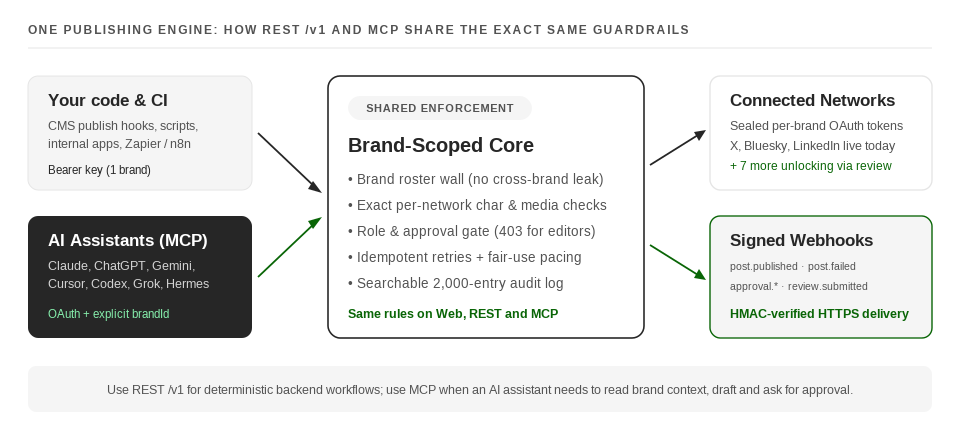
Before picking a vendor or writing an integration, separate who is initiating the post from what guardrails must run before publish. The architecture below shows how deterministic code and conversational AI agents converge cleanly onto one brand-scoped engine.
1. Direct platform APIs
Direct integration means registering your own developer application with X, Meta, LinkedIn, Google, TikTok, Pinterest and Bluesky, implementing each network’s OAuth 2.0 or ATProto session flow, building separate media uploaders, handling each network’s error codes, and maintaining compliance reviews year after year.
Direct APIs still make sense in one clear scenario: when a single platform’s deep native surface is your core product (for example, a dedicated X analytics engine or a bespoke YouTube Studio management app). For almost every other business, agency or internal automation team, building five direct adapters is undifferentiated plumbing.
2. Unified REST APIs and signed webhooks
A unified REST API abstracts every connected social network behind one JSON schema, one authentication header, one idempotency model and one signed webhook stream. Your backend emits a clean payload like POST /v1/drafts or POST /v1/posts, and the platform handles token refresh, JPEG normalization, platform-specific upload staging, retry backoff and delivery receipts.
Signed HTTPS webhooks close the loop: instead of polling status endpoints in a cron job, your backend listens for post.published, post.failed, approval.approved or account.needs_reconnect and updates your CRM, Slack channel or internal dashboard immediately.
3. Remote MCP servers for AI assistants and coding agents
The Model Context Protocol (MCP) standardizes how AI clients discover tools, read structured resources and invoke actions safely over remote HTTP with OAuth. Rather than writing custom OpenAI function schemas or maintaining a bespoke LangChain wrapper for every social endpoint, you point Claude, ChatGPT, Gemini, Grok, Cursor, Codex or Antigravity at a single remote MCP URL.
A serious publishing MCP server goes far beyond one publish_post endpoint. It exposes read-only resources (brand voice, saved photos, upcoming calendar, pending approvals), guided prompts (such as onboarding a new brand or triaging approvals), validation tools that check drafts against every network’s exact character and media limits, and strict server-side gates so the model cannot bypass human sign-off.
| Decision axis | Direct platform APIs | Unified REST API (/v1) |
Remote MCP server |
|---|---|---|---|
| Primary caller | Bespoke single-network software | Backend code, CMS hooks, CI, n8n/Zapier | Claude, ChatGPT, Cursor, Codex, AI agents |
| Auth model | Separate OAuth app per network | One scoped Bearer key (sp_live_...) per brand |
Browser OAuth grant + explicit brandId |
| OAuth & app reviews | You own every app review and renewal | Handled centrally by provider | Handled centrally by provider |
| Deterministic repeatability | High (once built) | Highest (idempotency keys + OpenAPI spec) | Context-aware drafting, deterministic tool guards |
| Human review before publish | You must build your own UI | Optional via draft + approval endpoints | Built in (draft links, web queue, review links) |
| Time to first safe post | Weeks to months | 15 to 30 minutes | Under 5 minutes |
Use REST /v1 when an automated system knows the exact copy and timestamp (for example, a release note, changelog or e-commerce drop). Use MCP when an AI assistant needs to read brand context, write network-specific drafts, check limits and ask a human before scheduling.
What actually breaks when you integrate direct platform APIs yourself
If you are weighing “build in-house” against using a unified API or MCP layer, budget for the four failure modes that routinely turn a two-day spike into permanent maintenance work.
X API v2: metered reads, writes and weighted lengths
X API v2 meters access tightly across read and write endpoints, making casual polling or unthrottled retries expensive fast. Even creating a clean post requires implementing X’s weighted character counter (280 weighted characters, 23 weighted characters per URL regardless of real length, weight 2 for CJK and most emoji) plus chunked media uploads and careful rate-limit tracking. If you also read timelines for cross-posting, forgetting since_id or exclude=retweets,replies can burn a monthly read allowance in an afternoon.
Bluesky ATProto: app passwords, byte-offset facets and blob uploads
Bluesky’s AT Protocol is refreshingly open and requires no gated app review, yet it still surprises developers coming from classic REST APIs:
- Byte offsets, not character offsets: Clickable URLs,
#hashtagsand@mentionsdo not linkify automatically from raw text. Your code must compute exact UTF-8 byte start and end indexes for everyfacet, which immediately breaks if you slice JavaScript UTF-16 strings containing multi-byte emoji or accented Spanish characters. - Dual text limits: Posts must satisfy both 300 grapheme clusters (via
Intl.Segmenter) and 3,000 UTF-8 bytes. - Separate blob pipeline: Every image must be uploaded first via
com.atproto.repo.uploadBlob, inspected for size limits, and attached by returned CID reference alongsidealttext and aspect ratio dimensions.
Meta Graph and Threads: two-step media containers and app review
Meta’s Instagram Graph API and Threads API do not publish media in one synchronous POST. Your code creates a media container with an accessible public image or video URL, polls container processing status until Meta finishes transcoding (handling silent timeouts and rejected formats such as PNG or WebP on Instagram, which requires JPEG), and only then triggers a second publish call. Getting production access for external users requires Meta Business Verification, screen recordings for every permission scope and periodic data-use checkups.
LinkedIn, TikTok, YouTube and Pinterest: token expiries and compliance audits
Each remaining network adds its own operational edge case:
- LinkedIn: Access tokens expire on fixed lifecycles, personal profiles restrict feed reading and organic post analytics compared with Company Pages, and image/document assets require multi-step upload registration.
- TikTok: Unaudited apps can only post private/sandbox videos until TikTok approves the Content Posting API audit, and read metrics require separate
video.listconsent. - YouTube: Exceeding default Data API quota units halts uploads until quota resets, and production OAuth scopes require Google’s API Services compliance review.
- Pinterest: Every pin requires a target board ID, image media and specific destination link validation.
Count not only the engineering hours to write your first post call, but the ongoing calendar hours to refresh tokens, re-pass platform audits and debug silent format rejections across every network you support.
Comparing developer-ready social APIs and MCP servers (2026)
If you want to skip maintaining seven platform adapters yourself, six established developer-accessible options stand out in 2026 (plus one notable waitlist to be aware of). They are ordered by architectural fit, not a single generic ranking.
| Platform | Best fit | REST API & webhooks | MCP server depth | Brand isolation & approvals | Networks live today (Nov 2026) | Entry cost (Nov 2026) |
|---|---|---|---|---|---|---|
| Spica Post | Developers, AI agents & multi-brand teams needing guardrails + human UI | 161 /v1 routes, OpenAPI 3.0.3, 14 signed HMAC webhooks (all paid plans) |
170 tools, 17 prompts, 16 resources, 10 URI templates + ?profile=core |
1 key = 1 brand; explicit brandId; 403 editor approval gate; audit CSV |
X, Bluesky, Mastodon, LinkedIn (+ 7 built, unlocking via review) | One-time Starter & flat monthly plans (see pricing) |
| Post Bridge | High-account publishers needing 10 live visual/video API networks now | REST API + npm CLI on all plans | 16 MCP tools (Claude, ChatGPT, Registry) | Web workspaces; API keys span accounts (external_ref filter); no approval queue |
10 networks live (incl. IG, TikTok, YouTube, GBP, Threads) | $39/mo Marketer (15 accts); $99/mo Operator (99+ accts) |
| Ayrshare | Multi-tenant SaaS products embedding social posting for external users | Mature REST API, Node/Python SDKs; webhooks on Launch ($299/mo)+ | Native Ayrshare MCP server | Multi-tenant user profiles (Business $599+/mo); headless (no end-user studio) | 14 networks live (incl. Reddit, Snapchat, Telegram) | $149/mo Premium (1 profile); $299/mo Launch; $599/mo Business |
| Postiz | Engineers wanting AGPL-3.0 open-source self-hosting via Docker | REST API + npm CLI on paid cloud or self-hosted | MCP server included | Cloud plans per channel; self-hosted gives full DB control (you own OAuth apps) | 20+ networks on Cloud (incl. Reddit, Discord, Mastodon) | Free self-host (AGPL-3.0); Cloud from $29/mo (5 channels) |
| Buffer | Lightweight solo workflows already living in Buffer | API + developer integrations with monthly request caps | MCP support available | Per-channel billing; lightweight approvals on Team ($12/mo per channel) | Broad mature coverage (incl. Mastodon, Bluesky, Threads) | Free (3 channels); $6/mo per channel Essentials |
| Nuelink | RSS, Shopify, podcast and catalog-to-social automations | REST API & webhooks on paid plans | MCP connector supported | Brand collections; focused on source-driven queues | Broad live network coverage | From $18/mo (7 channels) |
Note on MicroPoster: MicroPoster is strong for solo native cross-posting across X, Threads, Bluesky, Mastodon and LinkedIn, but as of November 2026 its /api page remains a waitlist and it does not ship an MCP server.
1. Spica Post
Spica Post is engineered so backend code, AI assistants and human reviewers all run through one shared, brand-isolated core. Every paid plan includes all 161 /v1 REST routes documented in OpenAPI 3.0.3, 14 HMAC-signed HTTPS webhook event types, and the full remote MCP server with 170 tools, 17 guided workflow prompts, 16 live resources, 10 dynamic URI templates, and a lean ?profile=core 28-tool profile for small context windows.
Where it fits best:
- You want both an API/MCP layer AND a human-facing approval studio: Your backend scripts or AI agents create validated drafts over
/v1or MCP, and teammates or clients review, edit and approve them in the web studio or via zero-login/review/<token>links without you building a single line of frontend UI. - You manage multiple brands or client workspaces: Each
sp_live_Bearer key is locked to exactly one brand, multi-brand MCP calls strictly require an explicitbrandId, and Editor roles are blocked at the server boundary (403 approval_required) across Web, REST and MCP for both social posts and hosted blog articles. - You want flat multi-brand economics and zero AI markups: Bring your own Claude, ChatGPT, Cursor, Codex or Gemini subscription over one OAuth MCP link, and scale brands, accounts and team seats cleanly without per-channel multipliers (check pricing for live Starter, Studio, Pro and Agency caps).
Real trade-offs:
- Live networks today vs in review: X, Bluesky, Mastodon (any public server via OAuth dynamic registration) and LinkedIn (personal destination) require no waiting on central platform approval. Instagram, Facebook Pages, Threads, Google Business Profile, YouTube, TikTok and Pinterest adapters are built in the codebase and unlock as each network’s official app review completes. If your code must publish live Instagram Reels or TikTok videos this week, pick Post Bridge, Ayrshare or Postiz Cloud until reviews clear.
- Not multi-tenant embedded SaaS reselling: Spica Post is built for your own business, creator brands or agency client workspaces (up to Pro’s brand and account ceilings). If you are building a B2B SaaS product that needs white-label OAuth onboarding for 5,000 external end-users, Ayrshare Business/Enterprise is purpose-built for that job.
2. Post Bridge
Post Bridge offers a lean, fast REST API, an npm CLI (npx postbridge-cli), client OAuth connect links (request_connect_link) and a focused 16-tool MCP server across 10 live social networks (including Instagram, TikTok, YouTube, Pinterest, Threads and Google Business Profile).
Where it fits best: Teams or developers pushing finished media and copy to all 10 visual and video networks today, or scaling past 150 accounts on Operator ($99/month for 99 accounts, then $1/account/month with no ceiling).
Real trade-offs: Post Bridge is publisher-first rather than a brand-kit studio; it does not include an internal approval queue, client post-approval portal, workspace audit log or strict single-brand API key walls (keys span accounts unless filtered via external_ref). See our detailed Spica Post vs Post Bridge comparison.
3. Ayrshare
Ayrshare is mature headless social API infrastructure built for SaaS companies embedding multi-network publishing, analytics and comment/DM moderation directly inside their own software across 14 live networks (including Reddit, Snapchat and Telegram).
Where it fits best: Funded SaaS products that need multi-tenant user OAuth linking for hundreds or thousands of external customers and official Node.js and Python SDKs.
Real trade-offs: Pricing reflects enterprise embedded infrastructure: Premium starts at $149/month for 1 profile without webhooks, Launch is $299/month (10 profiles, webhooks unlocked), and multi-tenant Business starts at $599/month (30 profiles). Because Ayrshare is headless, you build any human calendar or client approval UI yourself. See Spica Post vs Ayrshare.
4. Postiz
Postiz is an AGPL-3.0 open-source social scheduler with a REST API, npm CLI, MCP server and 20+ supported platforms on Postiz Cloud (including Reddit, Discord and Mastodon).
Where it fits best: Engineering teams who want to self-host on Docker for the cost of a VPS and do not mind registering and maintaining their own Meta, X, LinkedIn and TikTok developer apps, or teams who want built-in AI video/image generation credits on Cloud.
Real trade-offs: Self-hosting puts every OAuth app review, token failure and database upgrade back on your team. On managed Postiz Cloud, Standard is $29/month for 5 channels and 1 user (Pro is $49/month for 30 channels), giving noticeably less managed channel headroom per dollar than flat multi-brand studios. See Spica Post vs Postiz.
5. Buffer
Buffer remains the cleanest entry-level scheduler with a permanent 3-channel free tier and simple per-channel paid plans ($6/month per channel on Essentials; $12/month per channel on Team with lightweight approvals), plus growing MCP and API integrations.
Where it fits best: Solo makers or tiny teams managing 1 to 5 profiles who want familiar simplicity.
Real trade-offs: Per-channel pricing climbs rapidly at agency scale, and API/MCP automation is subject to request ceilings rather than built as a deep multi-brand developer surface.
6. Nuelink
Nuelink focuses on source-driven automation (RSS feeds, Shopify, WooCommerce, YouTube, podcasts) alongside REST API and MCP access starting at $18/month for 7 channels.
Where it fits best: E-commerce stores, bloggers and podcasters whose publishing trigger lives in an external feed or catalog rather than a bespoke app or AI conversation.
Real trade-offs: Less depth on multi-role agency governance, audit CSVs and fine-grained MCP brand-kit drafting compared with MCP-first studios.
Inside a production REST + MCP architecture
Good developer documentation shows exact contracts, not vague promises. Here is how Spica Post structures authentication, brand walls, human approvals, idempotent REST requests, webhook verification and MCP profiles in production so you can evaluate the same checklist against any provider.
1. Brand isolation: scoped Bearer keys vs explicit brandId
Multi-brand mistakes happen when credentials are too broad. Separating the REST and MCP trust boundaries prevents cross-brand leaks cleanly:
- REST
/v1keys: Generated on/account#developerwith thesp_live_prefix (up to 5 active keys per brand, shown once at creation). Each key is hard-bound to one single brand. Even if a CI script for Brand A is compromised or misconfigured, it cannot read or write Brand B. - MCP OAuth grants: One sign-in lets your assistant work across your authorized brands, so every tool call on a multi-brand login requires an explicit
brandIdreturned bybrands_list. If an AI model omitsbrandIdwhen more than one brand exists, the server refuses the call outright instead of guessing a default workspace.
2. Enforced approvals and human-in-the-loop review

Prompt instructions like “always ask me before posting” are helpful, but prompts are never a security boundary. Real safety lives on the server:
- Role-enforced
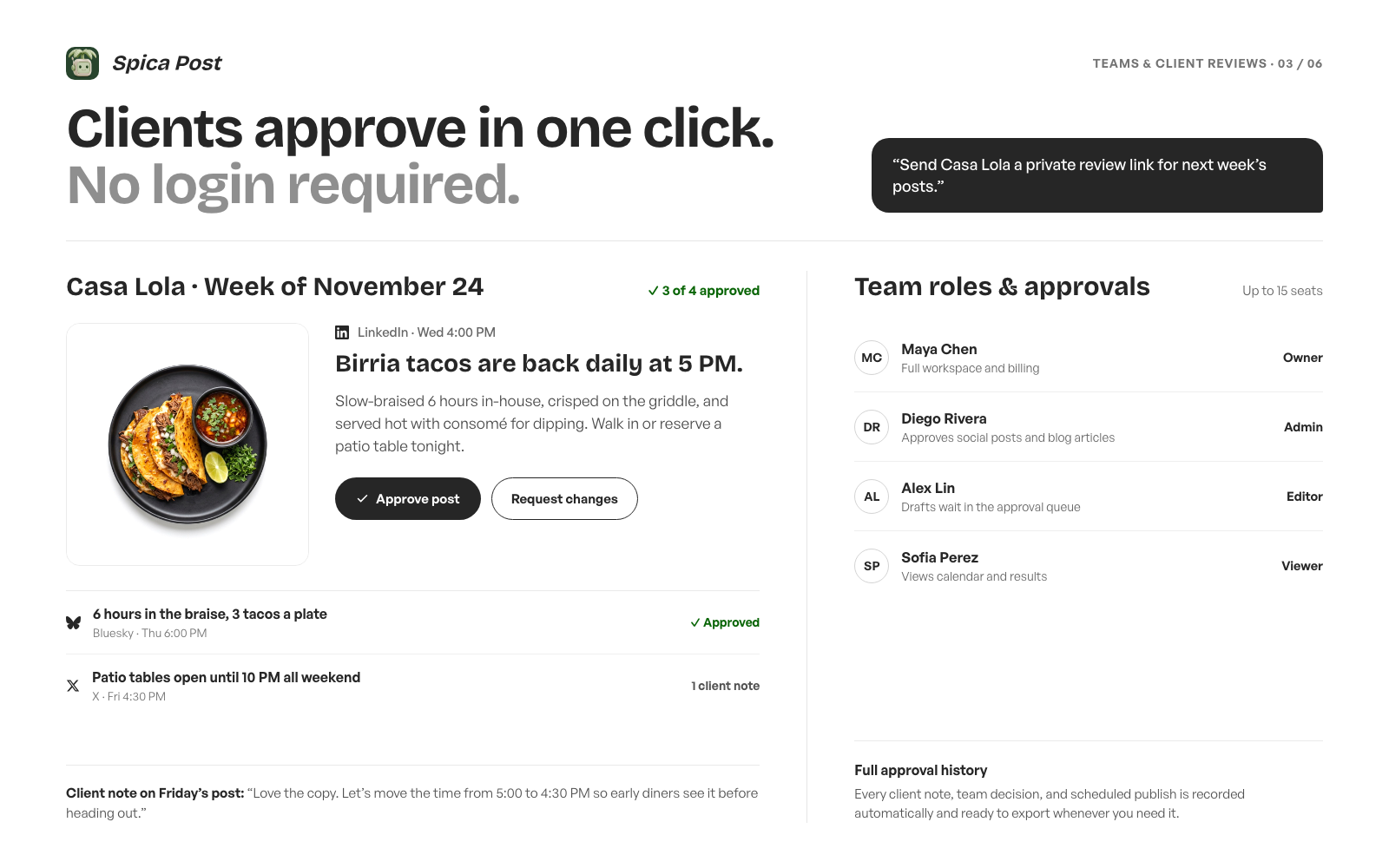
403 approval_required: Workspaces assign Owner, Admin, Editor and Viewer roles. Whenever an Editor (or any user whenrequireApprovalis toggled on) callspublish,schedule,schedule_batch,queue_addorjobs_retryover Web, REST or MCP, the server rejects direct execution with403 approval_requiredand instructs the caller to submit the draft viaapprovals_submit. - Zero-login client sign-off: Agencies can also generate shareable
/review/<token>calendar links (via web, REST orreview_links_save) so external clients preview scheduled posts and click Approve or Request changes without creating an account, firingreview.submittedwebhooks right back to your system.
3. Concrete REST /v1 flow: draft, idempotent schedule and signed webhooks
A production backend publishing flow takes three clean steps against https://app.spicapost.com/v1 (full OpenAPI 3.0.3 schema published at /v1/openapi.json, paced at up to 120 requests per minute):
Step A: Create a validated draft
curl -X POST https://app.spicapost.com/v1/drafts \
  -H "Authorization: Bearer sp_live_your_brand_key" \
  -H "Content-Type: application/json" \
  -d '{
    "title": "v2.4 release notes",
    "variants": [
      {
        "accountId": "acc_bsky_01",
        "text": "Shipped v2.4 today: faster webhook retries and lean MCP tool profiles. Full changelog at https://example.com/changelog",
        "mediaIds": ["med_01"]
      },
      {
        "accountId": "acc_x_01",
        "text": "Shipped v2.4 today: faster webhook retries and lean MCP profiles. Changelog: https://example.com/changelog",
        "mediaIds": ["med_01"]
      }
    ]
  }'
Step B: Schedule idempotently (safe to retry on network timeouts)
curl -X POST https://app.spicapost.com/v1/drafts/drf_123/schedule \
  -H "Authorization: Bearer sp_live_your_brand_key" \
  -H "Content-Type: application/json" \
  -d '{
    "version": 1,
    "idempotencyKey": "release-v2-4-2026-11-23",
    "scheduledAt": "2026-11-24T14:00:00Z"
  }'
Passing both optimistic locking (version) and a deterministic idempotencyKey guarantees that if your worker crashes mid-request or retries after a 502 timeout, the post is never double-published. (For single-shot backend scripts that do not need a draft preview, POST /v1/posts writes and schedules in one call.)
Step C: Verify incoming HMAC webhooks
Spica Post supports up to 5 HTTPS webhook endpoints per brand across 14 event types (post.scheduled, post.rescheduled, post.published, post.failed, post.needs_check, post.cancelled, draft.created, draft.updated, review.submitted, approval.requested, approval.approved, approval.rejected, inbox.replied, and account.needs_reconnect), with automatic exponential retries (up to 8 attempts over 24 hours). Every delivery carries Spica-Event and Spica-Signature: t=<unix_ts>,v1=<hex_digest> signed with your whsec_ secret:
import { createHmac, timingSafeEqual } from 'node:crypto';

export function verifySpicaWebhook(rawBody, signatureHeader, secret, maxAgeSec = 300) {
  const parts = Object.fromEntries(
    String(signatureHeader || '')
      .split(',')
      .map((kv) => kv.split('='))
  );
  const ts = Number(parts.t);
  if (!Number.isFinite(ts) || !parts.v1) return false;
  if (Math.abs(Math.floor(Date.now() / 1000) - ts) > maxAgeSec) return false;

  const expected = createHmac('sha256', secret)
    .update(`${parts.t}.${rawBody}`)
    .digest('hex');

  const a = Buffer.from(expected, 'hex');
  const b = Buffer.from(parts.v1, 'hex');
  return a.length === b.length && timingSafeEqual(a, b);
}
4. Concrete MCP flow: full 170-tool server vs lean ?profile=core
Connecting a coding agent or chat assistant requires zero client boilerplate:
- Claude Code:
claude mcp add --transport http spica-post https://app.spicapost.com/mcp - Codex:
codex mcp add spica-post --url https://app.spicapost.com/mcp - Antigravity (
agy):agy mcp add spica-post https://app.spicapost.com/mcp - Cursor, VS Code and JSON configs: point
"spica-post": { "url": "https://app.spicapost.com/mcp" }insidemcpServers.
For smaller context windows or narrow single-purpose agents (for example, a Cursor workspace rule that only drafts release posts), append ?profile=core (https://app.spicapost.com/mcp?profile=core) to load a compact 28-tool profile instead of all 170 tools. Either way, every call still passes through the exact same brand wall, limit validator, role gate and searchable 2,000-entry CSV audit log.
Keep your agent context tight. Use the full MCP server for general marketing and agency assistants that touch calendars, link pages, inbox replies and analytics; use ?profile=core for narrow coding or CI assistants that only draft and schedule release updates.
Production security and reliability checklist
Whether you build on Spica Post, Post Bridge, Ayrshare, Postiz or direct SDKs, verify these six operational invariants before going live:
- Require idempotency keys on every write path. Network retries without idempotency keys are the #1 cause of duplicate social posts.
- Validate webhook timestamps and use constant-time comparison. Reject signatures older than 5 minutes (
maxAgeSec = 300) and always compare digests withtimingSafeEqualon the raw request body bytes. - Normalize images to JPEG before upload. Every major network accepts JPEG, whereas PNG, WebP and iPhone HEIC fail silently or get rejected on specific endpoints (especially Instagram).
- Never store long-lived social OAuth tokens in client-side code or LLM prompts. Keep tokens sealed server-side and hand agents short-lived OAuth sessions or single-brand Bearer keys stored in a secrets manager.
- Subscribe to
account.needs_reconnectandpost.failedwebhooks. Social tokens expire when users change passwords or revoke permissions; alert your team before Monday’s scheduled campaign silently fails. - Keep an immutable audit trail. When multiple engineers, scripts and AI assistants share a workspace, a timestamped audit log attributing each action to the real user or key saves hours during incident review.
Which stack should you build on? (Shortlist)
- You want a unified REST
/v1API, HMAC webhooks, a deep 170-tool MCP server, brand-isolated keys AND a built-in human approval studio at flat pricing: Start with Spica Post (explore /developers/, /mcp/ and pricing). - You need live API publishing to Instagram, TikTok, YouTube, Pinterest and GBP this week with a lean 16-tool MCP server and high account scale: Start with Post Bridge (see Spica Post vs Post Bridge).
- You are embedding white-label multi-tenant social OAuth inside a SaaS product for hundreds of external customers: Start with Ayrshare Business or Enterprise (see Spica Post vs Ayrshare).
- You want AGPL-3.0 open-source code to self-host on your own Docker infrastructure (and you are willing to run your own OAuth app reviews): Start with Postiz (see Spica Post vs Postiz).
5-step integration smoke test before shipping
Run this five-step verification sequence in staging or on a low-stakes test brand before connecting production client accounts:
- Inspect live schema and auth scopes. Fetch
/v1/openapi.json(or connect/mcp?profile=core), callaccounts_list/GET /v1/accounts, and confirm the key sees only its intended brand. - Test deliberate validation failures. Submit a 350-grapheme Bluesky draft and confirm the validator returns structured field-level limit errors before anything reaches the queue.
- Test idempotent retry safety. Send the exact same
POST /v1/drafts/{id}/schedulepayload twice with the sameidempotencyKeyand confirm only one job is created. - Test the role approval boundary. Attempt a direct publish as an Editor (or with
requireApprovalenabled) and verify the server blocks it with403 approval_required. - Verify webhook signature rejection and delivery. Send a ping webhook, confirm your handler returns HTTP 200 for a valid
Spica-Signatureand HTTP 401 when one character of the body is tampered with.
Questions people ask
- When should I use a social media REST API vs a remote MCP server?
- Use a REST API for deterministic backend jobs such as publishing when a CMS article ships, syncing inventory launches, or wiring Zapier, Make and CI pipelines. Use a remote MCP server when an AI assistant or coding agent (Claude, ChatGPT, Cursor, Codex, Gemini) needs to inspect brand context, check platform limits, draft copy and route posts for human approval without custom glue code.
- Why do developers use a unified social media API instead of integrating X, Meta, LinkedIn and Bluesky directly?
- Each social network enforces its own OAuth flow, token expiration rules, media container upload pipeline, character math and multi-week app review process. A unified API or MCP server normalizes publishing, media uploads, retries and webhooks behind one contract so your team stops maintaining seven fragile platform adapters.
- How does brand isolation work when an AI agent or script manages multiple client accounts?
- Look for strict server-side boundaries rather than prompt instructions alone. On Spica Post, every REST API key is scoped to exactly one brand, and multi-brand MCP sessions require an explicit brandId parameter on every tool call (refusing calls that omit it), eliminating accidental cross-client posts.
- How do I stop an AI agent or automated script from publishing unapproved content?
- Enforce approvals at the API and server layer, not only in your prompt. In Spica Post, assigning a teammate the Editor role or enabling the workspace approval switch blocks direct publish and schedule calls with HTTP 403 approval_required across Web, REST and MCP until an Owner or Admin approves.
- Do I need an API key to connect Claude, ChatGPT or Cursor to a remote MCP server?
- On OAuth-enabled remote MCP servers like Spica Post, no API key or secret is pasted into chat settings. You add one server URL, sign in through your browser and click Allow, and you can revoke the grant instantly from your account page. Bearer API keys are reserved for your own backend REST scripts.
Sources
- Spica Post REST API, OpenAPI 3.0.3 specification and signed webhooks
- Spica Post MCP server architecture, 170 tools and client setup
- Spica Post live pricing, plans and allowances
- Model Context Protocol (MCP) official specification
- OpenAPI 3.0.3 Specification
- X API v2 developer documentation and character counting
- Bluesky ATProto developer documentation and rich text facets
- Meta Instagram Platform Content Publishing API documentation
- Post Bridge pricing, REST API and MCP documentation (verified Nov 2026)
- Ayrshare API tiers, multi-tenant profiles and pricing (verified Nov 2026)
- Postiz open-source and cloud pricing (verified Nov 2026)
- Buffer pricing and developer ecosystem (verified Nov 2026)
- Nuelink pricing and automations (verified Nov 2026)
- MicroPoster pricing and API waitlist page (verified Nov 2026)