Buffer
8 Best Buffer Alternatives in 2026 (By Workflow & Real Account Cost)
Compare 8 Buffer alternatives in 2026 by real 3-to-30 channel cost, Start Page migration, live networks, approvals, MCP and REST API access.
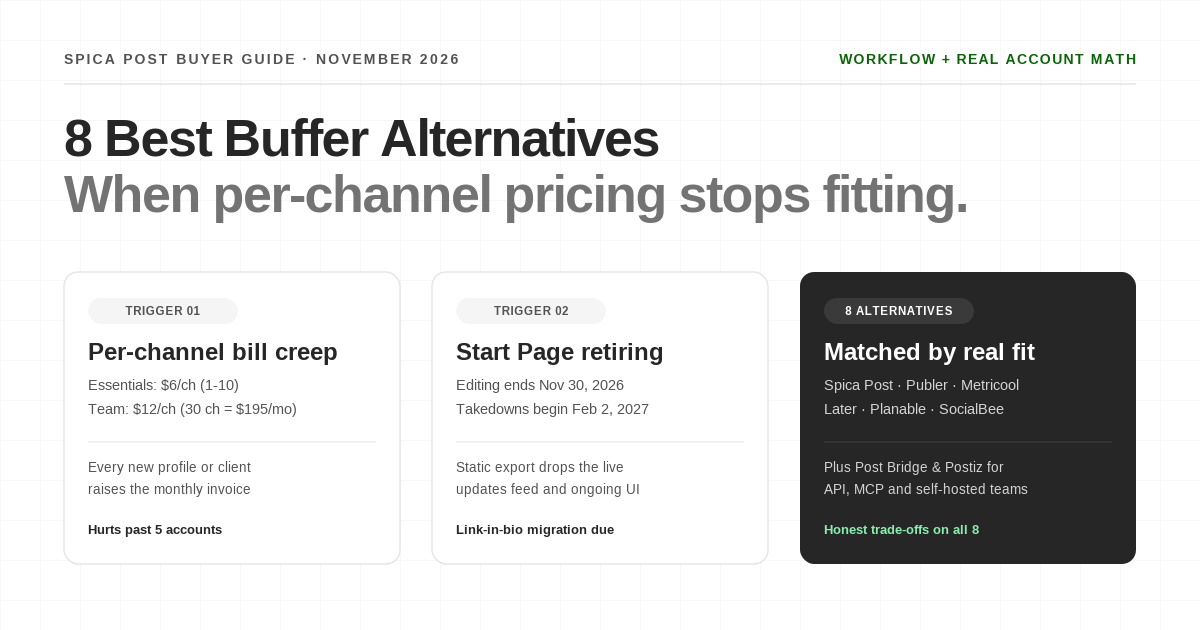
The best Buffer alternative in 2026 depends on why you are outgrowing Buffer: Spica Post for flat multi-brand pricing, AI-assistant MCP publishing, client review links, Auto-crosspost and a direct Buffer Start Page replacement with a live posts feed; Publer for low-cost 1-to-3 account recycling and Spintax; Metricool for analytics, competitor benchmarks and paid-ad reporting; Later for visual Instagram, TikTok and Pinterest grids; Planable for pixel-faithful agency mockup reviews; SocialBee for evergreen category queues; Post Bridge for flat high-account API publishing across 10 live visual and video networks today; and Postiz for AGPL-3.0 self-hosting or 20+ cloud platforms.
Buffer earned its reputation honestly. It is clean, dependable, supports 12 live networks (including Mastodon and Substack), and still offers one of the fairest forever-free plans on the market for three channels. For a solo creator testing a weekly cadence across Instagram, LinkedIn and Bluesky, staying on Buffer makes total sense.
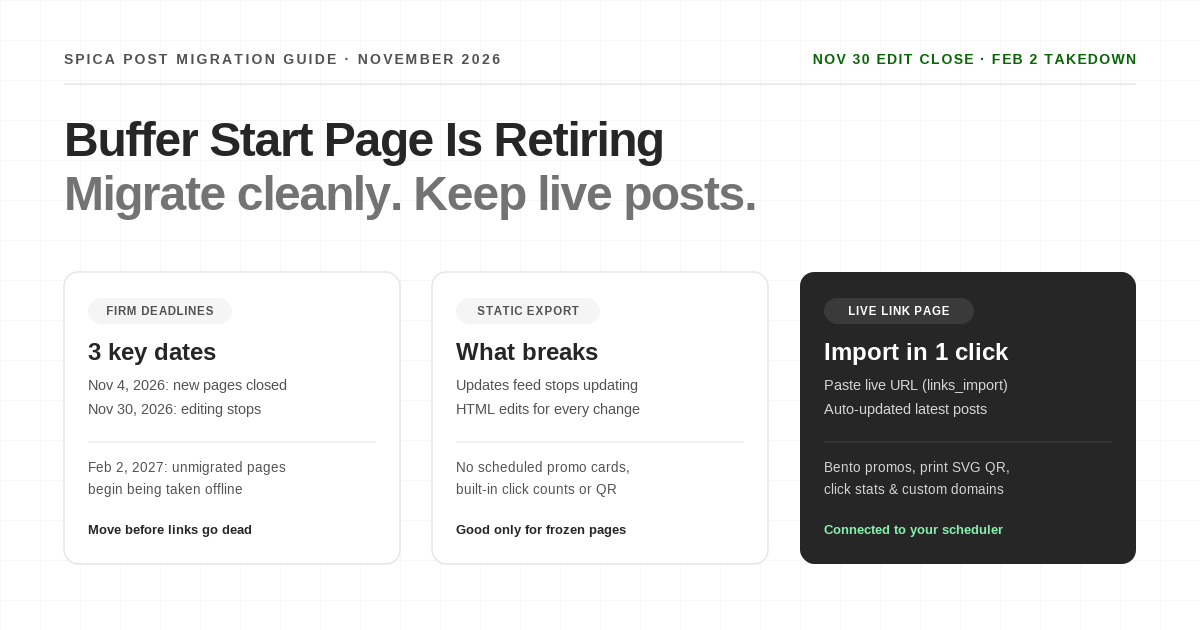
People leave Buffer for two very specific reasons in late 2026: per-channel billing math once they add a second brand or team approvals, and Buffer’s Start Page retirement announced on November 4, 2026 (editing ends November 30, 2026; takedowns begin February 2, 2027). The eight tools below are ordered for workflow navigation, not a single generic ranking, with honest trade-offs for every option including Spica Post.
Snapshot verified November 2026. Competitor prices are in USD and reflect published billing terms as of November 23, 2026. Check each provider’s live pricing page before subscribing, and check Spica Post’s pricing page for current Spica Post plans and account allowances.
Why teams outgrow Buffer: per-channel math and Start Page retirement
Before picking a replacement, check whether your frustration comes from price scaling, missing link pages, workflow gaps, or API limits.
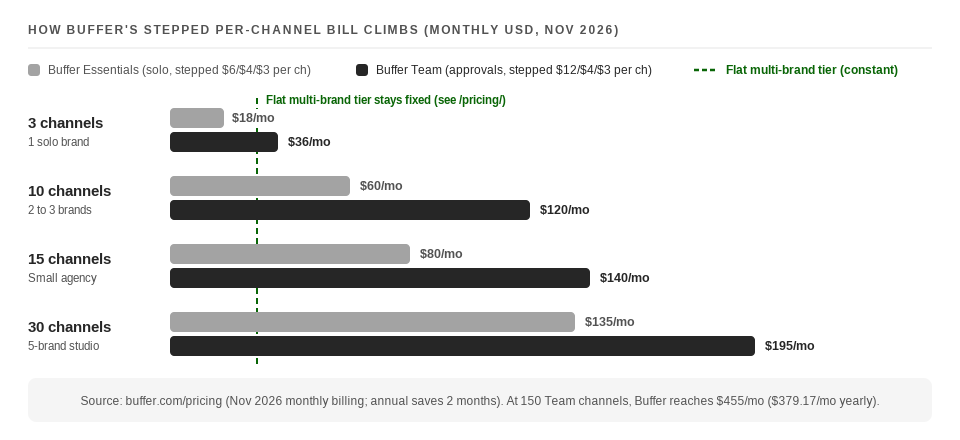
1. How Buffer’s stepped per-channel bill actually adds up
Buffer discounts channels above 10 ($6/ch for channels 1 to 10 on Essentials, $4/ch for 11 to 25, $3/ch for 26 to 50, $1/ch for 51+; and $12/ch for channels 1 to 10 on Team, $4/ch for 11 to 25, $3/ch for 26 to 50, $2/ch for 51+; annual billing saves 2 months). Even with volume steps, multi-brand totals climb steeply:
| Connected accounts | Buffer Essentials (monthly / yearly) | Buffer Team with approvals (monthly / yearly) | Typical buyer stage |
|---|---|---|---|
| 3 channels | $18/mo ($15.00/mo yr) | $36/mo ($30.00/mo yr) | 1 solo brand or small shop |
| 10 channels | $60/mo ($50.00/mo yr) | $120/mo ($100.00/mo yr) | 2 to 3 brands |
| 15 channels | $80/mo ($66.67/mo yr) | $140/mo ($116.67/mo yr) | Small agency or multi-location business |
| 30 channels | $135/mo ($112.50/mo yr) | $195/mo ($162.50/mo yr) | 5-brand studio or boutique agency |
| 150 channels | $335/mo ($279.17/mo yr) | $455/mo ($379.17/mo yr) | Scaling agency |
The crossover hits faster than most buyers expect. As soon as a small business connects 5 channels (Instagram, Facebook, LinkedIn, X, Bluesky or Google Business Profile) or turns on approvals for just 3 channels on Buffer Team ($36/month monthly), flat multi-brand tools begin saving hundreds to thousands of dollars a year.
2. Buffer Start Page is shutting down (and static export drops the live feed)
On November 4, 2026, Buffer disabled new Start Pages. Editing closes November 30, 2026, and unmigrated pages begin coming down February 2, 2027. While Buffer’s migration tool exports static HTML files and sets up a redirect, Buffer explicitly notes that the live social updates feed disappears on export, and future edits mean touching raw HTML or migrating to another link-in-bio service (see our full Buffer Start Page migration guide).
3. API media hosting and native cross-posting limits
Buffer’s GraphQL API and MCP connector are available even on Free (sharing 3,000 to 100,000 requests per 30 days), but Buffer’s developer docs specify that its API does not host media, forcing scripts and agents to host public image and video URLs externally. Buffer also has no native background auto-crosspost poller watching X or Bluesky, and no live .ics or Google Sheets calendar feeds.
Count your projected accounts twelve months from now, not today. If you plan to add a second brand, a teammate approval step or branded link pages, switch to a flat multi-brand pricing model before rebuilding your calendar twice.
8 Buffer alternatives compared at a glance
| Platform | Best fit | Billing unit | Approvals & client review | Link-in-bio replacement | API & MCP | Entry price (Nov 2026) |
|---|---|---|---|---|---|---|
| Spica Post | Multi-brand businesses, agencies, AI-assistant MCP & Start Page movers | Flat per plan (accounts & brands bundled) | Roles, internal queue, zero-login /review/<token>, CSV audit |
Yes (/@handle + live posts feed, URL import, QR, Pro custom domain) |
161 REST routes, 14 signed webhooks, 170 MCP tools + native media | One-time Starter & flat monthly plans (see pricing) |
| Publer | Solo/small teams wanting recycling, Spintax & Linkie | Per account (+ extra users) | Roles & approvals gated to Business ($10/acc/mo) | Yes (Linkie included) | API & MCP gated to Business | Free (3 accts, no X); $5/acc Pro; $10/acc Business |
| Metricool | Analytics, competitor tracking, ads & Spanish teams | Per brand tier (+ X add-on) | Approvals gated to Advanced ($53 to $67/mo) | Yes (SmartLinks) | MCP available; REST API on Advanced+ | Free (1 brand, no X/LinkedIn); Starter from ~$22/mo |
| Later | Visual Instagram grids, TikTok, Pinterest & Linkin.bio | Per Social Set (post caps apply) | Higher tiers only | Yes (Linkin.bio) | Limited developer focus | Starter $25/mo (1 set, 30 posts/profile); Growth $50/mo |
| Planable | Visual agency mockups & multi-level client feedback | Per workspace (brand) | Core strength (unlimited collaborators) | No | Limited | Basic $39/mo (4 pages); Pro $59/mo per workspace |
| SocialBee | Evergreen category queues & RSS recycling | Per profile tier | Higher agency tiers | No | No public self-serve REST API or MCP | Bootstrap $29/mo (5 profiles, 1 user) |
| Post Bridge | Developers & operators needing 10 live visual/video networks now | Flat tiers + $1/extra acct | No approval queue or client review portal | No | REST API, npm CLI & 16 MCP tools | Marketer $39/mo (15 accts); Operator $99/mo (99+ accts) |
| Postiz | Developers wanting AGPL-3.0 self-hosting or 20+ Cloud networks | Free self-host or Cloud tiers | Team features on higher Cloud tiers | No | REST API, npm CLI & MCP | $0 self-host (Docker); Cloud $29/mo (5 ch), $49/mo (30 ch) |
1. Spica Post
Spica Post is built for small businesses, creators and agencies outgrowing Buffer’s per-channel invoices and retiring Start Pages. Instead of charging per profile, Spica Post bundles isolated brands, dozens of connected accounts, team seats, approvals, link pages, calendar sync, Auto-crosspost, a full REST API and a 170-tool MCP server into flat plan tiers (see pricing for current Starter, Studio, Pro and Agency caps).
Where it fits best
- Dramatic savings once you pass 3 to 5 channels: Check our Spica Post vs Buffer math to compare 3, 15, 30 and 150 accounts side by side with approvals turned on. Spica Post also offers a one-time Starter option with no monthly bill for smaller setups.
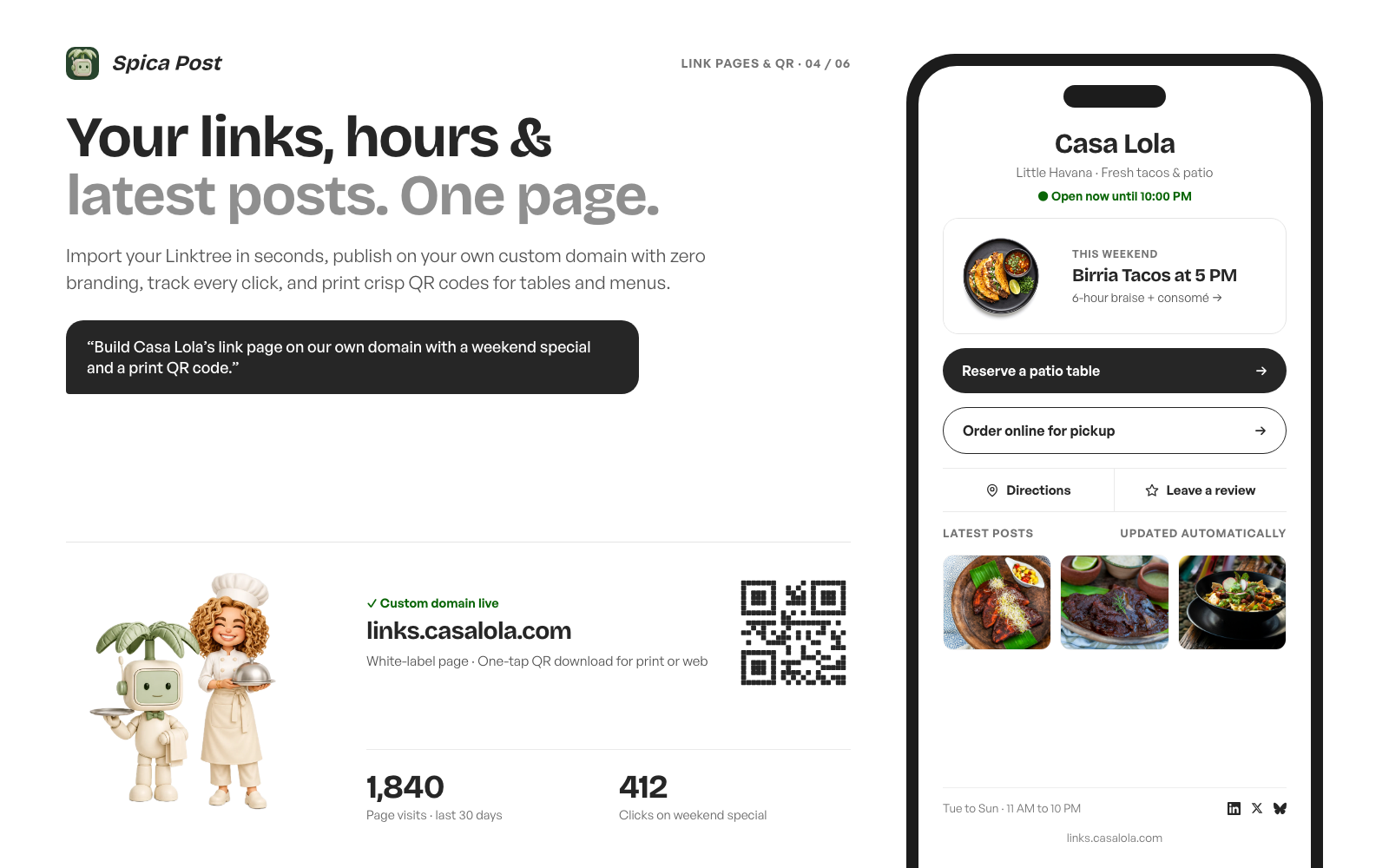
- Direct Buffer Start Page replacement with live posts: Paste your live Start Page URL into
/links(or ask your assistant to runlinks_import) to import your title, bio and buttons in one click, keep an automatic live latest-posts feed, add Bento promo boxes with start/end dates, download brand-styled SVG/PNG QR codes, track clicks on Studio/Pro, and map a white-label custom domain on Pro. - Agency governance without per-workspace multipliers: Role-based seats (Owner, Admin, Editor, Viewer), enforced
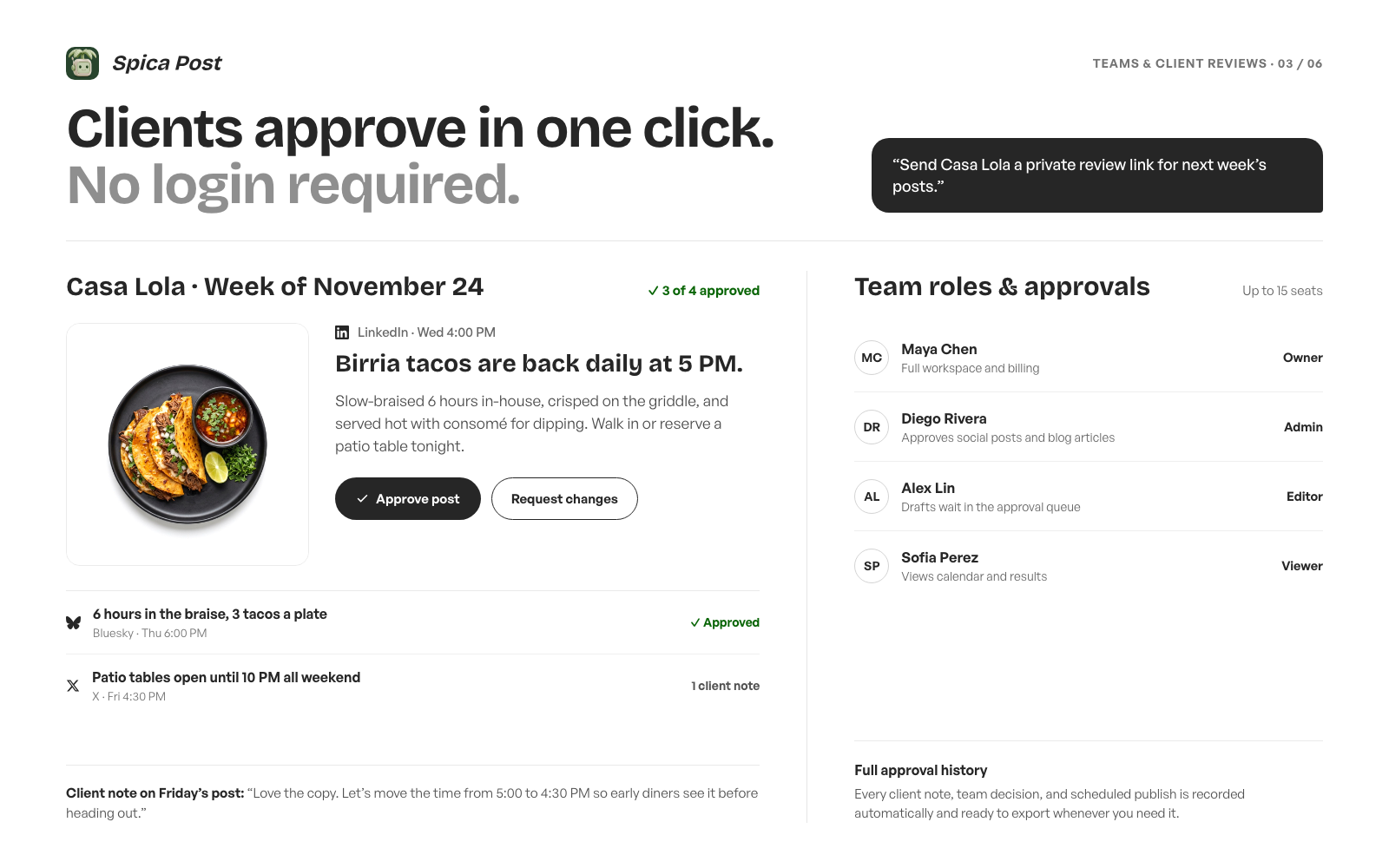
403 approval_requiredqueues for editors, searchable 2,000-entry CSV audit logs, live.icsand Google Sheets.csvcalendar feeds, and shareable zero-login client review links (/review/<token>). - MCP-first AI drafting + native Auto-crosspost + native media hosting: Connect Claude, ChatGPT, Gemini, Cursor or Codex over one OAuth link (with native R2 media uploads rather than BYO URL hosting), and mirror native X or Bluesky posts automatically with two-layer echo-loop protection.
Real trade-offs
- Live networks today vs. in review: X, Bluesky, Mastodon (any public server via OAuth dynamic registration) and LinkedIn (personal destination) require no central platform review on Spica Post. Instagram, Facebook Pages, Threads, Google Business Profile, YouTube, TikTok and Pinterest adapters are built in the app and unlock as each network’s official app review completes. If you need live Instagram Reels, TikTok or Substack publishing this week, stay on Buffer or pick a live-approved alternative below until reviews clear.
- No Substack adapter: Spica Post does not support Substack Notes publishing.
- No forever-$0 tier: Spica Post offers a 7-day free trial on Studio, Pro and Agency plus a one-time Starter tier, rather than a permanent $0 free plan.
2. Publer
Publer is a strong value alternative if you want Buffer’s familiar simplicity plus evergreen post recycling, Spintax caption variations, RSS auto-posting, automatic watermarks and Linkie bio pages across 12+ live networks (including Mastodon, Telegram and WordPress).
Where it fits best
Solo creators and small businesses running 1 to 3 accounts who want either a permanent $0 free plan (excluding X) or $4 to $5/account/month on Professional, with all major visual and video networks live today.
Real trade-offs
Publer charges per account plus per extra teammate, and gates its analytics, approval workflows, REST API and MCP server to Business ($10/account/month monthly, $8 yearly; every 10th account free). At 10 accounts with API/MCP and approvals, Publer Business runs roughly $72 to $90/month for one user before adding team seats (see Spica Post vs Publer).
3. Metricool
Metricool combines scheduling with deep cross-network analytics, competitor tracking (up to 100 competitors), paid-ad reporting (Meta, Google, TikTok Ads), Looker Studio connectors, SmartLinks and native Spanish support.
Where it fits best
Marketers, agencies and Spanish-speaking teams whose primary pain on Buffer is weak reporting and who want client-ready PDF/PPT decks alongside live publishing across major networks.
Real trade-offs
Metricool’s free plan excludes X and LinkedIn, X requires a paid add-on, and team approvals plus REST API access unlock only on Advanced ($53 to $67/month). It also lacks native X/Bluesky auto-crosspost mirroring and hosted bilingual blogs (see Spica Post vs Metricool).
4. Later
Later was built around visual Instagram grid planning, TikTok, Pinterest, YouTube and Snapchat and pairs scheduling with its established Linkin.bio storefront tool.
Where it fits best
E-commerce shops, restaurants and visual creators whose entire strategy revolves around how their Instagram grid looks and who want Linkin.bio tied to shoppable visual posts right now.
Real trade-offs
Later enforces strict monthly post caps per profile (for example, Starter at $25/month covers 1 Social Set with 30 posts/profile; Growth at $50/month monthly covers 2 Social Sets with 180 posts/profile), leans away from X and Bluesky text workflows, and does not ship an MCP server or developer REST suite.
5. Planable
Planable specializes in agency-client collaboration: pixel-accurate feed and Instagram grid previews, inline threaded comments directly beside each post, multi-level approval workflows and unlimited collaborators per workspace.
Where it fits best
Creative agencies managing demanding client stakeholders who insist on seeing visual feed mockups and commenting line by line before signing off.
Real trade-offs
Planable bills per workspace (brand): Basic starts at $39/month ($33 yearly, 4 pages, 60 posts/month) and Pro is $59/month ($49 yearly, 10 pages, 150 posts/month). Running 5 client brands with full approvals on Planable Pro costs $295/month monthly ($245/month yearly) and still caps monthly post volume per workspace. It also does not replace Buffer Start Page (see Spica Post vs Planable).
6. SocialBee
SocialBee excels at category-based evergreen queues: you organize posts into buckets (Tips, Case Studies, Offers, Curated Links), import RSS feeds, generate variations with built-in AI, and let SocialBee rotate your library automatically across all major networks.
Where it fits best
Coaches, podcasters and small businesses sitting on a deep library of evergreen educational tips who want set-and-forget category rotation rather than weekly batching.
Real trade-offs
SocialBee scales steeply for multi-brand teams (Bootstrap is $29/month for 5 profiles and 1 user with no approvals; Pro150 reaches $449/month monthly / $374/month yearly), has no public self-serve REST API or MCP server, and offers no link-in-bio page replacement.
7. Post Bridge
Post Bridge is a lean, modern publisher with all 10 major social networks live today (Instagram, TikTok, YouTube, Facebook Pages, LinkedIn, Pinterest, X, Bluesky, Threads and Google Business Profile), a REST API, an npm CLI (npx postbridge-cli), client OAuth connect links and a 16-tool MCP server.
Where it fits best
Solo marketers, developers and high-volume operators pushing finished videos and captions to 15 to 100+ visual accounts via scripts or AI assistants (Marketer is $39/month for 15 accounts; Operator is $99/month for 99 accounts, then $1/account/month).
Real trade-offs
Post Bridge is publisher-only: no brand kit, no internal approval queue, no client post-approval portal, no workspace audit log, no link-in-bio Start Page replacement, and API keys span accounts rather than enforcing single-brand isolation (see Spica Post vs Post Bridge).
8. Postiz
Postiz is an AGPL-3.0 open-source scheduler supporting 20+ platforms on Postiz Cloud (including Reddit, Discord and Mastodon) with a REST API, npm CLI, MCP server and built-in AI media credits.
Where it fits best
Developers who want to self-host on Docker for the cost of a VPS (and do not mind registering and renewing their own Meta, X, LinkedIn and TikTok OAuth apps), or teams needing Reddit and Discord publishing on Cloud.
Real trade-offs
On managed Postiz Cloud, Standard is $29/month for 5 channels and 1 user (Pro is $49/month for 30 channels), giving less managed account and approval value than flat multi-brand studios. Self-hosting shifts every OAuth review, broken webhook and database migration onto your engineering team (see Spica Post vs Postiz).
Never switch off Buffer purely to chase a lower entry sticker price. Switch because the new platform removes a structural bottleneck you actually hit: per-channel billing, Start Page retirement, weak approvals, missing MCP/API hosting, or lack of native cross-posting.
Quick shortlist: which Buffer alternative matches your setup?
- You are managing 5 to 150 accounts across multiple brands, migrating off Buffer Start Page, or wanting Claude/ChatGPT MCP + REST API + client approvals at flat pricing: Test Spica Post (see Buffer comparison and pricing).
- You manage 1 to 3 solo channels and want a $0 free plan or cheap evergreen recycling with all visual networks live today: Pick Publer (or stay on Buffer Free if 10 queued posts/channel is enough).
- Analytics, competitor tracking, ad dashboards and Spanish UI come first: Pick Metricool.
- Visual Instagram grid curation and Linkin.bio drive your shop: Pick Later.
- Client visual mockups and threaded feedback justify per-workspace pricing: Pick Planable.
- You need 10 live video/visual networks via API and MCP this week at high account counts: Pick Post Bridge.
- You want open-source Docker self-hosting or Reddit/Discord support: Pick Postiz.
5-step Buffer migration checklist (including Start Page)
Switch cleanly without missing a scheduled post or breaking bio links:
- Audit active channels and upcoming Buffer queue. Export or copy any scheduled posts slated for the next 14 days so nothing slips during cutover, and note whether you are paying for an unused Start Page channel slot after November 30, 2026.
- Import your Buffer Start Page before February 2, 2027. While your Start Page is still live, run one-click import (
links_importor/linksin Spica Post), publish your replacement/@handleor custom domain page, configure Buffer’s migration redirect, and update your social bio URLs directly. - Verify your required live networks before cancelling Buffer. Connect your accounts in the new platform, confirm account types (personal profile vs company page, business vs creator), and keep Buffer Free (up to 3 channels) temporarily if any specific network (such as Mastodon, Substack or an in-review channel) still needs bridge coverage.
- Test approvals, media uploads and links with one real post. Publish a live test with a JPEG photo and a tracked link, verify formatting on each target network, and confirm team roles or client review links behave as expected.
- Cancel or downgrade Buffer billing cleanly. Reduce paid channel counts or downgrade to Buffer Free before your next renewal date once your new calendar and link pages are live.
Questions people ask
- Why are small businesses and agencies looking for Buffer alternatives in late 2026?
- Two concrete triggers are driving switches: Buffer's stepped per-channel pricing escalates quickly past 5 solo channels or 3 team channels (reaching $140/mo for 15 Team channels and $195/mo for 30 Team channels monthly), and Buffer announced on November 4, 2026 that it is retiring Start Page (editing closes November 30, 2026; takedowns start February 2, 2027).
- When is it smarter to stay on Buffer instead of switching?
- Stay on Buffer if you manage 1 to 3 solo channels on its permanent $0 Free plan, need all 12 live networks right now including Mastodon and Substack, or only manage 1 to 4 profiles with unlimited team members on a very small channel count.
- Which Buffer alternative replaces Buffer Start Page with a live latest-posts feed?
- Buffer's static Start Page export drops the live updates feed. Spica Post includes branded /@handle link pages with a live latest-posts feed, built-in one-click URL import (links_import), Bento promo cards, QR codes, click tracking on Studio, Pro and Agency, and white-label custom domains on Pro.
- Which Buffer alternative is best for agencies managing 15 to 30+ accounts?
- If you want flat multi-brand pricing with team approvals, zero-login client review links, calendar sync, link pages and MCP/REST automation, Spica Post cuts monthly spend sharply compared with per-channel billing. If you need 10 live visual and video networks today at high account volume without an approval portal, Post Bridge is another strong flat-tier pick.
- Do Buffer alternatives also support MCP and REST API automation?
- Yes, though implementation depth varies. Spica Post includes 170 MCP tools, 161 REST routes, signed webhooks and native media hosting on every paid plan. Post Bridge and Postiz also offer REST APIs and MCP servers, while Publer gates API and MCP to its Business tier and SocialBee has no self-serve public API or MCP server.
Sources
- Buffer pricing and stepped per-channel billing (verified Nov 23, 2026)
- Buffer: We are Retiring Start Page (Nov 4, 2026)
- Buffer API rate limits and external media hosting docs
- Spica Post live pricing, plans and allowances
- Publer plans and per-account pricing (verified Nov 23, 2026)
- Metricool pricing, free tier and X add-on (verified Nov 23, 2026)
- Later pricing and Social Sets structure (verified Nov 23, 2026)
- Planable per-workspace pricing and approvals (verified Nov 23, 2026)
- SocialBee pricing and evergreen category queues (verified Nov 23, 2026)
- Post Bridge pricing, API and MCP documentation (verified Nov 23, 2026)
- Postiz open-source and cloud pricing (verified Nov 23, 2026)