Brand voice
How to Sound Like Yourself on Social Media (A Brand Voice in One Page)
Skip the 40-page corporate binder. Build a 1-page brand voice sheet in 30 minutes with real samples, banned clichés, and an easy team or AI handoff.
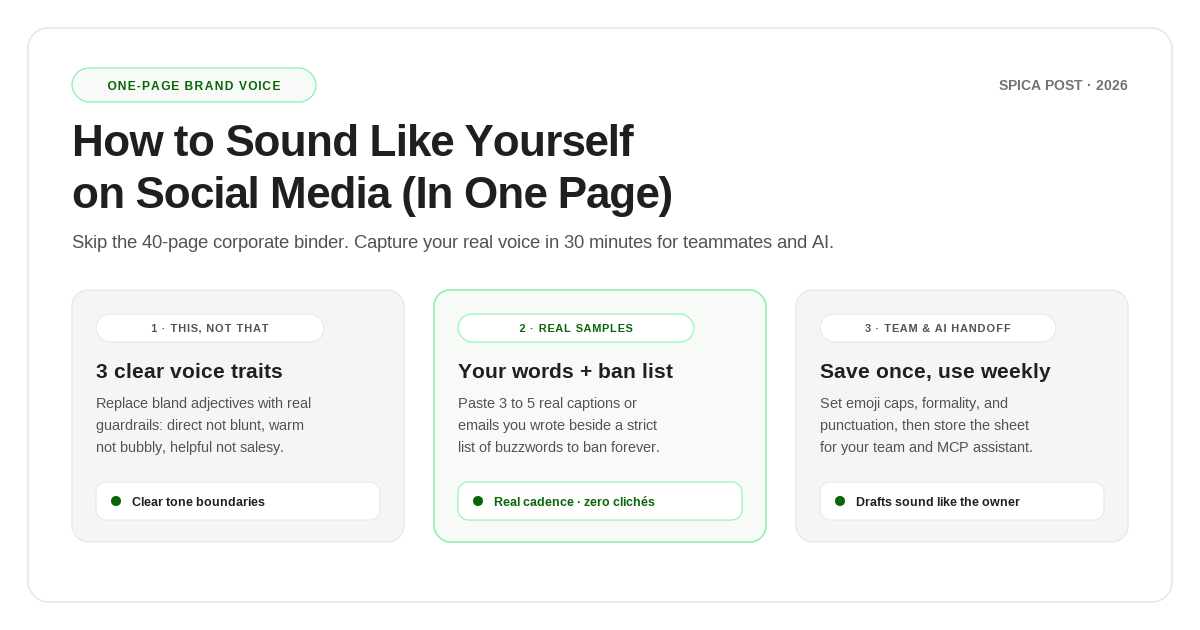
To build a brand voice for a small business that actually sounds like you, skip the 40-page corporate agency binder and write one practical page in 30 minutes holding five concrete ingredients: three traits paired with “this, not that” boundaries, phrases you actually say to customers alongside banned buzzwords, three to five real writing samples you already sent, four everyday style habits, and a clean handoff note for teammates or a connected AI assistant.
Most small businesses and creators do not struggle to sound human in person. Across a counter, over the phone, or inside a quick email to a repeat client, you sound calm, clear, helpful, and unmistakably yourself. The awkward shift happens the moment you open a blank social media composer or ask a helper to “write something engaging.” Suddenly a neighborhood baker writes “We are thrilled to elevate your weekend culinary journey!” and a local mechanic writes “Unlock seamless automotive excellence today!” Nobody talks like that, and customers scroll straight past it.
This guide explains why long brand manuals gather dust while a single concrete page changes your drafts immediately, walks step by step through each of the five ingredients with real examples across professions, hands you a complete copy-ready 1-page brand voice template, shows how to apply that sheet to both teammates and connected MCP assistants, and outlines honest Spica Post trade-offs.
Why 40-page brand binders fail small businesses (and why one page works)
Enterprise branding decks spend twenty pages on archetype wheels, mood boards, and abstract mission adjectives (“innovative, passionate, customer-centric, authentic”). As Nielsen Norman Group’s tone-of-voice research shows, real writing voice lives along concrete, observable dimensions (formal vs. casual, serious vs. playful, matter-of-fact vs. enthusiastic), not vague slogans that every competitor also claims.
When a busy shop manager, freelance designer, or connected AI tool needs to draft Tuesday’s update in five minutes, nobody opens a 40-page PDF. A one-page brand voice sheet solves that friction because every line is a direct, checkable decision:
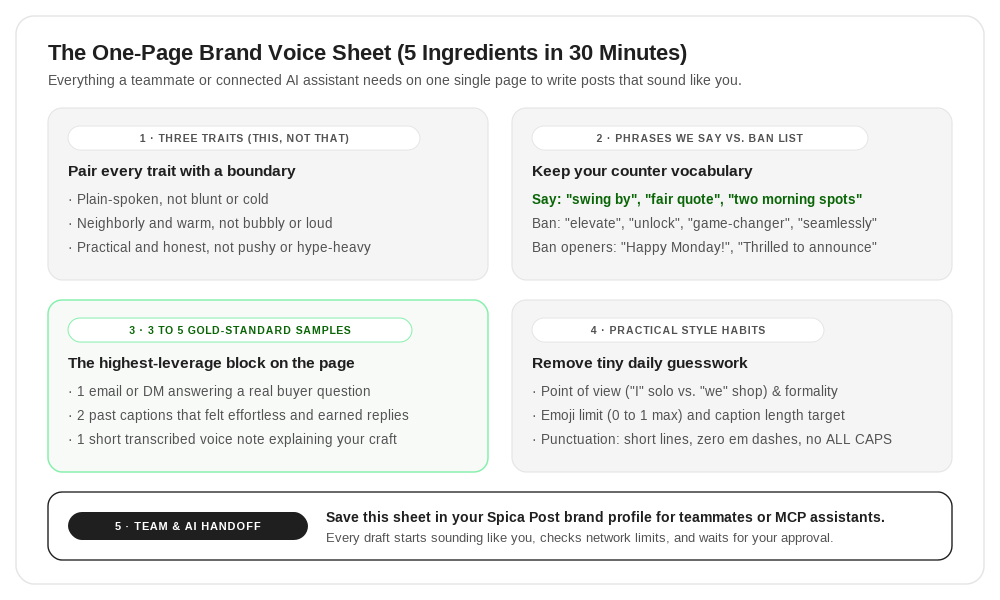
- It takes 30 minutes once instead of three agency workshops.
- Every rule is testable in seconds (you can look at a draft and immediately spot a banned word, three stacked exclamation points, or a stiff opener).
- It works identically for humans and AI assistants, keeping voice consistent whether you write the post yourself, hand it to an assistant manager, or draft through a connected workspace.
Ingredient 1: Three real traits with “this, not that” boundaries
Adjectives on their own are slippery. Tell two different writers to sound “friendly,” and one writes warm, plain sentences while the other adds six smiley emojis and opens every caption with “Hey besties!!”
Fix that immediately by picking exactly three voice traits and pairing every trait with a “not that” guardrail that stops writers from overshooting. Notice how clear these become across real small-business professions:
| Profession | Trait 1 (This, not that) | Trait 2 (This, not that) | Trait 3 (This, not that) |
|---|---|---|---|
| Neighborhood bakery | Warm and neighborly, not cutesy or bubbly | Specific about ingredients, not pretentious food-critic jargon | Honest about sell-outs, not fake scarcity hype |
| Plumbing or HVAC company | Plain-spoken and calm, not stiff or overly technical | Direct about pricing variables, not pushy or salesy | Helpful first, not lecturing or patronizing |
| Dental or wellness clinic | Reassuring and clear, not cold or clinical | Respectful of patient time, not overly casual or slang-heavy | Grounded in facts, not making exaggerated health promises |
| Boutique or gift shop | Practical and tasteful, not snobby or exclusive | Conversational, not breathless trend slang | Clear on sizing and care, not vague lifestyle fluff |
| Solo consultant or creator | Experienced and candid, not smug or guru-like | Concise and structured, not dry textbook prose | Generous with real examples, not vague motivational quotes |
Pick three pairs that feel true when you read them aloud. If a trait sounds like who you wish you were in a magazine ad rather than how you actually greet someone at your door, cross it out and write the honest version.
Ingredient 2: Phrases you actually say vs. banned buzzwords
Every owner already has natural spoken phrasing that makes regular customers smile and trust them. At the same time, marketing blogs and default AI drafts constantly inject hollow filler phrases that instantly erode trust (a pattern PlainLanguage.gov’s conversational writing guidelines advise replacing with direct, everyday words).
Spend five minutes building a two-column vocabulary list straight from your daily work:
Column A: Real counter phrases we actually use
Listen to how you talk to customers this week and jot down 6 to 10 genuine phrases you say naturally:
- How you greet or address buyers (“neighbors,” “folks,” “homeowners,” “friends,” or simply “you”).
- How you invite action (“swing by,” “call the front desk,” “drop your question below,” “grab a morning slot,” “bring your reference photo”).
- Everyday craft words specific to your profession (“fresh batch,” “walk-in bay,” “flat quote,” “two-week grow-out,” “wheel-thrown”).
Column B: Strict ban list (never publish these)
Write down 8 to 12 buzzwords, cliches, and throat-clearing openers that are permanently off-limits on your channels:
- Hollow verbs and adjectives: “elevate,” “unlock,” “transformative,” “game-changer,” “seamlessly,” “curated experience,” “unmatched excellence,” “delve.”
- Stiff corporate openers: “We are thrilled to announce,” “In today’s fast-paced world,” “At [Business Name], we pride ourselves on,” “Did you know…?”
- Forced social filler: “Happy Monday everyone!!,” “Link in bio for magic,” “Don’t walk, run!,” “Not just X, it’s Y.”
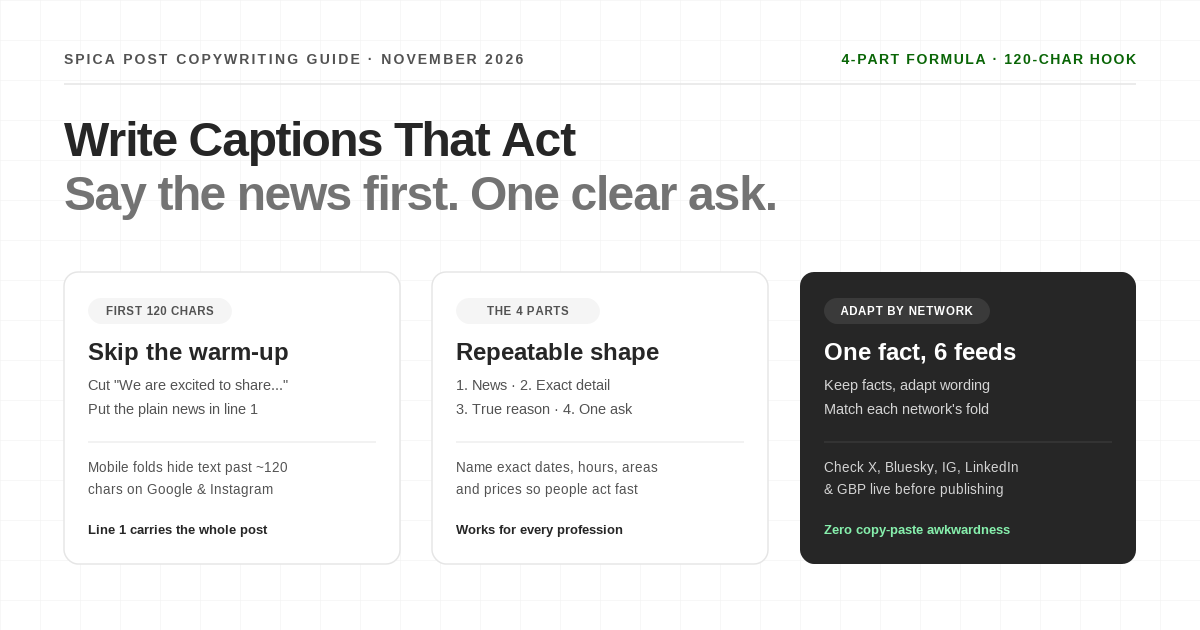
Cutting that short ban list alone immediately separates your posts from ninety percent of generic local accounts in your feed. For more caption-tightening tactics, pair this list with our four-part caption writing guide.
Ingredient 3: Three to five “gold standard” real samples
This single block does more work than every adjective on your sheet combined. Instead of trying to describe your rhythm abstractly, paste 3 to 5 short pieces of real writing you already produced where you sounded completely natural.
Where to find gold-standard samples if you dislike your old social posts
You do not need viral captions to find your true voice. Open three places where you already wrote without overthinking:
- Your email “Sent” folder: Find one reply where you calmly answered a tricky customer question about timing, care, or pricing. Sent emails almost always hold your clearest, warmest human cadence.
- A text message or DM to a regular: Pull a quick note letting someone know their order was ready or explaining an honest wait time (removing all private names or details).
- A reply to a Google review: Look for one review response that sounded warm and unscripted (see our Google review reply guide).
- A 45-second voice memo transcribed to text: Hit record on your phone, pretend a neighbor just asked your #1 counter question, answer aloud in three sentences, and transcribe your exact words.
Note one privacy boundary right beside your samples: never paste identifiable customer names, private phone numbers, personal situations, or customer quotes into public posts without asking the customer for explicit permission first. Keep internal voice samples anonymized if they came from private messages.
Ingredient 4: Practical style habits that end daily guesswork
Tiny formatting inconsistencies make a business account feel disjointed, especially when more than one person posts or when an AI assistant helps draft. Lock in five concrete formatting habits in five lines:
- Point of view and formality: Decide clearly between solo “I” (“I roasted a fresh Colombia lot at 6 AM”) and shop “we” (“We opened two Thursday repair bays”). If your business writes in Spanish or runs bilingual channels, state your formality explicitly right here: formal
usted(natural for clinics, law/tax offices, home services, and broad regional respect) versus informaltú(common for casual coffee shops, fitness studios, or personal creators). Never let half your posts sayustedand the other half saytú. - Emoji cap: Pick one clear number, such as 0 by default or at most 1 understated emoji at the end, and explicitly ban emoji bullet walls.
- Length and line rhythm: State your normal range (for example, “35 to 90 words in short 1-to-2-sentence paragraphs; put the concrete news inside the first 120 characters before mobile folds”). Check folds live anytime with our free character counter.
- Punctuation habits: State plainly what stays out: zero em dashes (use periods, colons, commas, or parentheses instead), at most one exclamation point per post (never
!!!), and no ALL-CAPS shouting. - Factual and permission guardrails: Never invent prices, discounts, hours, or guarantees; when a draft involves a client photo, home interior, or customer quote, include a mandatory check confirming explicit customer permission before scheduling.
Adapting one steady voice across networks without splitting personalities
Your voice stays constant everywhere; only the room changes slightly:
| Network | What stays identical | What adjusts cleanly |
|---|---|---|
| Google Business Profile | Plain vocabulary, honest facts, zero hype | Shortest and most direct; state hours, offer end date, and city in line 1 with zero hashtags |
| Instagram & Facebook | Warmth, real counter phrasing, emoji cap | Lead inside the first 120 to 125 characters before the fold; close with one clear local ask |
| LinkedIn (personal profile) | Direct, jargon-free honesty | Room for 100 to 180 words sharing a practical workbench lesson, milestone, or hiring note |
| X, Bluesky & Mastodon | Dry clarity, zero filler openers | Tightest pacing (inside 280 to 500 characters); plain descriptive alt text on every image |
| TikTok & YouTube Shorts | Spoken cadence matching your real voice | Front-load the payoff in seconds 0 to 3; keep spoken words simple and visual |
Copy-ready one-page brand voice sheet template
Copy this entire template into a single document (brand-voice.md or a one-page doc) and spend 30 minutes filling in the bracketed fields with real examples from your business:
One-Page Brand Voice Sheet: [Business or Creator Name]

## 1. Who We Are and Who We Talk To
- What we do: [Plain one-sentence description of your work]
- Where we serve: [City, neighborhoods, or online scope]
- Typical customer: [Who buys from you and what they care about most]

## 2. Three Voice Traits (This, Not That)
- [Trait 1, e.g., Direct and clear], NOT [guardrail, e.g., blunt or cold]
- [Trait 2, e.g., Warm and neighborly], NOT [guardrail, e.g., bubbly or hype-heavy]
- [Trait 3, e.g., Practical and honest], NOT [guardrail, e.g., salesy or lecturing]

## 3. Words We Say vs. Strict Ban List
- Real phrases we naturally use: "[Phrase 1]", "[Phrase 2]", "[Phrase 3]", "[Phrase 4]"
- Words and openers NEVER allowed: "elevate", "unlock", "game-changer", "seamlessly", "delve", "thrilled to announce", "in today's fast-paced world", "Happy Monday!", "not just X, it's Y"

## 4. Three to Five Gold-Standard Samples (Match This Rhythm)
- Sample 1 (Customer email or DM answer): "[Paste 3 to 4 real sentences, anonymized]"
- Sample 2 (Past social caption that felt effortless): "[Paste real caption]"
- Sample 3 (Spoken explanation of a common question): "[Paste 2 to 4 transcribed sentences]"
- Sample 4 (Optional review reply or seasonal update): "[Paste real reply]"

## 5. Practical Style and Fact Habits
- Perspective and formality: [e.g., Shop "we" / Solo "I"; Spanish formality: formal "usted" or informal "tú"]
- Length and mobile fold: [e.g., 35 to 90 words; concrete news inside first 120 characters]
- Emojis and punctuation: [e.g., 0 to 1 emoji max; zero em dashes; max one exclamation mark; no ALL CAPS]
- Factual and consent boundary: Never invent prices, hours, or offers. Ask explicit customer permission before posting any identifiable customer photo, home, or quote.
Ingredient 5: Handing your one page to a teammate or AI assistant
A brand voice sheet only pays off when it sits right where drafts get written.
Onboarding a teammate or helper in ten minutes
Hand a new shop coordinator, part-time marketer, or freelancer your one-page sheet alongside three real photos from this week and ask them to draft three test captions: one service availability update, one answer to a common customer question, and one reply to a 5-star review. Read all three aloud together. Every tweak you make in that ten-minute walkthrough eliminates weeks of awkward rewrites later.
Loading your voice into an AI assistant over MCP (without copy-pasting every chat)
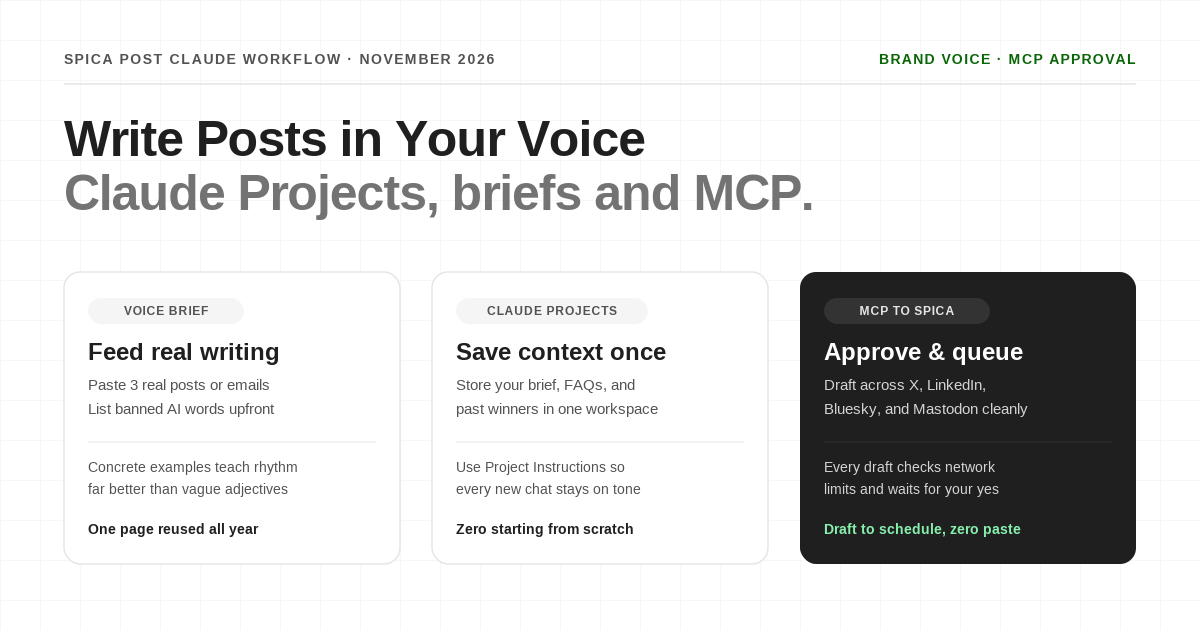
If you use Claude, ChatGPT, Gemini, or another assistant to turn quick weekly notes into multi-network drafts (see our guides on using Claude in your own voice and ChatGPT content calendar prompts), stop pasting tone instructions from scratch every Monday.
When you save your brand details inside Spica Post Studio and connect your assistant through Spica Post MCP (built on the open Model Context Protocol specification), your assistant reads your saved brand profile directly before drafting. Combine your saved Spica Post brand profile with your one-page voice sheet inside your assistant’s project instructions, then run a calm three-step weekly loop:
- Drop raw weekly facts (two finished jobs, a seasonal cutoff, or a real counter question) instead of asking the assistant to invent ideas out of thin air.
- Let your assistant draft and validate channel limits automatically against each network’s character and media limits while keeping your banned words out.
- Run the 20-second read-aloud test before saying yes. Read every draft aloud once. If you would stumble over a phrase talking to a neighbor at your front counter, swap those three words for your own before approving the schedule.
A 30-minute sprint to finish your sheet today
Block half an hour on a quiet afternoon and move through these five timers without overthinking:
- Minutes 0 to 5: Write your three “this, not that” traits.
- Minutes 5 to 12: Pull three sent emails or natural replies from your inbox and paste them as your gold-standard samples.
- Minutes 12 to 18: List six real phrases you say weekly and ten buzzwords you refuse to publish.
- Minutes 18 to 23: Lock in point of view, formality (
ustedvs.túif bilingual), emoji cap, punctuation, and customer permission guardrails. - Minutes 23 to 30: Save the sheet in your shared folder and Spica Post brand setup, then test it by drafting one real post for tomorrow.
Real trade-offs to weigh with Spica Post Studio and MCP
Here is the transparent November 2026 picture if you consider using Spica Post to hold your brand profile and draft with your assistant:
- What works live today: Spica Post gives you a saved brand profile (colors, fonts, logo, hours, business notes, and photos), branded post templates, hosted Link Pages with QR codes, tracked
/l/short links, full MCP connectivity for assistants like Claude and ChatGPT, and live direct publishing plus Auto-crosspost across X, LinkedIn personal profiles, Bluesky (with live Unified Inbox), and Mastodon. Review flat workspace plans anytime on our pricing page. - Honest platform and workflow limits: No saved brand profile or AI prompt replaces a real owner’s 20-second approval read; Spica Post intentionally waits for your approval rather than auto-generating unchecked posts behind your back. On network rollout, integrations for Google Business Profile (API approved, completing live profile verification), Instagram, Facebook Pages, Threads, TikTok, Pinterest, YouTube (OAuth verified, completing compliance audit), and LinkedIn Company Pages are built and finishing platform review before opening live across customer workspaces. You can still draft voice-true posts for every channel in Studio or over MCP today and paste into pending networks cleanly while approvals wrap up.
Open a blank single page today, pull three honest emails from your Sent folder, write down ten buzzwords you refuse to touch, and give yourself, your team, and your assistant one steady reference that sounds unmistakably like you.
Questions people ask
- Why does a small business need a brand voice sheet if the owner writes most posts?
- Even when you write most posts yourself, a one-page voice sheet saves you from slipping into stiff announcement language on busy Friday afternoons, and it lets a part-time teammate, agency helper, or connected AI assistant draft posts that already match your real phrasing before you spend time editing.
- How long should a small business brand voice guide be?
- One single page is ideal. Corporate 40-page brand binders get skimmed once and forgotten inside a shared folder. A crisp one-page sheet with three traits, a spoken-vs-banned phrase list, three to five real writing samples, and practical style habits actually gets read every week.
- What is the single most helpful part of a one-page brand voice guide?
- Your three to five gold-standard writing samples are the highest-leverage section on the page. Real emails, captions, or text replies you already sent to customers show your natural sentence length, rhythm, and word choices far more accurately than abstract tone adjectives like authentic or engaging.
- How do I use a one-page brand voice sheet with an AI assistant without sounding robotic?
- Store your sheet beside your saved brand details and pass both to your assistant alongside strict factual limits and a banned-word list. Ask the assistant to draft from your real weekly notes, verify every date and price, and never publish until you read the draft aloud and approve it.
- Should my brand voice change completely across LinkedIn, Instagram, TikTok, and Google Business Profile?
- Keep your core personality and vocabulary the same across every channel, and adjust only the pacing and format to fit the room. You stay the same honest owner everywhere; LinkedIn simply gets slightly deeper shop lessons, while Google Business Profile stays crisp, factual, and local.