Small business
DIY Social Media vs. Hiring an Agency: Real Hours and Costs
Compare true owner hours, hidden agency coordination time, 2026 retainer ranges, and the hybrid assistant path before signing a monthly contract.
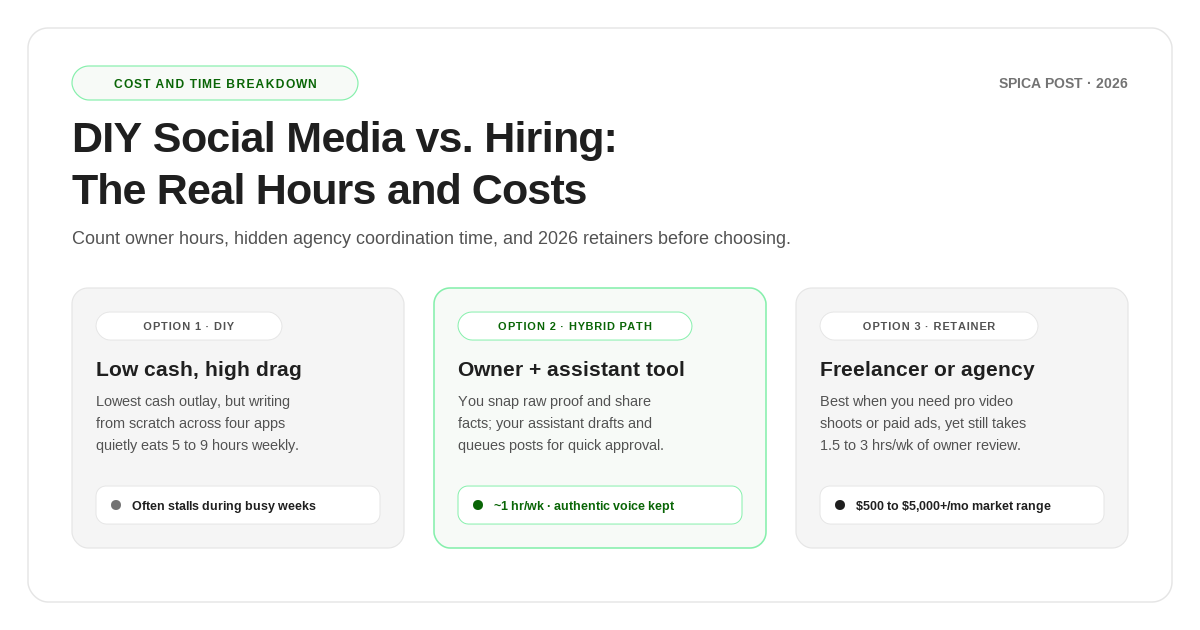
Deciding between DIY social media and hiring an agency comes down to two numbers most small business owners forget to include in the comparison: the real billable value of unstructured owner hours spent winging posts each week, and the hidden 1.5 to 3 hours a week of owner coordination that stays on your plate even after you sign a monthly agency retainer. If you need ongoing studio video production, complex paid ad campaigns, or dedicated full-time community moderation, hiring a strong freelancer or agency makes real financial sense. If you already know what happens in your business every week and only lack the time to draft, adapt, and schedule posts across networks, a hybrid middle path (owner proof plus an assistant-connected scheduler and fast approval queue) delivers far better authenticity at a fraction of retainer costs.
Every small business owner eventually hits the same fork in the road. You start running your own accounts in the evenings, get slammed with real customer work for three weeks, look up to see your profiles have been silent since last month, and immediately start pricing out freelancers and marketing agencies. That is the exact moment people overpay for retainers that still feel disappointing, or swear off hiring altogether and slide right back into stressful midnight posting.
This breakdown lays out the honest 2026 numbers behind all four paths (unstructured DIY, the hybrid middle path, freelance managers, and full-service agencies), unpacks the hidden agency coordination tax nobody puts in a sales deck, shares a copy-ready vetting checklist before you sign any contract, and explains when each option actually pays for itself.
Snapshot verified November 2026. Small-business retainer benchmarks reflect published 2026 U.S. marketing pricing surveys (such as WebFX) and U.S. Bureau of Labor Statistics occupational wage data. For current Spica Post workspace plans and allowances, always review Spica Post’s pricing page and the free Savings Calculator.
The true cost of unstructured DIY social media
DIY social media looks “free” on a profit-and-loss statement because no invoice arrives at the end of the month. That accounting illusion vanishes the moment you track every scattered minute spent trying to publish without a repeatable system.
Where 5 to 9 unstructured DIY hours quietly vanish every week
When an owner manages three or four channels manually without batching or templates, the clock rarely stops at “typing a caption”:
- Deciding what to say (1.5 to 2 hours/week): Staring at a blinking cursor after a 10-hour workday, scrolling competitors for inspiration, and getting pulled into unrelated feed videos.
- Hunting and fixing media (1 to 2 hours/week): Digging through camera rolls, cropping vertical photos into horizontal cuts, tweaking fonts in design apps, and discovering a PNG or HEIC file failed upload.
- Rewriting and posting across apps (1.5 to 2 hours/week): Logging into Instagram, Facebook, Google Business Profile, LinkedIn, or Bluesky separately, fighting login prompts, and tweaking text to clear each platform’s limits.
- Scattered inbox and review checks (1 to 2 hours/week): Opening five apps three times a day to see whether anyone asked about Saturday hours or left a Google review.
Even at a conservative 6 hours per week (roughly 25 hours a month), an owner whose operational or billable time is worth $75 an hour is spending $1,875 per month in opportunity cost on chaotic DIY marketing. Worse, DIY breaks at the exact wrong moment: the busier your shop, clinic, salon, or service truck gets, the faster posting drops to zero, creating a feast-or-famine lead cycle two months later.
What hiring a freelancer, agency, or employee really costs in 2026
Hiring outside help solves the blank-screen problem, yet pricing varies dramatically because “social media management” bundles completely different scopes under one label. Before comparing quotes, separate the three common hiring structures in 2026.
Freelancers, agencies, and in-house hires side by side
Published 2026 small-business market pricing surveys (such as WebFX social media pricing benchmarks) and federal labor benchmarks (U.S. Bureau of Labor Statistics occupational data) place realistic U.S. costs in these brackets:
- Independent freelancer ($500 to $2,500/month market range): Typically covers 1 to 2 core platforms, basic graphic creation, a monthly calendar of 8 to 16 posts, and light caption writing. Hourly freelance rates commonly fall between $35 and $150/hour depending on experience. Paid ad management, on-site filming, and weekend DM moderation are usually extra.
- Boutique or full-service agency ($1,000 to $5,000+/month market range): Entry small-business retainers frequently sit between $1,000 and $2,500/month for static organic management across 2 to 4 channels, scaling toward $3,000 to $5,000+/month when short-form video editing, monthly reporting calls, and active community management are bundled. Paid social ad management is almost always billed separately (either a percentage of ad spend or a separate monthly management fee on top of your actual media budget).
- Full-time in-house hire ($65,000 to $130,000+/year before overhead): According to the U.S. Bureau of Labor Statistics, median annual wages sit at $74,750 for public relations specialists and $133,660 for advertising and promotions managers, before payroll taxes, healthcare, software seats, and camera gear. In-house hiring only pays off once social content and paid campaigns generate major direct revenue every week.
The hidden coordination tax agencies rarely mention on sales calls
This is the single biggest surprise for small business owners who sign their first $1,800/month retainer expecting social media to disappear off their calendar forever: an outside agency does not live inside your shop, kitchen, studio, or service van.
Unless you pay extra for regular on-site photographers to shadow your crew every week, your agency still depends on you for four ongoing inputs:
- Raw real-world proof: Someone on your team still has to snap real photos of finished jobs, fresh inventory, staff moments, and seasonal specials, and confirm explicit customer permission before sharing any identifiable client face, property, or message. If you stop sending photos, your agency fills the calendar with sterile stock images and generic holiday quotes that locals scroll straight past.
- Operational facts: Your agency does not know that you changed holiday hours, hired a new specialist, sold out of a popular item, or launched a spring tune-up offer unless you email or message them ahead of time.
- Draft review and factual corrections: Because an outside writer does not know the exact technical nuances of your profession, you must read their monthly content batch and correct pricing errors, wrong terminology, or stiff corporate phrasing before it goes live.
- Status meetings and reporting calls: Biweekly or monthly check-ins plus back-and-forth Slack or email threads routinely add up.
Add those four realities together and most owners on a monthly retainer still spend 1.5 to 3 hours every single week feeding and reviewing their agency. If the agency delivers high-performing video ads or handles 200 customer DMs a day, those two coordination hours are a bargain. If you are spending two hours a week correcting bland organic captions you could have approved in fifteen minutes yourself, the retainer math breaks down fast.
Comparing all four models side by side
Before choosing a model, map your actual weekly owner hours (separating direct creation from hidden coordination) alongside monthly cash outlay.
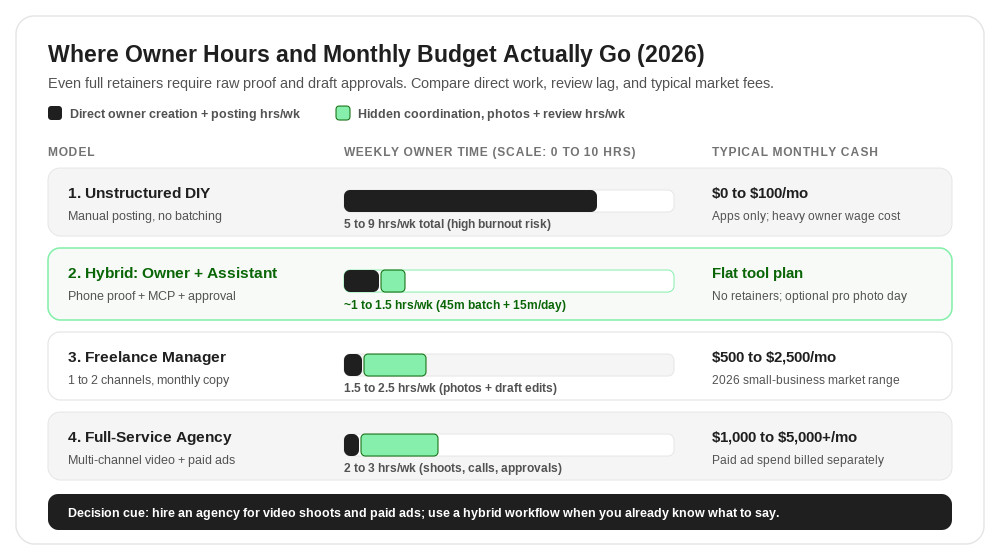
| Model | Owner time per week | Typical 2026 monthly cash | Voice authenticity | Handles pro video shoots and paid ads? | Best fit |
|---|---|---|---|---|---|
| 1. Unstructured DIY | 5 to 9 hrs (fragmented) | $0 to $100 (basic apps) | High, when active | Only if owner films and manages ads | Brand-new solo shops testing their first channel |
| 2. Hybrid: Owner + Assistant & Scheduler | 1 to 1.5 hrs (batched + daily check) | Flat workspace tool plan (check pricing) | Highest (real facts, your approval) | Pair with quarterly local photographer or specialist as needed | Most local businesses, service professions, and independent creators |
| 3. Freelance Manager | 1.5 to 2.5 hrs (photos + approvals) | $500 to $2,500/mo (market range) | Medium to High (depends on briefing) | Usually light editing only; ads often separate | Busy owners who dislike writing and have steady raw photos to hand over |
| 4. Full-Service Agency | 2 to 3 hrs (shoots, calls, approvals) | $1,000 to $5,000+/mo + ad spend | Medium unless closely guided | Yes (multi-skill team, paid media, video studio) | Multi-location brands or growth-stage companies scaling paid acquisition |
Notice a subtle software trap inside DIY and hybrid budgets as well: many legacy schedulers charge per social channel or per team seat, which quietly pushes a small team running eight or twelve accounts toward $100 to $250/month in tool fees alone. You can test your own channel and seat counts directly in our free Savings Calculator to compare per-channel bills against flat workspace plans before committing to any stack.
The hybrid middle path: how busy owners get agency consistency in 60 minutes a week
Between exhausting DIY and a $2,000/month retainer sits a practical middle lane that fits the majority of small businesses and creators in 2026: keep raw proof and final approval in-house, and hand repetitive drafting, formatting, and scheduling to your AI assistant connected to a clean publishing studio.
How the hybrid division of labor works in practice
Think about which 20 percent of social media actually requires the business owner, and which 80 percent is mechanical formatting:
- What only you (or your crew) can supply (20 minutes/week): Real phone photos snapped in daylight while you are already doing the work (with explicit customer permission whenever a customer’s face, home, or vehicle is visible), plain facts about this week’s hours or offers, and two real questions customers asked at the counter or on the phone.
- What an assistant + publishing studio handles (5 minutes of review): Your connected AI assistant (Claude, ChatGPT, Gemini, Grok, or another MCP-compatible assistant) reads your saved brand voice, hours, colors, and service area, turns your raw notes into tailored drafts for every connected network checked against each platform’s exact character and image limits, and loads them onto one visual calendar.
- What stays strictly under your control (10 minutes/week): Nothing publishes without your approval. You scan the drafted week in one sitting (or review posts through an internal approval queue or shareable zero-login client review link if a staff member drafts for you), fix any phrasing that does not sound like you, approve, and let scheduled slots run automatically while you work.
Adding selective specialist help without a permanent retainer
Choosing the hybrid path does not forbid hiring creative pros. In fact, it lets you deploy your marketing budget far more sharply: instead of paying $1,500 every month for generic Canva quotes, keep your weekly organic posting running smoothly on the hybrid workflow and hire a local photographer or videographer for one half-day shoot every quarter ($400 to $1,000 once a quarter). That single shoot gives you 40 crisp, real images and short clips of your team, storefront, and craft to feed your weekly calendar for the next ninety days.
Five questions to ask before signing any agency or freelancer contract
If your business genuinely needs ongoing paid ad management, heavy short-form video production, or multi-channel campaign creative, hiring a vetted freelancer or agency is a smart investment. Copy and email these five questions before paying a setup fee so there are zero surprises six months later.
Copy-ready agency vetting email template
Subject: Quick scope questions before we finalize the proposal
Hi [Name],
Thanks for sending over the proposal. Before we move forward, could you confirm five quick details in writing for our records?
Looking forward to reviewing these together. Best, [Your Name]
Copy-ready weekly owner-to-assistant (or freelancer) brief
Whether you hand your weekly facts to a freelance manager or straight to your AI assistant connected via MCP, a consistent five-line brief cuts revision time in half:
Weekly content brief for [Week of Date]:
- Operational news / hours: [e.g., Open regular hours Mon to Fri; closing at 2 PM Saturday for local street fair]
- Featured offer or open slots: [e.g., 3 Tuesday morning tune-up slots left; mention our spring checklist]
- Real customer question heard this week: [e.g., “How long does a full install usually take?”]
- Attached phone photos (customer permission confirmed on all): [Photo 1: finished patio deck in daylight; Photo 2: crew loading morning truck]
- Tone note: Plain, helpful neighbor tone, zero corporate buzzwords, link to our booking button.
A 4-point test to pick your path this week
Skip guesswork by answering four direct yes-or-no questions honestly:
- Do you need paid Meta, TikTok, or Google Ads managed actively every week to hit revenue targets? If yes, hire a paid-acquisition specialist or agency with clear ad-spend reporting, and keep organic posting lightweight.
- Does nobody on your team have the willingness or basic comfort to snap two clean daylight photos a week on a phone? If yes, budget for a recurring local content shooter or a local boutique agency that physically visits your location once a month.
- Do you already know your offers, hours, and customer questions, and simply get stuck writing and formatting posts for three or four networks? If yes, do not sign a $1,500/month retainer yet. Run the hybrid assistant-plus-scheduler workflow for 30 days first; you can always layer an agency on top later with far sharper clarity on what actually converts.
- Are you losing more than 4 hours a week to unstructured DIY without steady weekly posts going out? If yes, stop raw DIY immediately and move to either a structured 1-hour hybrid batch workflow or a scoped freelancer with clear deliverables.
Honest Spica Post trade-offs before you decide (November 2026)
If you are evaluating Spica Post for the hybrid middle path (or if you are an agency managing multiple small-business clients), here is what Spica Post handles today and what it intentionally does not replace:
- What is built and live today: Spica Post connects your own AI assistant (Claude, ChatGPT, Gemini, Grok, and other MCP clients) or web studio to flat workspace plans without per-channel or AI-credit add-ons (check our pricing page and Savings Calculator for live plan details). You get multi-brand isolation, team seats with roles, an internal approval queue, shareable zero-login client review links, a branded Link Page with click-tracked
/l/short links, direct publishing and Auto-Crosspost across X, Bluesky, Mastodon, and LinkedIn personal profiles, plus Bluesky comment triage inside the Unified Inbox. - What Spica Post does not do and what is in review: Spica Post is a publishing, drafting, and workflow studio, not a creative agency: it never visits your location to shoot video, never runs paid ad campaigns, and never replaces human judgment on sensitive customer issues. On network availability as of November 2026, connectors for Instagram, Facebook Pages, Threads, Google Business Profile, TikTok, YouTube, and Pinterest are built and completing platform review or verification (drafts prepared for pending networks wait cleanly in your workspace until connected). Review live network standing anytime before subscribing.
Before you sign a six-month contract or burn another Sunday night formatting captions by hand, measure one honest week of your hours, plug your account count into the Savings Calculator, and choose the simplest path your business can actually hold twelve months from now.
Questions people ask
- How much does it cost a small business to hire a social media freelancer or agency in 2026?
- Across 2026 small-business marketing surveys, freelance social media retainers commonly run $500 to $2,500 per month for one or two channels, while boutique agency retainers commonly range from $1,000 to $5,000 or more per month depending on video production, channel count, and community management. Paid advertising spend is almost always billed separately.
- Does hiring a social media agency eliminate the owner's weekly time commitment?
- No. Even with a full-service retainer, someone inside the business still spends roughly 1.5 to 3 hours a week shooting authentic job or product photos, collecting customer permissions, sharing real hours and promos, joining check-in calls, and reviewing drafts so posts do not read like generic stock templates.
- When is DIY social media actually more expensive than using a structured tool or hybrid workflow?
- Unstructured DIY becomes expensive the moment an owner who bills $75 to $150 an hour spends 6 to 8 fragmented hours a week wrestling with captions, resizing photos, and jumping across apps. Valuing your own time honestly shows why a disciplined 1-hour hybrid workflow beats both frantic DIY and premature agency retainers.
- What is the hybrid middle path between DIY and hiring an agency?
- In the hybrid path, the owner or front-desk team spends about 45 to 60 minutes a week capturing raw phone photos and plain weekly facts, an AI assistant connected to a scheduling studio drafts platform-adapted posts checked against every network's limits, and the owner approves the queue in five minutes. You can still hire a local photographer once a quarter for polished visuals without paying a permanent monthly retainer.
- What should a small business owner check before signing a social media agency contract?
- Confirm five items in writing before paying a deposit: every social account and ad account stays registered in your business's own legal name, you own all raw photos and videos created during the contract, you see and approve drafts before publishing, paid ad budgets are separated transparently from management fees, and cancellation notice periods are clearly defined.
Sources
- WebFX: Social Media Marketing Pricing Benchmarks for Small Businesses
- U.S. Bureau of Labor Statistics: Public Relations Specialists Occupational Outlook
- U.S. Bureau of Labor Statistics: Advertising, Promotions, and Marketing Managers
- Spica Post Free Savings Calculator: compare social tool billing models
- Spica Post Pricing: flat workspace plans without per-channel fees